Key Takeaways from the Ankara Summit 2026: Is This Really NATO 3.0?
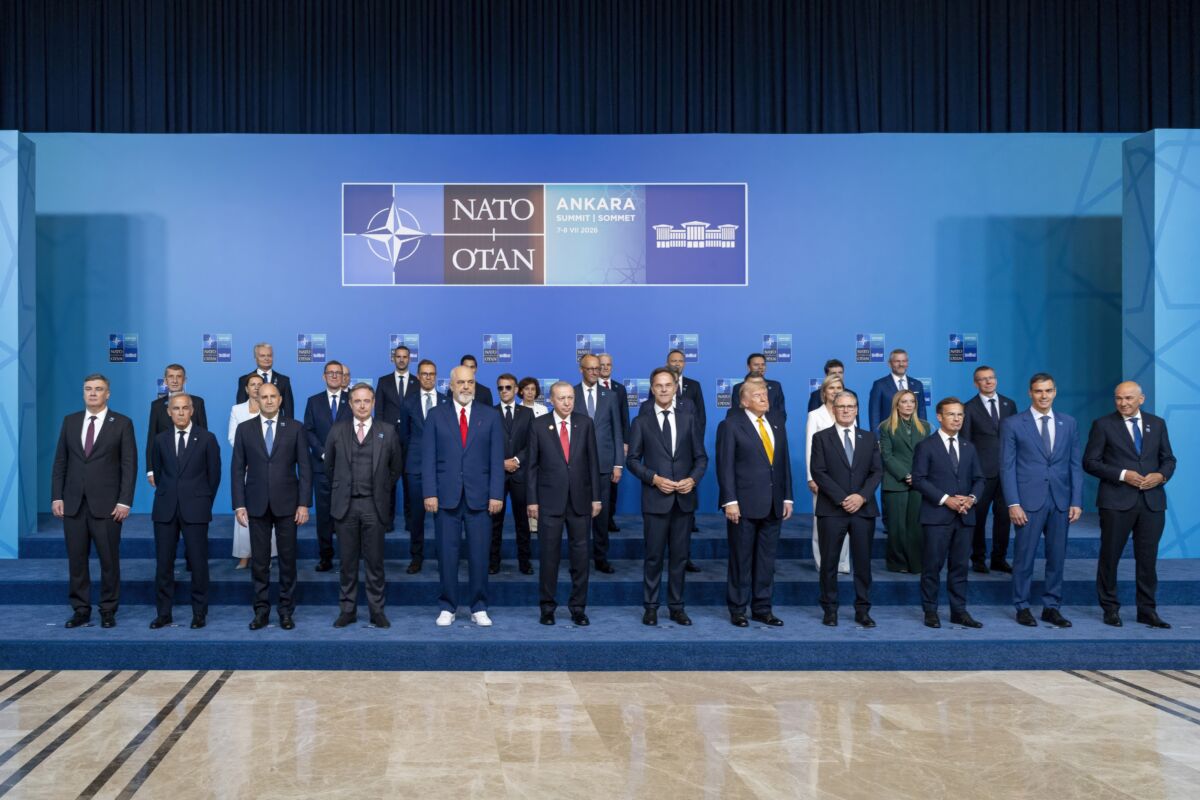
Given the magnitude of the strategic shifts underway, the recent NATO summit that took place in Ankara, Turkey, could mark a turning point for Western defense. Numerous statements and rather pessimistic expectations for Europe dominated the run-up to this important meeting. In the following pages, we present the key takeaways for understanding this meeting, which we organize according to their most significant aspects.
WHAT IT IS, FREQUENCY, AND PURPOSE OF THE SUMMIT | The NATO summit is a high-level meeting that brings together the Heads of State and Government of member countries to assess the security environment, adopt strategic decisions, and reaffirm founding commitments, such as the collective defense that Article 5 enshrines, as occurred on this occasion.[1] This year’s edition took place on July 7 and 8 at the Presidential Complex in Ankara and marked the second time Turkey hosted the summit, after Istanbul in 2004. The summit is traditionally held annually; however, following Ankara, allies left next year’s summit in Albania pending, without a set date —the final communiqué, notably brief, did not even commit to a future date—. This is due, in large part, to the allies’ desire to avoid the constant friction that has marked recent meetings with United States President Donald Trump.[2]
PRIOR EXPECTATIONS AND KEY STATEMENTS | Official expectations pointed toward projecting unity and showcasing concrete progress on the historic agreement from the Hague Summit (2025), which set the goal of investing 5% of GDP in defense by 2035.[3] Secretary General Mark Rutte had coined the term “NATO 3.0” and stated his intention to build “a stronger Europe within a stronger NATO.”[4] However, transatlantic tensions heavily shaped the pre-summit atmosphere, as many anticipated that United States President Donald Trump would once again reproach allies for their lack of support in Washington’s war against Iran, and would renew his startling threats to annex Greenland.[5]
SIX MOST RELEVANT ASPECTS OF THE SUMMIT |
Source: Own elaboration.
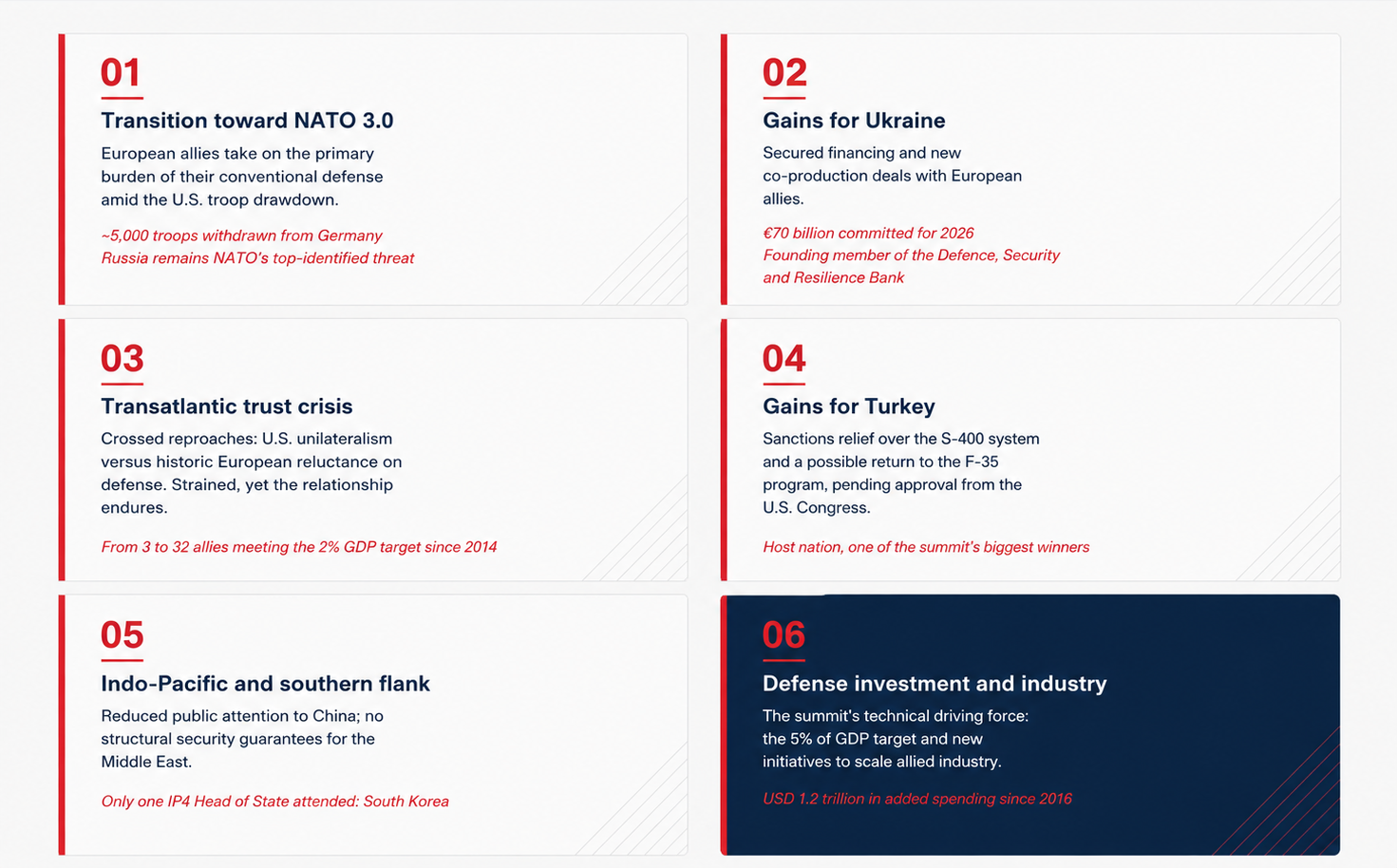
- Transition toward NATO 3.0 (burden shifting): An effective transfer of operational responsibilities became evident. Amid the drawdown of U.S. forces and reinforcement capabilities in Europe —which includes the withdrawal of roughly 5,000 troops from Germany and the cancellation of the rotational brigade destined for Romania, while the Pentagon completes a posture review whose findings it will release by late 2026— European allies have already begun filling the gaps the United States left behind and taking on the primary burden of their conventional defense.[6] Nonetheless, NATO continues to identify Russia as the principal threat to European security and stability.[7]
Source: NATO.[8]
Gains for Ukraine: Although the conflict with Iran drew much of the attention, Ukraine secured substantial gains. Allies committed €70 billion in equipment, assistance, and military training for 2026, with a pledge to sustain at least equivalent levels in 2027; Kyiv signed three framework agreements for drone co-production with Estonia, the Netherlands, and Denmark, and became a founding member of the Defence, Security and Resilience Bank.[9] Trump, for his part, announced that Washington could grant Ukraine licenses to manufacture interceptors for the Patriot air defense system; although this remains, for now, a verbal and unsigned offer.[10] The more concrete response to the interceptor shortage came from other allies: Germany financed PAC-3 missiles, several countries placed a joint order with the manufacturer, and NATO’s procurement agency announced the purchase of 700 PAC-2 and 200 PAC-3 missiles.
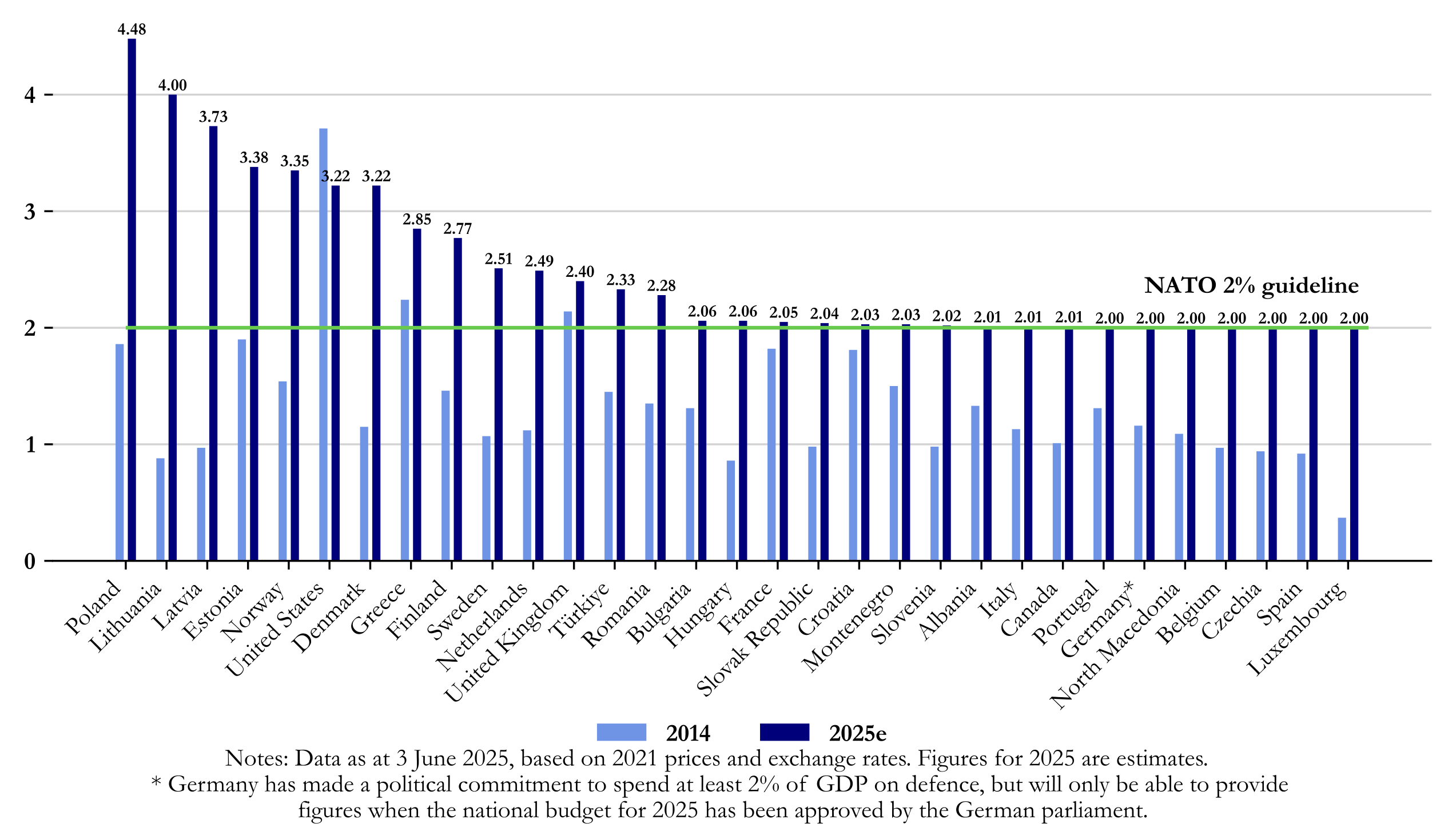
Transatlantic trust crisis: The summit exposed a strained relationship, with reproaches running in both directions, though one organization that endures. Washington’s unilateral actions —such as the war against Iran without prior consultation—, its insults toward Spain, which it branded a “lost cause,” and its continued insistence on Greenland have led Europe to view the United States as a less reliable partner.[11] From the American standpoint, however, the criticism points to decades of European reluctance on defense spending, with allies that cut their budgets after the Cold War and increasingly relied on the U.S. security umbrella, to the point that in 2014 only three countries met the 2% of GDP target that allies had set at Wales.[12] Indeed, the fact that all 32 allies now meet that threshold confirms, paradoxically, that Washington’s pressure had an effect and was not without merit.
Gains for Turkey (sanctions and F-35s): The host country emerged as one of the summit’s biggest winners. Drawing on his personal rapport with President Erdogan, Trump committed to lifting the sanctions Washington imposed in 2020 over Turkey’s purchase of the Russian S-400 air defense system and opened the door to reversing the ban on F-35 fighter jet sales to Ankara; although this latter measure will require Congressional approval and still faces opposition from allies such as Greece and Israel.[13]
The Indo-Pacific and the southern flank: Confronting the urgency of restructuring the European pillar and managing Iran and Russia, the summit devoted —on this occasion— reduced public and explicit attention to the China threat. In this regard, of the Indo-Pacific partner bloc (IP4: Australia, South Korea, Japan, and New Zealand), only one Head of State attended, South Korean President Lee Jae Myung; nonetheless, Japan, South Korea, and the United States signed an agreement on the sidelines of the summit on the development of small nuclear reactors.[14] The summit also lacked structural security guarantees for the southern flank and the Middle East.[15]
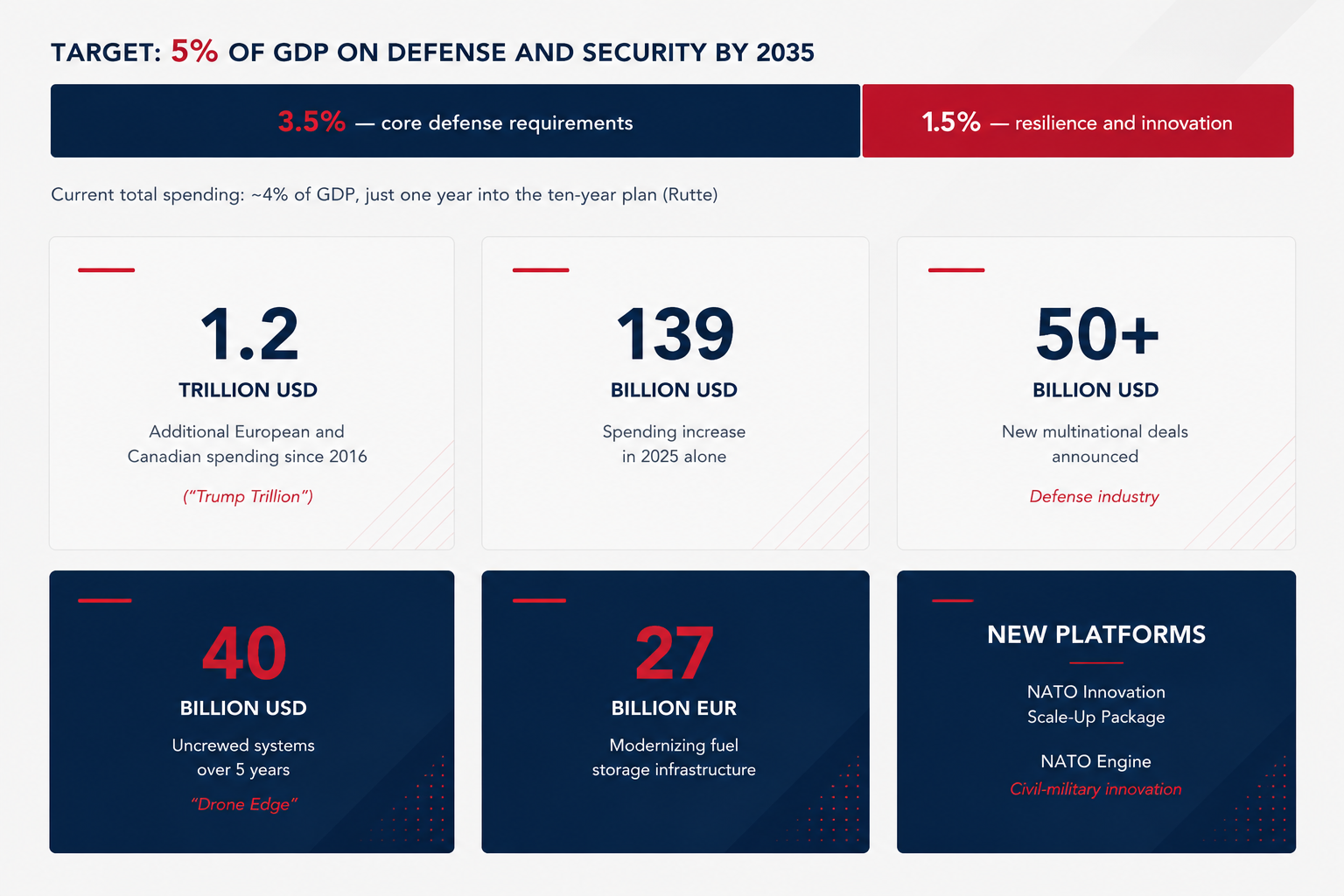
Defense investment and industrial development: This area was the summit’s technical driving force. European allies and Canada have increased spending by USD 1.2 trillion since Trump’s first term (the so-called Trump Trillion), including a USD 139 billion increase in 2025 alone.[16] This effort aims to meet the 5% of GDP target —3.5% for core defense requirements and 1.5% for security-related areas (resilience and innovation)[17]— and, according to Rutte, total spending already stands at around 4%, just one year into the ten-year plan. During the summit, allies announced more than USD 50 billion in new multinational defense-industry deals.[18] In addition, NATO launched the Innovation Scale-Up Package and the NATO Engine, a network that connects innovative companies with civilian and military factories equipped with flexible production capacity, in order to rapidly scale the manufacturing of new technologies. Allies also rolled out two major initiatives: the Drone Edge, which envisions USD 40 billion in uncrewed systems over the next five years, and a €27 billion investment to modernize fuel storage and distribution infrastructure, including new pipelines toward the eastern flank of the Alliance.[19]
Source: Own elaboration.
NATO AND LATIN AMERICA | Although this summit has no direct impact on the region, it offers a good opportunity to address two distinct categories of countries that engage with the United States and with NATO. On one hand, there is the Alliance’s global partner status —the case of Colombia—, which enables cooperation in peacekeeping missions, participation in defense capability development, and information-sharing on global threats such as cyberterrorism. This status, however, does not entail participation in the organization’s political decision-making, nor does it carry the collective-defense principle of Article 5. On the other hand, there are the United States’ Major Non-NATO Allies (MNNA), a bilateral and strategic relationship exclusive to Washington. This facilitates access to the purchase of U.S. weaponry, technology transfer, joint military training, and participation in research projects; however, it does not include an automatic military defense pact in the event of an attack, since it is not a NATO-linked partnership. Argentina, Brazil, Colombia, and Peru fall into this latter category.
THE FUTURE OF THE ALLIANCE | NATO is undergoing a forced mutation. Europe no longer places blind trust in the American security umbrella and is rapidly building its own strategic autonomy and defense-industrial base. For now, the Alliance is playing for time, seeking to minimize the impact of the pressure President Trump exerts while Europe rearms.[20] Indeed, no sooner had the summit concluded than the president floated withdrawing U.S. forces from Europe if he remains unsatisfied over Greenland. In the long run, should political trust recover following future changes in the Washington administration, this crisis could prove to be a kind of “blessing in disguise,” giving rise to a more balanced, more lethal alliance with two strong, autonomous pillars.[21] That remains to be seen; for now, however, the Alliance endures.
[1]NATO, “The Ankara Summit Declaration,” July 8, 2026, https://www.nato.int/en/about-us/official-texts-and-resources/official-texts/2026/07/08/the-ankara-summit-declaration?selectedLocale=
[2]Atlantic Council, “Eleven takeaways from the NATO Summit in Ankara,” July 9, 2026, https://www.atlanticcouncil.org/dispatches/eleven-takeaways-from-the-nato-summit-in-ankara/
[3]Oana Lungescu, “NATO 3.0 to Emerge at Ankara Summit Amid Fragile Unity,” Royal United Services Institute, July 6, 2026, https://www.rusi.org/explore-our-research/publications/commentary/nato-30-emerge-ankara-summit-amid-fragile-unity
[4]Mark Rutte, in “NATO Secretary General Mark Rutte on the Ankara summit agenda,” Atlantic Council, June 25, 2026, https://www.atlanticcouncil.org/event/nato-secretary-general-mark-rutte-on-the-ankara-summit-agenda/
[5]Atlantic Council, “Eleven takeaways from the NATO Summit in Ankara,” July 9, 2026, https://www.atlanticcouncil.org/dispatches/eleven-takeaways-from-the-nato-summit-in-ankara/
[6]Félix Arteaga and Luis Simón, “La cumbre de Ankara: ¿hacia una OTAN 3.0?,” Real Instituto Elcano, July 9, 2026, https://www.realinstitutoelcano.org/analisis/la-cumbre-de-ankara-hacia-una-otan-3-0/
[7]NATO, “The Ankara Summit Declaration,” July 8, 2026, https://www.nato.int/en/about-us/official-texts-and-resources/official-texts/2026/07/08/the-ankara-summit-declaration?selectedLocale=
[8]NATO, “Defence Expenditure of NATO Countries (2014-2025),” 2025, https://www.nato.int/content/dam/nato/webready/documents/finance/def-exp-2025-en.pdf
[9]Oana Lungescu, “NATO 3.0 to Emerge at Ankara Summit Amid Fragile Unity,” Royal United Services Institute, July 6, 2026, https://www.rusi.org/explore-our-research/publications/commentary/nato-30-emerge-ankara-summit-amid-fragile-unity
[10]John Haltiwanger and Rishi Iyengar, “Trump Hands NATO a Mixed Bag,” Foreign Policy, July 8, 2026, https://foreignpolicy.com/2026/07/08/trump-nato-ankara-summit-iran-ukraine-greenland-spain/
[11]Atlantic Council, “Eleven takeaways from the NATO Summit in Ankara,” July 9, 2026, https://www.atlanticcouncil.org/dispatches/eleven-takeaways-from-the-nato-summit-in-ankara/
[12]NATO, “Defence Expenditure of NATO Countries (2014-2025),” 2025, https://www.nato.int/content/dam/nato/webready/documents/finance/def-exp-2025-en.pdf
[13]Atlantic Council, “Eleven takeaways from the NATO Summit in Ankara,” July 9, 2026, https://www.atlanticcouncil.org/dispatches/eleven-takeaways-from-the-nato-summit-in-ankara/
[14]Atlantic Council, “Eleven takeaways from the NATO Summit in Ankara,” July 9, 2026, https://www.atlanticcouncil.org/dispatches/eleven-takeaways-from-the-nato-summit-in-ankara/
[15]Félix Arteaga and Luis Simón, “La cumbre de Ankara: ¿hacia una OTAN 3.0?,” Real Instituto Elcano, July 9, 2026, https://www.realinstitutoelcano.org/analisis/la-cumbre-de-ankara-hacia-una-otan-3-0/
[16]Oana Lungescu, “NATO 3.0 to Emerge at Ankara Summit Amid Fragile Unity,” Royal United Services Institute, July 6, 2026, https://www.rusi.org/explore-our-research/publications/commentary/nato-30-emerge-ankara-summit-amid-fragile-unity
[17]NATO, “Defence Expenditure of NATO Countries (2014-2025),” 2025, https://www.nato.int/content/dam/nato/webready/documents/finance/def-exp-2025-en.pdf
[18]NATO, “The Ankara Summit Declaration,” July 8, 2026, https://www.nato.int/en/about-us/official-texts-and-resources/official-texts/2026/07/08/the-ankara-summit-declaration?selectedLocale=
[19]NATO, “NATO Innovation Scale-Up Package,” July 8, 2026, https://www.nato.int/en/about-us/official-texts-and-resources/official-texts/2026/07/08/nato-innovation-scale-up-package?selectedLocale=
[20]Rishi Iyengar and John Haltiwanger, “NATO’s Waiting Game: Less Trump. More Europe. What’s next?,” Foreign Policy, July 9, 2026, https://foreignpolicy.com/2026/07/09/nato-summit-ankara-trump-europe-rutte-erdogan/
[21]David V. Gioe, “The Transatlantic Crucible: Why the Crisis Between Washington and Europe May Be a Blessing in Disguise,” Foreign Affairs, June 4, 2026, https://www.foreignaffairs.com/united-states/transatlantic-crucible-europe-nato