The Nuclear Non-Proliferation Regime Under Strain
- por Diego Sazo & Camila Hernández
- Comments and Articles
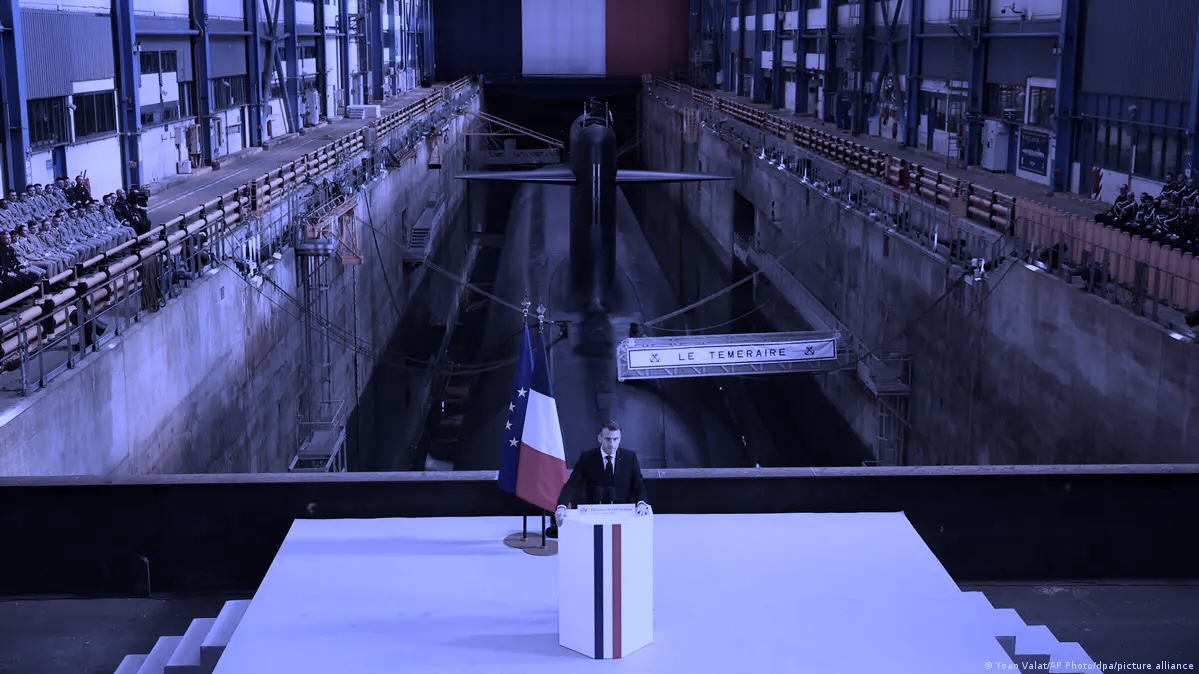
On 3 February 2026, President Macron spoke in front of the nuclear submarine Le Téméraire at the Île Longue military base in France.
Three weeks before the launch of Operation Epic Fury, a development of major significance for international security went largely unnoticed. New START, the last remaining agreement limiting and reducing strategic nuclear weapons between the United States and Russia, expired without either side moving to renew it. As a result, for the first time since 1972, the world’s two largest nuclear powers were left without formal caps or mechanisms for data exchange, inspection and mutual verification of their strategic arsenals. The signal is troubling, particularly given that the two countries account for nearly 90 per cent of the world’s 12,241 nuclear warheads[1].
The year 2026 has been especially critical for efforts to prevent and contain nuclear proliferation. The attacks by the United States and Israel against Iran, President Trump’s questioning of NATO, and rising interstate tensions in East Asia have weakened the so-called nuclear taboo[2], making nuclear weapons appear once again as attractive instruments of self-protection.
It is against this backdrop that the Eleventh Review Conference of the Treaty on the Non-Proliferation of Nuclear Weapons (NPT) begins this week in New York[3]. Held every five years, the conference brings together the 191 States Parties to assess compliance with the treaty’s three pillars: non-proliferation, disarmament and the peaceful use of nuclear energy. It is also the only multilateral forum in which the nuclear powers must account to the rest of the world for their commitments in this area.
The precedents are not encouraging. The 2005, 2015 and 2022 conferences all failed to produce a consensus document, while the deterioration of the strategic environment has continued to erode the political foundations of the regime. In an increasingly strained global context, the central question facing the conference is not whether the NPT can still produce multilateral consensus. It is, rather, how resilient that capacity remains in an environment radically different from the one in which the treaty was created.
2. The NPT: a cornerstone under pressure
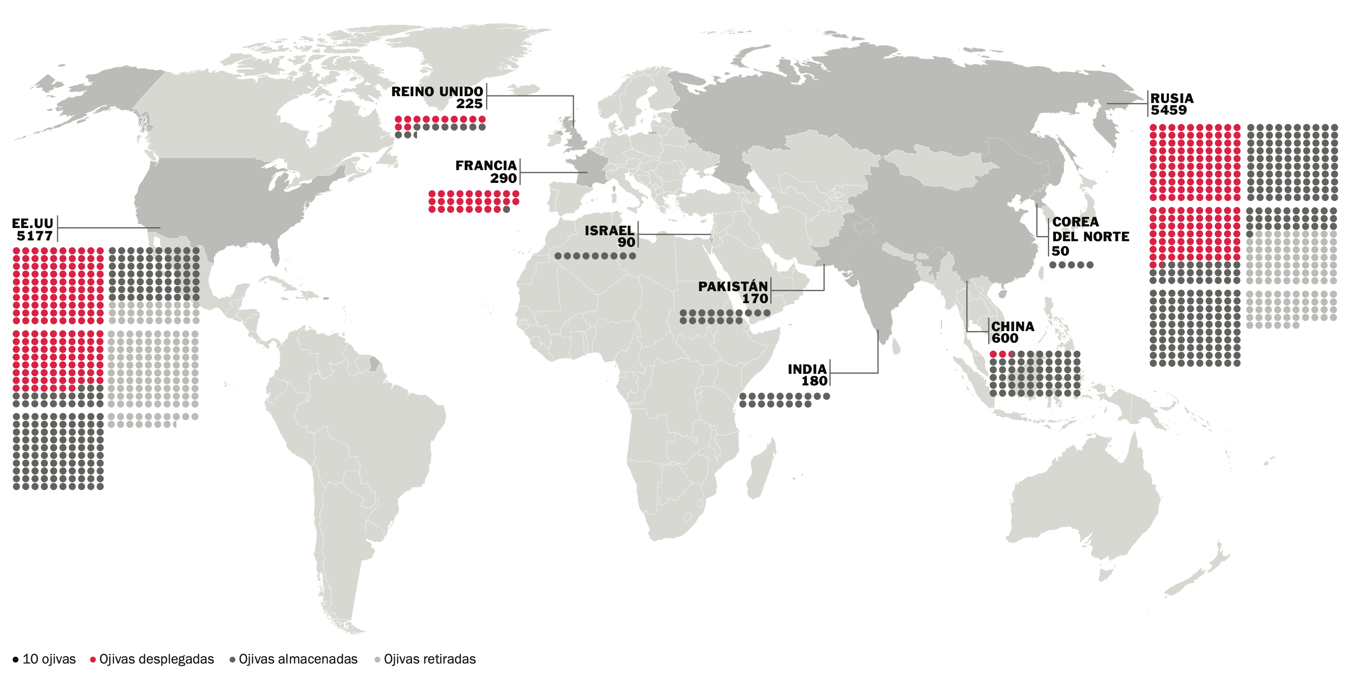
The NPT, adopted in 1968, is the most widely ratified arms control and disarmament agreement in history. With 191 signatories, its significance lies in having secured the voluntary —and legally binding— renunciation by states of a capacity for mass destruction, in favour of collective security rather than individual deterrence. Its record to date has been positive. In the 1960s, several projections anticipated that by the end of the twentieth century there could be as many as 20 or 25 nuclear powers[4]. Today, however, only nine states acknowledge possessing, or are widely understood to possess, this type of weaponry (Figure 1). The NPT also remains the central axis of the nuclear non-proliferation architecture, around which complementary instruments are organised, including the safeguards mechanisms of the International Atomic Energy Agency (IAEA), nuclear-weapon-free zones and treaties banning nuclear tests.
At the normative level, the NPT rests on a foundational distinction between states recognised as having the right to possess nuclear weapons —the United States, Russia, the United Kingdom, France and China— and those that are not. On the basis of that asymmetry, the treaty is organised around three pillars. The first is the containment of proliferation. Nuclear-armed states commit not to transfer nuclear weapons or assist in their development, while all other states renounce their acquisition. The second is disarmament: Article VI requires all States Parties to pursue negotiations in good faith on measures relating to the cessation of the nuclear arms race and to nuclear disarmament. The third is the peaceful use of nuclear energy. Article IV recognises the right of all states to develop this technology for civilian purposes.
Figure 1. Global nuclear weapons inventories, January 2025.
Yet the NPT’s historical success coexists with a structural tension. By institutionalising a military hierarchy between the “nuclear haves” and the “nuclear have-nots”, the treaty entrenched a persistent inequality: the latter have upheld their renunciation, while the former have preserved their arsenals and continue to modernise them, not only quantitatively but also qualitatively[5]. This has fuelled growing doubts about whether the disarmament promise contained in Article VI is being fulfilled, contributing to the erosion of the multilateral regime’s legitimacy.
3. A fragile strategic environment
The Eleventh NPT Review Conference is taking place in one of the most challenging contexts since the end of the Cold War. Four elements define this picture of systemic fragility in 2026 (Figure 2).
The first is the collapse of the last bilateral nuclear arms control framework between the two leading nuclear powers. Beyond its formal expiry in February 2026, New START had already ceased to function in practice in 2023, when Russia suspended its participation, inspections stopped and data exchanges were interrupted. The formal loss of this regime removes transparency and predictability from the relationship between Washington and Moscow. More importantly, it reinforces among non-nuclear-armed states the perception that the obligation to negotiate disarmament in good faith is no longer a priority. The problem is even more serious given that both powers continue to pursue programmes for the qualitative improvement of their arsenals (a process known as vertical proliferation): the United States through the LGM-35A Sentinel, the Columbia-class submarine and the B-21 Raider bomber; and Russia through the Sarmat, the Yars, the Avangard hypersonic system and new intercontinental ballistic missiles (ICBMs)[6].
Figure 2. The erosion of the nuclear non-proliferation regime, 2022–2026.

This absence of nuclear arms control between the United States and Russia also comes at a time when deterrence is gaining renewed political salience. China, for its part, increased its arsenal from approximately 500 warheads in January 2024 to around 600 in January 2025. It is also building new ballistic missile silo fields and expanding its submarine and air capabilities, with an ambitious horizon for 2030. North Korea continued its ballistic missile tests and, in November 2024, tested the Hwasong-19, a new solid-fuel missile, while Kim Jong-un called for an “unlimited” expansion of the country’s nuclear programme. In Europe, Trump’s criticism of NATO reopened the debate over security guarantees, while the Northwood Declaration of 2025 reaffirmed the strategic value of nuclear deterrence through a bilateral framework between two nuclear powers: the United Kingdom and France.
The Iranian crisis adds a different, but equally corrosive, pressure. The attacks by the United States and Israel against Iranian nuclear infrastructure —in June 2025 and again in February 2026— have brought back to the centre of the debate the treaty’s most delicate ambiguity: how to distinguish between peaceful use and latent proliferation, and what mechanisms the regime has to manage that boundary when diplomatic dialogue collapses and is replaced by military force. Before the attacks, Iran had accumulated 440.9 kg of uranium enriched to 60 per cent, far above the 3.67 per cent permitted under the 2015 Joint Comprehensive Plan of Action. After the attacks, the IAEA lost continuity of knowledge over Iranian inventories when inspections were suspended. Iran remains a party to the NPT, but the safeguards regime has been left in suspense, a reminder that nuclear verification ultimately depends on the political will of the states being monitored.
Finally, this situation is compounded by the recent record of the review process itself. Of the last four review conferences, only the 2010 conference produced a final consensus document. The 2005, 2015 and 2022 conferences all failed to do so. Another failure in New York would not mean the immediate legal collapse of the NPT, whose validity does not formally depend on the success of these meetings. But it would deepen a more subtle —and therefore more dangerous— form of deterioration: the erosion of the treaty’s normative capacity[7]. The NPT is the institutional node on which a broader architecture depends. A third consecutive conference without agreement would therefore reinforce the perception that the regime can no longer reaffirm its own rules or uphold its commitments before its most powerful members.
4. Implications for Latin America and Chile
The implications for Latin America and Chile should be read against this potential loss of credibility in the NPT. Although the region does not face an immediate nuclear threat in military terms, it does depend on the stability of the non-proliferation regime for strategic, economic and institutional reasons. When the global nuclear architecture weakens, its effects are not confined to the major powers. They also reach medium-sized and small states, which rely on norms, verification mechanisms and multilateral arrangements to reduce their vulnerability.
Chile, moreover, has a consistent record of commitment to the non-proliferation regime (Figure 3). Beyond its formal adherence to the regime’s central instruments, Chile has actively participated in the verification mechanisms of the Comprehensive Nuclear-Test-Ban Treaty and ratified the Treaty on the Prohibition of Nuclear Weapons in 2021, reaffirming its value as a complement to —not a substitute for— the NPT. This position places Chile among the non-nuclear-armed states pressing for Article VI to be given effective substance, on the conviction that the regime’s legitimacy ultimately depends on disarmament ceasing to be a deferred promise.
Figure 3. Chile and the central instruments of the NPT regime

Chile’s interest in preventing and containing proliferation, however, is not only normative. It is also material. The deterioration of the regime increases the risk that states in crisis, or non-state actors, may gain access to nuclear or radioactive materials, a particularly sensitive scenario for regions with limited prevention and response capacities. Similarly, nuclear escalation in Europe, the Middle East or the Korean peninsula would have immediate effects on energy markets, commodities and global finance. For an economy highly dependent on foreign trade, such as Chile’s, these external shocks would not be abstract: they would affect prices, logistics chains, energy costs and the margins of macroeconomic stability.
From this perspective, the New York conference matters more than it may first appear. For the international community, it is another test of whether the rules-based international order retains its influence or is giving way to a logic of national interest. For Chile, preserving the NPT and the architecture surrounding it is not an exercise in abstract adherence to international law. It is a way of safeguarding a strategic environment in which medium-sized states can still rely on rules rather than on deterrent capabilities of their own.
Diego Sazo
Head of International Relations Research, AthenaLab
Camila Hernández
Co-founder of the Centre for Non-Proliferation Studies (CNP Chile) and WIIS Chile, the Women in International Security network
Download analysis
[1] Stockholm International Peace Research Institute, SIPRI Yearbook 2025: Armaments, Disarmament and International Security (Oxford: Oxford University Press, 2025).
[2] James M. Acton, “Is the Nuclear Taboo Eroding?,” Carnegie Endowment for International Peace, 2023; and Nina Tannenwald, “The Bomb in the Background: What the War in Ukraine Has Revealed About Nuclear Weapons,” Foreign Affairs, February 24, 2023.
[3] The meeting takes place from 27 April to 22 May 2026.
[4] Arms Control Association, “Timeline of the Nuclear Nonproliferation Treaty (NPT),” Arms Control Association, last view on May 2025.
[5] Hans M. Kristensen y Matt Korda, “World Nuclear Forces,” in SIPRI Yearbook 2024: Armaments, Disarmament and International Security (Oxford: Oxford University Press, 2024), 272–367.
[6] Hans M. Kristensen y Matt Korda, “World Nuclear Forces,” en SIPRI Yearbook 2025: Armaments, Disarmament and International Security (Oxford: Oxford University Press, 2025), 178-202.
[7] Alexander Wendt, Social Theory of International Politics (Cambridge: Cambridge University Press, 1999) y Martha Finnemore y Kathryn Sikkink, “International Norm Dynamics and Political Change,” International Organization 52, nº 4 (1998): 887-917.