On China: What Kissinger Would Advise Trump
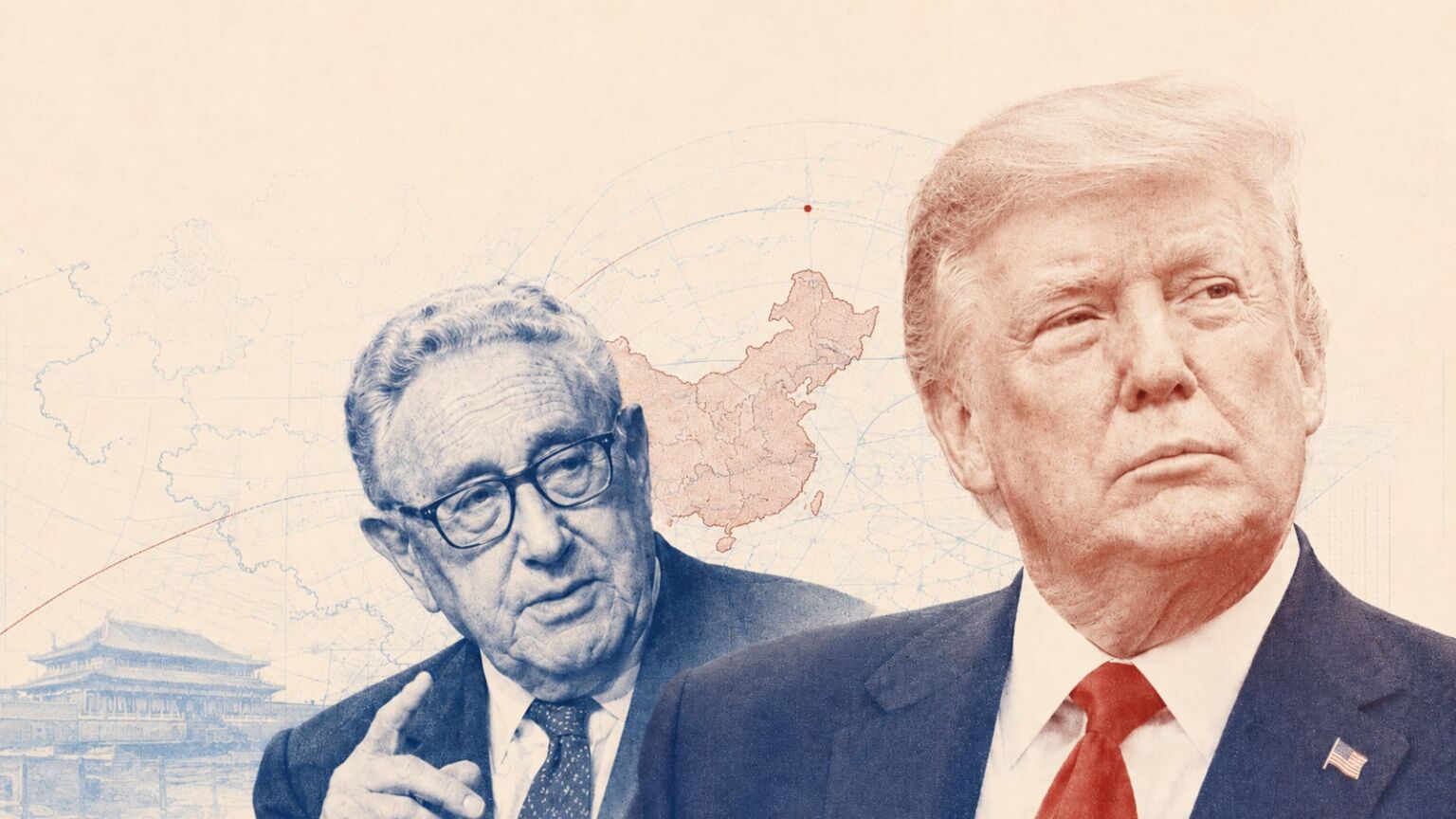
Between 13 and 15 May, US President Donald Trump is making a state visit to China. His meeting with Xi Jinping, their first bilateral meeting in China since 2017, comes at a moment of acute international tension. The wars in the Middle East and Ukraine, together with the trade dispute and recent frictions over technological competition, have raised the stakes of a summit whose expectations are as high as they are uncertain.
Although the agenda for the closed-door talks remains unknown, the Taiwan question, the contest over advanced semiconductors, rare earths and the regulation of artificial intelligence are all expected to feature prominently. Yet almost as important as the agenda itself are the political assumptions with which Washington and Beijing arrive at the meeting.
On one side of the table will be President Trump: risk-prone, impulsive, unpredictable in his decision-making, and convinced that China is conspiring to displace the United States as the world’s leading power. On the other will be Xi Jinping: patient, disciplined, ruthless towards domestic dissent, and confident that China’s rise is historically inevitable.
From Washington’s perspective, the Trumpian traits that have shaped foreign policy have so far produced uneven results. In Venezuela, his international assertiveness removed Maduro from power and succeeded in co-opting the Chavista regime. In Iran, by contrast, it triggered a costly war that destabilised the region. With China, however, engagement demands a different approach, shaped by history, culture and the nature of strategic competition. At least, that is what one of the most perceptive observers of US-China relations would have advised: Henry Kissinger.
Kissinger and the China question
For several decades, Kissinger (1923-2023) was a recurring point of reference for almost every US president on the China question, largely because of his exceptional experience. He dealt directly with figures such as Mao Zedong and Deng Xiaoping, with whom he established channels of trust and helped forge lasting understandings. Having visited China more than fifty times, Kissinger was able to observe at close range the country’s strategic opening and its emergence as an influential force in the world today .
In his later years, Kissinger became convinced that Washington and Beijing had mutually persuaded themselves that the other represented a strategic threat . For the former secretary of state, once perceptions of danger harden between nuclear powers, specific disputes cease to be contained issues and come to be read as tests within a wider confrontation. Politics then loses flexibility, and each incident tends to acquire broader meaning, with potentially catastrophic consequences.
In an increasingly unstable and conflict-prone world, what advice would Kissinger have offered Trump on the eve of his meeting with Xi? As an exponent of Realpolitik, any Kissingerian recommendation would have begun with a diagnosis of the conditions shaping political reality and the capabilities of the actors involved. Three elements, in particular, would have been decisive.
The diagnosis
What China is and how it thinks
For Kissinger, China’s first distinctive feature was its character as a civilisation-state, marked by an exceptional degree of historical continuity. Unlike other civilisations that fragmented or disappeared, China has preserved over the centuries a powerful consciousness of unity. In Kissinger’s view, that trajectory left a deep and uncompromising political imprint: any internal division is seen as a temporary anomaly against an assumed original condition of unity. This historical memory is crucial to understanding Beijing’s position on Taiwan today.
From that continuity also emerged a particular way of understanding China’s place in the world. For long periods, China saw itself as the civilisational centre of a broader hierarchical order: “all under heaven” (tianxia). This outlook helps explain why China’s historical diplomacy was not organised around the Western logic of equal sovereign peers, but around asymmetrical and stratified relationships, calibrated according to proximity, usefulness or threat . Within that framework, the stability of China’s surrounding environment mattered more than territorial expansion in the nineteenth-century European sense.
Kissinger emphasised that this Sinocentric tradition produced a distinct strategic culture. Rather than privileging open confrontation or the decisive battle, Chinese strategic thought has tended to value patience, indirect manoeuvre, incremental advantage and the gradual erosion of the adversary . This is not only a matter of material power, but also of time, position, perception and control of the surrounding environment. For Kissinger, grasping this difference is essential, because any negotiation with China must be anchored in these parameters rather than in Western categories of cost-benefit analysis and short-term results.
US interests today
The next step in Kissinger’s diagnosis would be to clarify how US national interests should be ordered in relation to a counterpart such as China. Before Trump, the United States still tended to frame its global interventions as an expression of manifest destiny: the remaking of the world in its own image, as a free, democratic and capitalist society . Under Trump, however, normative preferences have been displaced by a strategic hierarchy centred on the preservation of security, international primacy and economic prosperity.
In practice, these interests are expressed in US foreign policy through three main priorities. The first is to prevent rivalry with other great powers from turning into direct confrontation, chiefly through military and technological deterrence. The second is to preserve US credibility in Asia, with Taiwan as the most sensitive point in that equation. The third is to protect the domestic economic base and the room for manoeuvre needed to sustain a prolonged competition without being drawn into peripheral wars of attrition.
Within this framework, assets such as semiconductors, artificial intelligence, supply chains, critical minerals and advanced manufacturing cease to be merely economic questions and become part of the hard core of the national interest. The same is true of Taiwan. More than an abstract cause or a bargaining chip, the island brings together questions of credibility, regional balance and escalation risk, with potentially significant consequences for US interests.
The international system under strain
For Kissinger, the profiles of China and the United States would acquire particular weight in 2026. The war in Ukraine remains far from an armistice. After a brief truce brokered by Washington, continued fighting, drone attacks and deep distrust between Moscow and Kyiv show that neither violence nor negotiation has yet produced a sustainable path out of the conflict. At the same time, the US-Iran war has shown how quickly a regional crisis can spill into the Gulf, threaten civilian infrastructure, affect the Strait of Hormuz and draw in actors that had sought to remain on the sidelines.
From a realist perspective, what matters is not only the existence of several simultaneous conflicts, but the way in which they inject instability into the system. As open wars accumulate, cooperation becomes harder, diplomacy loses influence, and the risk grows that regional disputes will become connected to one another. In that context, the relationship between the United States and China is no longer an isolated problem. It becomes part of an overloaded strategic landscape in which trade, technology, energy, maritime security and the military balance are increasingly intertwined.
Trump’s visit to Beijing therefore takes place at a moment when the margin for miscalculation is narrower and the cost of mutual misreading potentially far greater.
Kissinger’s Realist Counsel
On the basis of this diagnosis of conditions and capabilities, Kissinger would probably have offered the US president three pieces of advice.
Accept the persistence of conflict
Kissinger’s first piece of advice to Trump would probably be to accept the enduring nature of conflict. In his conceptual framework, sovereign states have interests, and those interests will naturally collide. The problem arises when they cease to be negotiable and become organised instead around suspicion and military threat. At that point, a specific crisis can escalate into a systemic confrontation.
Kissinger would not have told Trump to end the rivalry with China. He would have urged him to recognise its structural character: two powers that increasingly perceive each other as strategic threats while competing for power, technology, prestige and influence.
Kissinger would also have warned that a rivalry of this magnitude cannot be eliminated; it can only be managed. Managing it requires strategic hierarchy, historical judgement and clear limits. Hierarchy, to distinguish vital interests (those linked to survival) from secondary ones. Historical judgement, to understand that China does not see this competition as a passing episode, but as part of a much longer trajectory. And clear limits, to prevent reciprocal pressure from sliding into an uncontrolled dynamic.
Kissinger would therefore have warned against both maximalism and naivety. He would have advised Trump to assume that conflict will persist and that, precisely for that reason, the central task of foreign policy is to prevent structural rivalry from becoming open confrontation. On that basis, a second piece of advice follows: not merely to accept conflict, but to keep it within a certain equilibrium.
Image 1. Kissinger’s Realpolitik: three cascading pieces of advice

Maintain the balance of power
If conflict with China is persistent, Kissinger’s second piece of advice would be to prevent that rivalry from crossing the threshold of what can be tolerated. To that end, Trump should not seek genuine trust with Beijing, but rather a form of coexistence without trust, sustained by a balance of power clear enough to be credible, even if always fragile and imperfect. In a relationship of this kind between superpowers, stability does not rest on political affinity or expectations of convergence, but on the shared conviction that crossing certain limits would carry devastating costs.
This logic requires conditional strategic engagement. The United States and China may negotiate, cooperate partially or contain specific crises, but without losing sight of the fact that they remain structural competitors. The aim, then, would not be to build a deep partnership, but to prevent rivalry from becoming a spiral of tension, retaliation and overreaction. For Kissinger, this was precisely the function of the balance of power: not to eliminate disagreement, but to prevent disputes from becoming terminal tests of the relationship .
In the current context, such prudence matters even more. With several fronts of tension open across the international system, a serious rupture between Washington and Beijing would have consequences far beyond those of an ordinary bilateral dispute. The balance of power, therefore, should not be understood as a truce based on good intentions, but as a principle of containment. And that containment becomes even more necessary when highly sensitive issues are at stake, issues that should not be forced towards definitive resolution.
Subordinate principles to strategic prudence
Kissinger’s third piece of advice to Trump would address a more delicate problem for critics of Realpolitik: the relationship between principles and pragmatism. He would not have suggested that the United States abandon its values. But he would have warned against allowing certain principles to lead automatically to armed confrontation over issues of the highest sensitivity. In international politics, not every disagreement can be resolved definitively without imposing excessive risks on the system. And when the relationship between two great powers is at stake, forcing clear-cut definitions can be more dangerous than managing ambiguity.
This reasoning would be especially relevant to Taiwan. Kissinger would probably have warned that seeking a conclusive resolution to a sovereignty dispute of such magnitude would not necessarily produce greater stability. On the contrary, it could precipitate a far larger crisis. A new détente, in this context, would not mean appeasing China or naively expecting it to liberalise. It would mean something more sober: agreeing to disagree. In other words, accepting that some conflicts require prudent management, avoiding both capitulation and terminal definition. In his memoirs, Kissinger recalled that Mao was in no hurry over Taiwan and that China could wait a hundred years to resolve the issue . That Chinese relationship with time widens the strategic horizon for manoeuvre.
Washington’s objective, therefore, should not be to settle every ambiguity prematurely, but to prevent those ambiguities from leading to war. Kissinger would have understood that, in a world of nuclear weapons and exponential advances in artificial intelligence, open confrontation between great powers would no longer be a conventional war, but a civilisational risk. Precisely for that reason, strategic prudence is not weakness. It means recognising that, in some conflicts, containing escalation may be a higher form of politics.
Conclusions
In Kissinger’s eyes, the meeting between Trump and Xi matters less for the announcements it may produce than for the kind of relationship it helps to consolidate. The deeper problem is not the existence of rivalry between the United States and China; that rivalry is already structural. The difficulty is that, in an international system burdened by wars, technological pressures and reciprocal perceptions of threat, competition may cease to be manageable and become a sequence of crises increasingly difficult to contain.
From that perspective, Washington’s greatest mistake would be to confuse firmness with maximalism, or to believe that every ambiguity is a weakness that must be corrected at once. A Kissingerian reading would point in a different direction. China does not behave like just another Western power, but acts from a distinct historical memory, strategic temporality and conception of order. The United States, for its part, faces not only a commercial or military challenge, but a prolonged competition in which its own hegemony is at stake. On that basis, the task is not to resolve the rivalry, but to restore political limits to it.
China’s opportunity, then, does not necessarily lie in defeating the United States, but in waiting for it to wear itself down. A Washington strained by Ukraine, the Middle East, Taiwan, technological competition and its own internal polarisation offers Beijing a strategic opening that Kissinger would have viewed with concern. That dispersion weakens US predictability and allows China to play a long game, presenting itself as a pole of stability against the volatility of its rival. That, precisely, will be Trump’s challenge in Beijing: not only to negotiate with Xi, but to show that the United States can still sustain a strategy that outlasts its own immediate pressures.
Diego Sazo
Head of International Relations Research, AthenaLab
NOTES
[1] Henry Kissinger, On China (New York: Penguin Press, 2011).
[2] The Economist, “Henry Kissinger Explains How to Avoid World War Three”, May 17, 2023.
[3] Henry Kissinger, On China (Penguin Press, 2011), 24-25.
[4] Kissinger, On China, 30-32.
[5] Zbigniew Brzezinski, The Grand Chessboard: American Primacy and Its Geostrategic Imperatives (Basic Books, 1997).
[6] Henry Kissinger, A World Restored (Grosset & Dunlap, 1964).
[7] Henry Kissinger, White House Years (Little, Brown, 1979), 1062.