Conscious Dependence: AI, Sovereignty, and National Security

On June 26, 2026, Chile’s ambassador to the United States signed our country’s accession to the Pax Silica Declaration, a technological alliance that the American state is building around semiconductors, advanced computing, and artificial intelligence. The initiative seeks to articulate an economic security consensus among allied countries across the entire AI supply chain, thereby reserving access to frontier models for its members[i].[ii] In addition, our country joined the Joint Statement on AI Opportunity, an agreement that seeks to establish a common approach favorable to innovation and the accelerated deployment of AI. These two developments align with the recommendations AthenaLab put forward last May[iii], when Chile stood outside the then newly created initiative, occupying an ambivalent position as a supplier of critical inputs for artificial intelligence without access to the advanced capabilities those materials make possible.
However, these diplomatic advances in AI occur in parallel with two events that call them into question. The decision adopted by the United States on June 12, 2026, to globally block access to Anthropic’s Fable 5 and Mythos 5 models showed that not even its partners are exempt from having their supply of frontier AI suspended by unilateral decision and without prior notice[iv]. Meanwhile, as Washington and American AI firms sought to shield the advantages of their latest developments by accusing the Chinese company Alibaba of illicitly extracting Claude’s capabilities, in China the firm Z.ai, part of the Zhipu ecosystem, announced the launch of GLM-5.2, an open model that narrows the performance gap with American models at a fraction of the cost of access compared with closed alternatives such as ChatGPT Plus or Claude Pro[v].
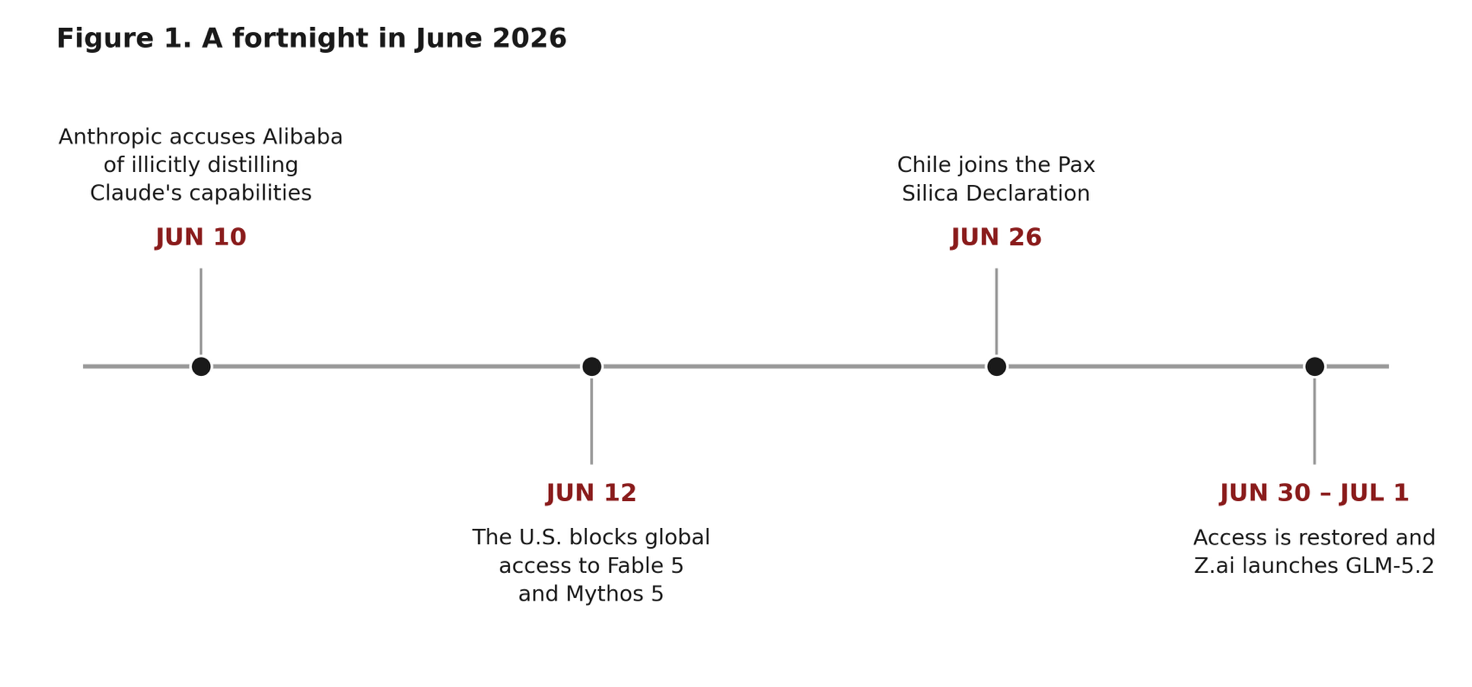
Within the same two weeks span, then, Chile secured a seat at the table where, supposedly, the terms of access to frontier AI are set, and witnessed compelling proof that this privileged position offers no guarantees. It also gained evidence that access to the most advanced AI models will not remain the privilege of Pax Silica’s members.
Pax Silica
Pax Silica was launched in December 2025 as the flagship United States initiative for building an economic security consensus among allies around the layers that sustain AI (critical minerals, energy, semiconductors, data centers, and language models)[vi]. The original declaration, signed by nine countries[vii], reflected a logic of “market access for all, frontier access for allies”; open access to consumer-grade technology, while preferential availability of frontier semiconductors and computing power remained reserved for those aligned with Washington.
The June 2026 Pax Silica meeting expanded that founding group from nine to twenty-four signatories, adding Chile alongside other countries and the European Union as a bloc. It also launched a semiconductor traceability pilot project in Panama and the Foundry School program with Stanford University to train talent in advanced manufacturing[viii].
This means Chile moves from being a supplier of copper and lithium with no participation at the levels where the AI chain concentrates its value, to joining a group that, in theory, should have a voice in the terms of access to that technology.
The ambiguity of commitments
On June 12, 2026, just days after this expansion of Pax Silica was signed, the United States Department of Commerce ordered Anthropic to globally suspend access to Fable 5 and Mythos 5, its most advanced models, invoking export controls on national security grounds.[ix] The order made no distinction between allies and non-allies, nor between Pax Silica members and the rest of the world, and since Anthropic had no mechanism to apply it selectively, it blocked access for all its foreign users. Until July 1st, the date on which the United States government authorized the models’ broad-based use, the entire world was left waiting on a decision in which it had neither voice nor vote.
This episode confirms what we argued this past June[x] regarding the shift in control over advanced AI models away from the companies that develop them and toward states. Moreover, this shutdown failed to recognize the standing of the very allied countries Pax Silica seeks to bring together among its members. One can assume Chile joined this alliance hoping for greater certainty over its access to frontier technologies, yet the blocking of the models mentioned above demonstrated that such availability can be halted by the unilateral decision of a third state, without prior notice or consultation.
A privilege called into question
Almost in parallel with the Fable 5 and Mythos 5 shutdown, on June 10th Anthropic sent a letter to the United States Congress accusing the Chinese company Alibaba of a massive campaign to extract Claude’s capabilities through what are known as distillation attacks, which consist of using a more advanced model’s outputs to train one’s own model at lower cost[xi]. Anthropic described the episode as the largest campaign of its kind known to date and called for sanctions, at a time when the United States already identifies Alibaba as a company linked to the Chinese armed forces[xii].
China’s response arrived almost immediately, though not in the courts but in the marketplace. On June 30th, the firm Z.ai launched GLM-5.2, a model whose parameters are published for anyone to download and run on their own infrastructure. According to specialized media, this model approaches the performance of Claude Mythos in advanced coding and the autonomous execution of complex tasks, at a fraction of the cost of comparable American alternatives[xiii].
These developments suggest that while Washington attempts to contain the leakage of its most valuable capabilities through legal and regulatory means, the gap with China is narrowing in practice, through the emergence of near-frontier models available to any actor willing to download them.
The paradox for Chile
These three events configure a paradox. Chile secured a membership in a forum in which the terms of access to frontier artificial intelligence would presumably be negotiated, an availability that had seemed reserved for a small group of countries. Yet that very same week it became clear that belonging to that forum does not make a country immune to the very dependence that presumably motivated its accession, because control over the broad-based use of frontier models (the final stage of the chain) still rests primarily with a single state actor, one capable of suspending them without notice even to its own allies. At the same time, the advantage Pax Silica promises to share among its members is depreciating in real time, as near-frontier capability is already being developed by other actors, openly and at low cost.
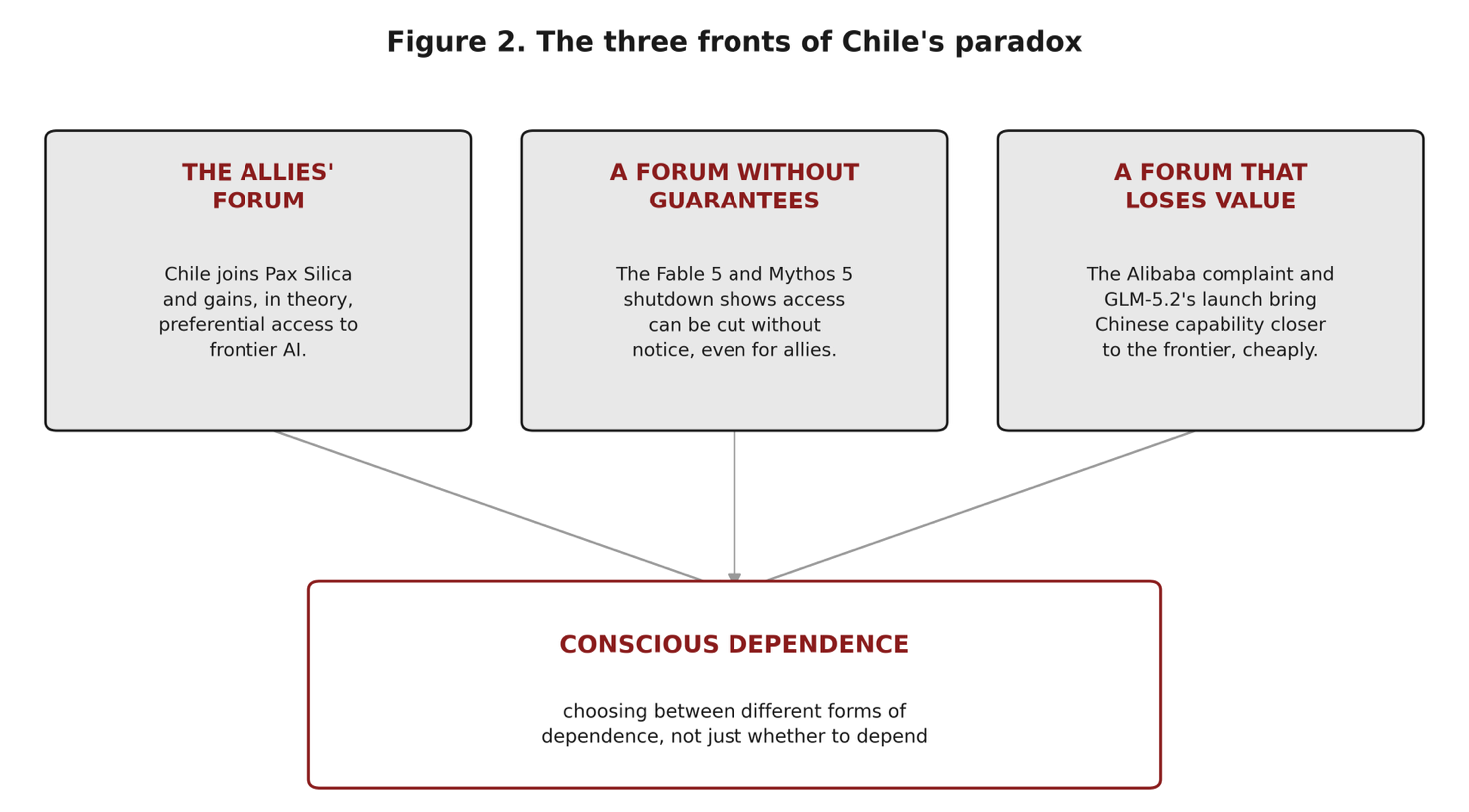
The consequence is that what matters for Chile is no longer simply whether it belongs to a bloc of allies in the field of AI development, but what concrete guarantees it obtains from that membership, and, at the same time, what real alternatives exist outside that bloc. The dependence Chile must manage, identified in an earlier analysis as one of the decisions the country needed to make, now entails a calculated choice among different forms of reliance, including that of increasingly accessible Chinese models. Each alternative carries its own risks of continuity, data governance, and security, which Chile must weigh from a national security perspective.
Initiatives to drive forward
Considering the events described above, there are at least five initiatives Chile could pursue, even though our country does not hold a dominant position in the production chain for AI models. Its leverage lies instead in capitalizing on its privileged position as a supplier of critical minerals and in the possibility of hosting data centers powered by sustainable energy, thereby adding to its role as a supplier of inputs that of host to critical AI infrastructure.
First, Chile should propose that Pax Silica incorporate continuity clauses and advance-notice requirements for regulatory suspensions such as those affecting Fable 5 and Mythos 5. At present the alliance contains no commitment to stability of access for its member countries, such that no member would again face a suspension without minimum guarantees. This should be a priority for Chilean diplomacy, put forward to the alliance itself as a condition applicable to all its members.
Second, Chile should negotiate bilaterally with the United States its own terms of guaranteed, rather than merely preferential, access to frontier computing and models. The aim would be for our country to obtain verifiable commitments, with timelines and complaint mechanisms in the event of a future suspension.
Third, open alternatives offered by China, such as GLM-5.2, should be evaluated against high technical standards and without automatic exclusion. This means establishing explicit criteria for data governance, security, and traceability before cost convenience ends up determining, by default, which provider processes sensitive information belonging to the state or to the country’s critical sectors.
Fourth, the assessment of future service suspensions should fall to a formal higher-level body responsible for national security, rather than remaining subject to ad hoc coordination among the Ministry of Foreign Affairs, the Ministry of Science, Technology, Knowledge, and Innovation, and the National Cybersecurity Agency. None of these bodies alone possesses the vantage point required to anticipate and respond to episodes of this kind, which is why a higher-level body should permanently assume that coordinating role.
Finally, this discussion should gain public visibility now, rather than waiting for the next suspension to find the country without a defined position. This means arriving at an explicit position, communicated by the Chilean state and capable of being known both by its Pax Silica partners and by alternative providers, so that the conditions Chile demands are clear before dependence deepens.

None of these initiatives requires Chile to choose definitively between the United States, China, or other state actors. What is necessary is to stop treating access to frontier AI models as a benefit acquired through membership in an institution, and instead to approach the matter as a dependent relationship that must be actively managed on Chile’s own terms, while the room to set those terms still exists.
Conclusions
Chile moved from standing outside the forum that reserves preferential terms of access to frontier artificial intelligence for its members to joining it, only to discover that this forum offers no guarantee of full protection and, finally, to find that this advantage could become less exclusive in the short term. Membership in Pax Silica is a valuable step, though its real value for a country without a dominant position in the development of these models will depend on whether Chile treats it as the first stage of a relationship still to be built, rather than as a safeguard already secured. The window of time to set its own conditions, within the limited scope of influence a country of our size commands, will keep narrowing with every new episode like that of Fable and Mythos, or with every new Chinese model that shortens the distance still separating the states that develop frontier models from those that merely aspire to reach it.
[i] U.S. Department of State. Pax Sílica. June 26th, 2026. https://www.state.gov/translations/spanish/pax-Sílica
[ii] “A term used to designate the most advanced AI models available at any given time, whose performance and dual-use potential draw the greatest regulatory and national security attention.
[iii] Alejandro Amigo, “Beyond chatbot: implications of IA to Chile”, AthenaLab, May 4th, 2026.
[iv] Anisha Sircar, “Anthropic Disabled Fable 5 And Mythos 5 After A U.S. Export-Control Order. Here’s What Happened”, Forbes, June 16th, 2026, https://www.forbes.com/sites/anishasircar/2026/06/16/anthropic-disabled-fable-5-and-mythos-5-after-a-us-export-control-order-heres-what-happened/
[v] Wired. “China has its own Mythos. It’s called GLM-5.2, and it’s a warning shot for the U.S.”. June 30th, 2026. https://es.wired.com/articulos/china-tiene-su-propio-mythos-se-llama-glm-52-y-es-un-disparo-de-advertencia-para-ee-uu
[vi] U.S. Department of State. Pax Sílica. June 26th, 2026. https://www.state.gov/translations/spanish/pax-Sílica
[vii] United States, Japan, South Korea, Singapore, the Netherlands, Israel, the United Arab Emirates, the United Kingdom, and Australia.
[viii] Pax Sílica. https://www.state.gov/translations/spanish/pax-Sílica
[ix] CNBC. “Anthropic disables access to Fable 5 and Mythos 5 to comply with government directive”,
June 12th, 2026. https://www.cnbc.com/2026/06/12/anthropic-disables-access-to-fable-5-and-mythos-5-to-comply-with-government-directive.html
[x] Alejandro Amigo, “Resilience or subordination before the AI: challenges for Chile”, AthenaLab, June 9th, 2026.
[xi] BBC. “Anthropic accuses Chinese rival Alibaba of illicitly extracting AI capabilities”, June 24th, 2026. https://www.bbc.com/news/articles/cwyklykn5dwo
[xii] Reuters. “US says BYD, Baidu, Alibaba and other tech giants are aiding China’s military”, June 8th, 2026. https://www.reuters.com/world/asia-pacific/pentagon-lists-entities-designated-chinese-military-company-2026-06-08/
[xiii] Wired. “China has its own Mythos. It’s called GLM-5.2, and it’s a warning shot for the U.S.”, June 30th, 2026. https://es.wired.com/articulos/china-tiene-su-propio-mythos-se-llama-glm-52-y-es-un-disparo-de-advertencia-para-ee-uu