One Authority at Sea: The Strategic Case for Keeping Chile´s Maritime Authority Integrated into the Chilean Navy
INTRODUCTION
In a country whose economy, connectivity, and security depend structurally on the sea, determining who controls navigation, protects ports, oversees maritime activities, conducts search and rescue operations, and responds to threats originating at sea is a strategic decision. The central question, therefore, is not whether these functions have civilian, law-enforcement, or military components—they clearly encompass all three—but rather which organization can integrate them most effectively, with fewer duplications, more efficient use of resources, and a greater capacity to respond.
Chile’s experience demonstrates that incorporating the Directorate General of the Maritime Territory and Merchant Marine (DIRECTEMAR) into the Navy has made it possible to build a specialized authority with its own identity and regulations, while benefiting from the support of an institution with a nationwide presence, a hierarchical structure, permanent logistical capabilities, and the capacity to operate from ports to the high seas. This arrangement does not eliminate coordination with other agencies. On the contrary, it facilitates it by providing the state with a clearly identifiable maritime counterpart and a chain of command capable of transforming information, regulations, and operational assets into an effective response.
In light of recent statements by members of the National Congress, it is important to emphasize that the institutional status of the maritime authority is not merely an administrative matter. This document argues that Chile should keep DIRECTEMAR as an integral part of the Navy and under the Ministry of National Defence. This conclusion rests on four reasons. First, the model reflects the country’s history, geography, and actual capabilities. Second, it integrates functions that inevitably overlap at sea. Third, it avoids the coordination and duplication costs found in separate institutional models. Finally, it is consistent with the most relevant international trend: not necessarily merging every agency by law, but integrating maritime surveillance, intelligence, command, and assets so that they operate as a single system.
1. THE SEA DOES NOT ALLOW FOR A SIMPLE DIVISION BETWEEN DEFENCE AND SECURITY
The conceptual distinction between external defence and internal security is necessary in a democratic state. However, applying it mechanically to the maritime domain creates problems. On land, institutional boundaries often coincide with jurisdictions, responsibilities, and assets that are relatively distinct. At sea, by contrast, the same platform, crew, or sensor may detect a fishing vessel violating regulations, a boat being used for illicit trafficking, a ship causing pollution, a vessel in distress, or a foreign unit conducting activities of interest to national defence. Moreover, the nature of an incident may change during an operation, and the response may require administrative, law-enforcement, diplomatic, and military powers within a matter of hours.
This overlap explains why the scope of maritime security has expanded. It is no longer limited to navigational safety or compliance with port regulations. It now includes transnational organized crime, illegal fishing, critical infrastructure protection, cybersecurity, pollution, traffic control, irregular migration, hybrid threats, and grey-zone activities. Ports, moreover, are no longer merely places where cargo is transferred. They are critical nodes for supply chains, energy, and foreign trade. The Economic Commission for Latin America and the Caribbean’s port report for 2024–2025 highlights how geopolitical, climatic, technological, and logistical disruptions have turned port resilience into a strategic issue for Latin America.
Institutionally separating naval affairs from maritime affairs does not cause real-world problems to become similarly segmented. It merely forces the state to reconstruct, through agreements, joint centres, and protocols, the unity it previously divided, turning a supposedly “good idea” into an operational inconsistency. When threats are ambiguous and response times are short, the principal value lies not in the administrative purity of each agency, but in the continuity between detection, assessment, enforcement, and the deployment of assets. Chile already possesses this continuity through DIRECTEMAR’s integration into the Navy.
2. THE CHILEAN MODEL IS THE PRODUCT OF THE COUNTRY’S OWN EXPERIENCE
Chile’s maritime authority was not recently incorporated into the Navy as a response to temporary circumstances. Its development occurred alongside the formation of the state and the need to regulate maritime activity along an extensive and fragmented coastline located far from the country’s main political centres. From the earliest harbour master’s offices to the present-day DIRECTEMAR, Chile gradually built an organization combining regulation, maritime law enforcement, navigational safety, environmental protection, and state presence.
The 1978 Navigation Act consolidated this process by defining the maritime authorities and expanding the responsibilities of the Littoral Service. The current model maintains a professional specialization within the Navy, with a territorial structure comprising maritime governorates, harbour master’s offices, and local maritime outposts. These are complemented by search and rescue systems, traffic control, telecommunications, maritime signalling, vessel inspections, pollution prevention, and maritime law enforcement. DIRECTEMAR therefore operates as a specialized public service while retaining access to the Navy’s logistical base, professional expertise, and major operational assets. This enables operational continuity from the coastline and ports to Chilean jurisdictional waters and international waters.
This relationship generates significant institutional economies. Units belonging to the Littoral Service can concentrate on patrols, enforcement, rescue operations, and navigational support while relying on naval vessels, aircraft, command systems, and surveillance capabilities when a situation exceeds their own resources. Similarly, the Navy obtains continuous knowledge of maritime traffic and activities taking place within its areas of interest. This connection strengthens maritime domain awareness and allows the response to be scaled up gradually, without having to transfer the problem from one institution to another.
The arrangement is also consistent with the resources available to a medium-sized maritime power. Creating a separate institutional architecture would require unnecessary expenditure to duplicate training centres, logistical systems, infrastructure, communications, maintenance, intelligence, procurement, and administrative support. Even if a new institution initially received some of the existing assets, it would eventually need to develop its own nationwide structure. The purported benefits of specialization could ultimately be financed through duplication and budgetary competition, without producing any increase in the state’s effective presence at sea.
Figure 1. Geographical distribution of maritime governorates and harbour master’s offices

Source: DT35 | Maritime Capabilities: A Proposal for Chile. AthenaLab.
3. THE ARGENTINE CASE: A SEPARATION THAT REQUIRES COORDINATION TO BE REBUILT
A Chilean senator recently stated that Chile “should have an independent maritime service, like the United States Coast Guard or Argentina’s Naval Prefecture.” Argentina provides a particularly useful comparison because it shares with Chile an extensive area of maritime responsibility, Antarctic interests, fishing resources, major ports, and a professional naval tradition. The Argentine Naval Prefecture historically developed in connection with the Navy, but ceased to be institutionally subordinate to it in 1984 and is currently a federal force under the Ministry of National Security. Decree 457 of 2025 reaffirmed this status and assigned it responsibilities for navigational safety policing, pollution prevention, maritime protection, and judicial policing.
The Prefecture is a professional institution with significant capabilities. The issue, however, is not its quality, but the structural effect of maintaining two national organizations with maritime assets, command centres, specialized personnel, and overlapping responsibilities. The Argentine Navy retains responsibilities for the surveillance and control of maritime spaces, as well as national responsibility for maritime search and rescue. The Prefecture, meanwhile, controls navigation, operates rescue sub-centres, enforces regulations, and deploys coast guard vessels and aircraft. Consequently, the two organizations must continuously coordinate functions that belong to a single operational continuum.
Argentina’s own practices illustrate this cost. In 2020, the Ministries of Defence and Security had to sign specific agreements to coordinate the surveillance of jurisdictional waters and complement the use of Navy and Prefecture vessels and aircraft. In 2023, the two institutions held meetings to deepen their coordination on search and rescue. In 2025, the Navy continued to serve as the national SAR authority, while the Prefecture operated rescue coordination sub-centres. The creation of the Joint Maritime Command likewise sought to centralize the surveillance and control activities conducted by different agencies. These measures are reasonable, but they also reveal the underlying problem: institutional separation creates the need for additional mechanisms to restore unity in information, planning, and the deployment of assets.
To argue that the Argentine model has produced more disadvantages than benefits is therefore to recognize that it creates frictions the state must manage permanently: coordination between ministries, the delimitation of responsibilities, information sharing, systems compatibility, the prioritization of assets, and the determination of who takes command when an incident evolves from an administrative violation into a security or defence threat. Chile does not need to import these frictions when it already possesses an integrated and proven system.
There is also a historical lesson. Argentina’s separation reflected its own political process and a rigid distinction between defence and internal security. This precedent cannot automatically be transferred to Chile. Institutions should not be copied because of superficial similarities in name or form. They must be assessed according to a country’s geography, strategic culture, legislation, and available resources. For Chile, the correct question is not “Why is there no independent prefecture?” but rather “What specific problem would one solve?” and whether that benefit would compensate for the loss of integration. So far, the evidence points in the opposite direction.
4. COMPARATIVE TRENDS FAVOUR THE INTEGRATION OF CAPABILITIES
International models vary. The United States has a Coast Guard that is institutionally separate from the Navy and operates under the Department of Homeland Security during peacetime. Italy maintains a corps of harbour master’s offices with its own identity, but integrated into the Italian Navy and subject to the functional authority of different ministries. In Brazil and Peru, the maritime authority is exercised through their respective navies. Norway incorporates its Coast Guard into the Navy. The United Kingdom distributes responsibilities among civilian agencies, police forces, and the Royal Navy.
This diversity makes it impossible to argue seriously that there is a single universal administrative model. Nevertheless, it does reveal a common trend: states are seeking to integrate functions, information, and assets that previously operated in a fragmented manner. The United Kingdom created the Joint Maritime Security Centre to bring together information and intelligence from the Border Force, maritime agencies, the police, the Armed Forces, and other organizations, with the objective of producing a unified understanding of threats. Norway is planning standardized vessels for both Navy and Coast Guard missions, taking advantage of common support, maintenance, and capabilities. Even the United States, despite placing its Coast Guard under civilian authority in peacetime, maintains it as an armed service, a law-enforcement agency, a maritime regulator, and a defence component within a single multimission organization.
China has likewise moved from a dispersed structure towards greater concentration of its coast guard forces: first by merging different agencies and later by transferring the Coast Guard to the People’s Armed Police. Beyond the differences between political systems, the institutional logic is clear. In the face of strategic competition and grey-zone operations, unity of command, operational mass, and the connection between law enforcement and state power are highly valued.
The relevant global trend, therefore, is not that every maritime authority must formally report to a navy. Rather, it is that maritime responsibilities should not function as isolated silos. States are seeking information-fusion centres, clear chains of command, interoperable systems, multipurpose assets, and rapid transitions between law-enforcement, regulatory, and defence functions. Chile already enjoys a comparative advantage in this area. Separating DIRECTEMAR from the Navy would run counter to this trend by fragmenting an integrated structure, only to attempt to reconstruct it later through interagency coordination.
Figure 2. DGTM areas of responsibility
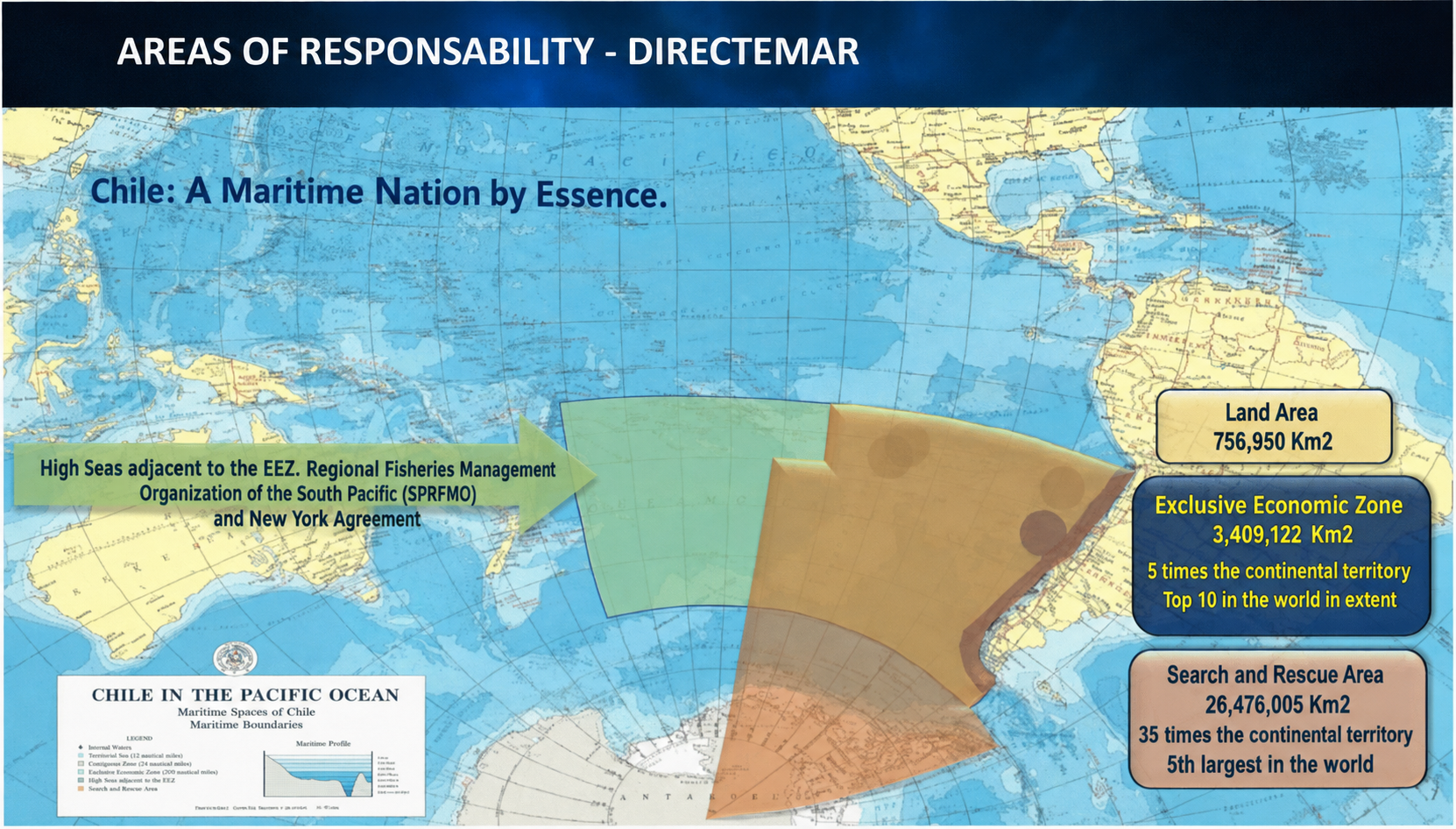
Source: DT35 | Maritime Capabilities: A Proposal for Chile. AthenaLab.
5. WHY SHOULD THE MARITIME AUTHORITY REMAIN UNDER THE MINISTRY OF DEFENCE?
Keeping DIRECTEMAR within the Navy necessarily entails maintaining its institutional position under the Ministry of Defence. This does not turn all its functions into military operations, nor does it prevent civilian oversight. The maritime authority operates under specific legislation, fulfils international obligations, administers its own resources, and cooperates with ministries, prosecutors’ offices, police forces, customs agencies, fisheries services, and environmental bodies. Its position within the defence sector primarily determines its institutional foundation, chain of command, and access to naval capabilities.
Transferring it to the Ministry of Public Security might appear logical when considering only its maritime law-enforcement function. That mission, however, is just one part of a much broader mandate. DIRECTEMAR is the navigational authority, maritime administration, and search and rescue service. It serves as Chile’s technical body before the International Maritime Organization, acts as the environmental authority within its jurisdiction, and constitutes part of the state’s presence in remote areas. It must also operate in spaces where the distinction between public security and defence can change rapidly, including the exclusive economic zone, island territories, and Antarctic waters.
The Ministry of Defence offers three advantages. First, it sustains an organic relationship with the naval force and its surveillance, communications, logistics, and maintenance systems, allowing DIRECTEMAR to draw on a broad range of available capabilities. Second, it facilitates capability planning for scenarios ranging from routine operations to international crises. Third, it protects a long-term national maritime perspective by preventing maritime assets from being absorbed by short-term land-based policing priorities. This last point is particularly important in a country where urgent internal security demands can easily displace less visible, but essential, maritime investments.
Coordination with the Ministry of Public Security should be strengthened, particularly in relation to drug trafficking, organized crime, and criminal infiltration of ports. Coordination, however, does not require transferring institutional authority. The best solution is to improve protocols, joint intelligence, interoperability, and planning while preserving the organic unity between the maritime authority and the Navy. In this way, Chile can combine specialized law-enforcement capabilities with broader maritime reach, without dismantling an architecture that works.
Finally, no clear problem has been identified in the current organization, nor has it been established what problem would be solved by changing DIRECTEMAR’s institutional dependence or replacing it. The organic separation of DIRECTEMAR from the Navy and its transfer to another authority should follow a rationale aimed at resolving a specific issue and improving the efficiency or effectiveness of state action. In this case, neither objective is apparent. There may, however, be other motivations driven more by political than technical interests, such as creating new structures within the government of the day that would provide positions to be allocated at its discretion. One hopes that this remains no more than an alternative theory. Nevertheless, some of the arguments being voiced give cause for concern.
6. INTEGRATING CAPABILITIES
Defending the existing model does not mean arguing that it cannot be improved. DIRECTEMAR faces gaps in funding, fleet renewal, persistent surveillance, infrastructure, cybersecurity, and data analysis. These limitations would remain even if it became an independent service. Maritime and port activity has increased, but its resources have not necessarily expanded at the same rate. Protecting ports, submarine cables, energy terminals, and access routes requires new capabilities. Organized crime also demands closer cooperation with Customs, the Public Prosecutor’s Office, Carabineros, and the Investigative Police.
These limitations should be addressed by strengthening the system, not dividing it. Chile needs a maritime and port security policy that defines national objectives, priority risks, and interagency responsibilities. It also needs a maritime information-fusion centre integrating naval, police, customs, port, fisheries, and commercial data. Given its territorial coverage, technical experience, and connection with the Navy, DIRECTEMAR is naturally positioned to form the operational core of such a system, subject to political direction and clear rules for information sharing.
Adequate funding is equally decisive for the fulfilment of its responsibilities. If the state expects the maritime authority to protect an extensive area of responsibility and respond to increasingly sophisticated threats, it must ensure the renewal of its patrol vessels, boats, aircraft, sensors, communications equipment, and digital systems. Maintaining its institutional dependence under the Ministry of Defence without funding its capabilities would produce integration in form only.
CONCLUSIONS
Chile’s experience shows that integrating the maritime authority into the Navy is not an anomaly that needs to be corrected, but an advantage that should be preserved. The model brings together maritime regulation, law enforcement, search and rescue, environmental protection, surveillance, and the backing of the naval force within a single institutional architecture. This arrangement makes it possible to use a common territorial and logistical structure, reduce duplication, and respond continuously to incidents whose nature may change rapidly.
The Argentine case demonstrates the costs of the alternative. A separate prefecture may be professional and effective in carrying out its responsibilities, but it requires the state to maintain two maritime systems and create agreements, commands, and coordination mechanisms to connect them. These efforts do not demonstrate an Argentine institutional failure. They demonstrate that separation generates a permanent institutional burden. Chile would gain no evident advantage by reproducing it.
There is no universal administrative formula, but there is a clear tendency towards operational integration, information fusion, interoperability, and coordinated command. Brazil, Peru, and Norway maintain organic links between their maritime authorities and their navies. The United States concentrates civilian, law-enforcement, and military functions within a single Coast Guard, while the United Kingdom has had to build joint structures to overcome institutional fragmentation. In this context, dividing the Navy and DIRECTEMAR would mean moving in the opposite direction.
Creating new structures within the Chilean state, in a context of budgetary constraints, would merely add bureaucracy and impose new costs on the country, without clearly identifying the problem that is meant to be solved. It would amount to copying practices that do not necessarily reflect Chile’s national reality or responding to interests that are not aligned with those of the state.
For these reasons, the most advantageous option for Chile is to keep DIRECTEMAR as an integral part of the Navy and under the Ministry of National Defence. The reform that is needed is not institutional separation, but institutional strengthening: more resources, better information systems, greater interagency coordination, and a national policy recognizing maritime security as a condition of sovereignty, public protection, and economic development. In a maritime country, unity of action at sea is not an institutional convenience, but a strategic capability of the state.
IGNACIO MARDONES COSTA
Director of International Affairs