CONVERSATION | AthenaLab facilitates Arctic-Antarctic dialogue between Chile and Canada
This article was translated automatically and may contain differences from the original. For reference, read the original.
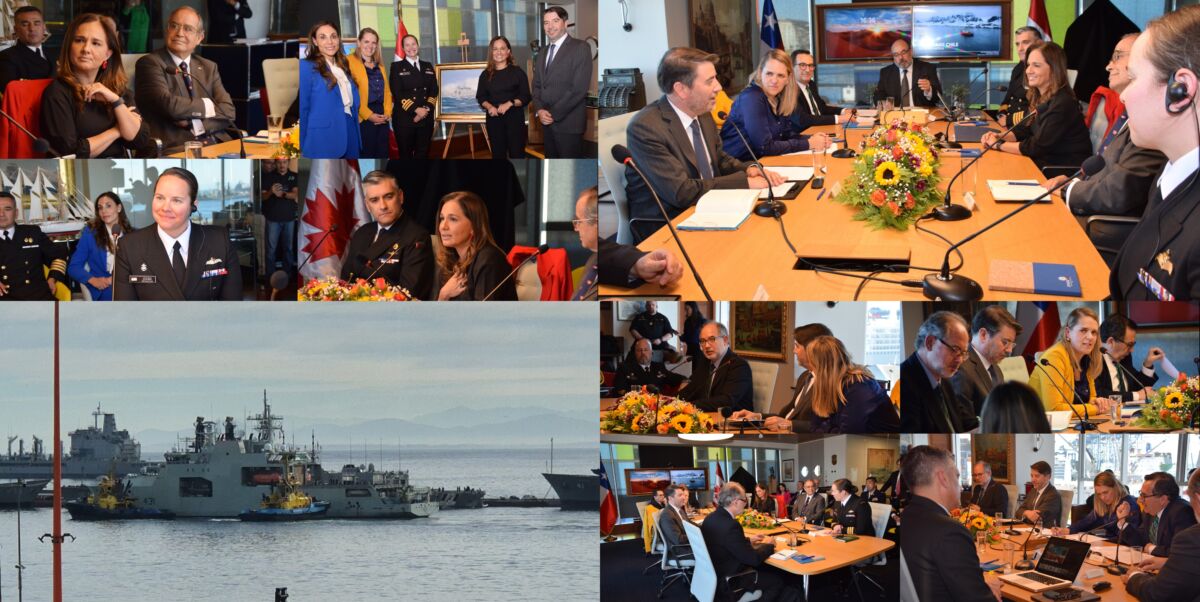
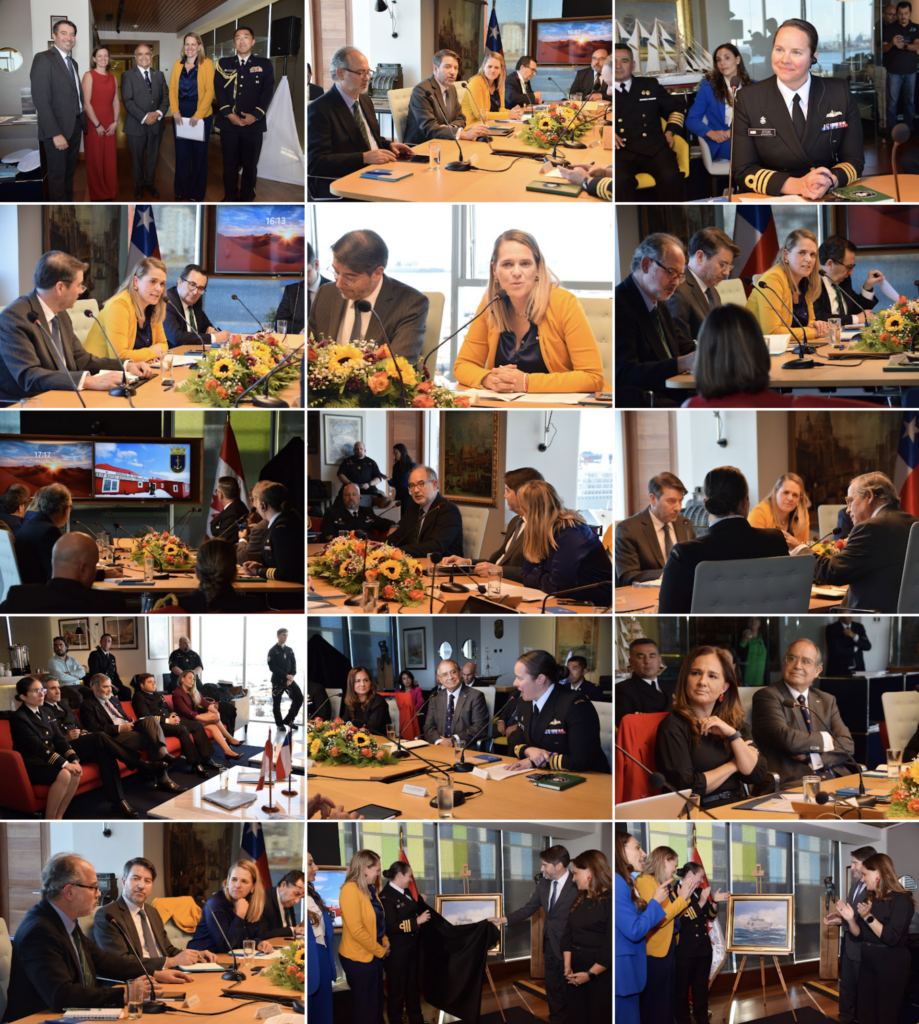
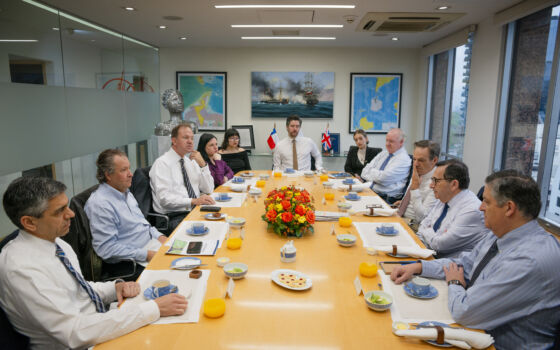
“Opposites attract.” Under this concept, AthenaLab organized a conversation on March 31 at its offices in Valparaíso, aimed at sharing experiences about the Arctic and Antarctica between Canada, the northernmost country in the world, and Chile, the southernmost.
The dialogue also took advantage of the arrival of the patrol vessel “HMCS Margaret Brooke”, as part of Operation Projection 2025, a historic mission being the first circumnavigation of South America and the first visit to Antarctica by a ship of the Royal Canadian Navy.
With differences and similarities, the Arctic and Antarctica face common challenges, such as the intensification of climate change and geopolitical competition. Given that Chile and Canada are democracies that support a rules-based international order and are committed to environmental protection, it seems clear that supporting a norm-based governance in the polar regions is the best option for both, without it being an impediment to consistently and continuously improving national presence and infrastructure.
Opening the interventions, the Canadian Ambassador to Chile, Karolina Guay, highlighted the significance of the meeting, as it allows for the explanation that her country is more present in Antarctica than is commonly believed through sophisticated equipment, long-standing scientific research, and personnel providing logistical services to private companies and also to recent expeditions, such as that of the “HMCS Margaret Brooke.”
She also emphasized the signing of a recent memorandum of understanding between the Chilean Antarctic Institute (Inach) and Polar Knowledge Canada, to establish a permanent character for scientific exchange between the countries.
According to Guay, despite the evident differences, there are points of connection between the Arctic and Antarctica, such as the challenges posed by a more competitive geopolitics, a climate change that is manifesting more intensely, and the need to preserve natural resources. She further stated that in this scenario, Canada and Chile can share many experiences.
Then, Senator Kenneth Pugh, who chairs the binational parliamentary committee, added that there are similarities between Chile and Canada that should lead to closer relations, such as positioning in the Pacific theater, the extent of their coastlines, and concerns raised by China’s actions.
He recalled the exchange between the navies in terms of training, cooperation, and modernization of platforms as an asset. “Countries that trust each other at sea can also trust each other on land,” he expressed. He added that it is now time to seek new areas of deep cooperation with a country that is already the largest direct investor in Chile.
In turn, the Executive Director of AthenaLab, Juan Pablo Toro, reviewed the conclusions of the Working Document No. 30, “Geopolitical Update of the Chilean Antarctic Territory”, which states that while the Antarctic Treaty System (ATS) has provided an effective model of collective governance favorable to Chile’s interests, there are no guarantees that it will endure. On the contrary, geopolitical pressure on the last discovered continent seems to be increasing over time, and the dual-use of technologies in the civil-military realm is a growing concern.
“For the Chilean state, significant challenges arise. One of the most evident is the need to inhabit Antarctica with greater determination and further south. The extreme isolation, changing and severe weather conditions, and the need to travel long distances without reliable communications constitute the natural context of the white continent. But it is a national obligation to be present,” he assured.
He explained that when attempting to foresee the future of Antarctica, it is inevitable to look north, where the other pole is located. Despite their unique and distinct characteristics, both regions suffer similar impacts due to climate change and geopolitical competition. Understanding Canada’s case is very useful for Chile, Toro estimated, as it is a liberal democracy that controls 40% of the Arctic, respects the rules-based international order, and promotes market openness, just like Chile. Therefore, there is a similar understanding of the role of the poles in the international arena.
In her intervention, the Deputy Minister of Foreign Affairs, Gloria de la Fuente, emphasized Chile’s commitment to extending its presence into the depths of the white continent, where there is currently a summer base at Glaciar Unión, and acknowledged the need to inhabit the depths of Chile’s sovereign space towards the South Pole, which should be part of a state policy. In fact, she visited the southernmost tip of the country accompanied by President Gabriel Boric.
De la Fuente emphasized that the Antarctic territory is a fundamental part of national sovereignty, as well as a geographical area that is a natural reserve dedicated to peace and scientific research. She also highlighted the role of the Armed Forces as Antarctic operators, without which it would be impossible to develop presence and scientific research.
“While Chile is a medium-sized country internationally, it is also a regional Antarctic power,” said the Deputy Minister of Foreign Affairs. She advocated for including Chile’s projection on the continent within a long-term strategic plan, as it is “important to have a state vision on these types of issues.”
Regarding Canada, she stated that the country has much to learn from its experience in the Arctic, as “in a globalized and interdependent world (…), one must be interested in what happens in other regions.” For example, both poles suffer geopolitical tensions and are key to regulating climate change.
“We believe we are in a position to contribute substantively to the greater scientific and operational deployment that Canada is interested in undertaking in Antarctic latitudes. Chile is an essential partner for any country or scientific program wishing to operate in West Antarctica and especially in the Antarctic Peninsula; and we are confident that the community of values and the extensive friendship we have with Canada can also materialize in these matters,” affirmed the Deputy Minister, who highlighted the logistical support provided to the “HMCS Margaret Brooke” during its recent visit to King George Island.
In this regard, the ship’s commander, Frigate Captain Teri Share, expressed gratitude for the support received during a navigation she described as “unique,” as no Royal Canadian Navy vessel had ever reached such a southern point.
The head of the Antarctic Division of the Chilean Navy, Captain Carlos Rodríguez, stated that among the multiple tasks the navy performs to reinforce national sovereignty on the continent, one of them is precisely to assist in the safe navigation of foreign vessels.
In the penultimate intervention, Luis Valentín Ferrada, an academic from the University of Chile and principal researcher at the Millennium Institute BASE, pointed out that the current global geopolitical situation is contaminating the Antarctic discussion, which used to be more cooperative in nature.
Therefore, Ferrada explained, when it was decided not to support Belarus by consensus for consultative member status in the ATS due to its support for Russian military actions against Ukraine, this has resulted in blocking Canada’s application in retaliation, despite the fact that this country meets all the conditions, such as conducting scientific activities and advancing expeditions to the white continent. As the ATS is now being “politicized,” the expert in Antarctic law concluded that Ottawa will have to wait to see its aspiration realized.
Closing the conversation, the head of studies at AthenaLab, John Griffiths, highlighted Chile’s efforts from its origins towards the Antarctic continent. This would be the result of an early geopolitical vision that began with the Liberator Bernardo O’Higgins and continues through time with figures such as General Manuel Bulnes, General Ramón Cañas Montalva, and diplomat Óscar Pinochet de la Barra.
He also noted that most attendees recognize that the current transformation of the international order has an impact on Antarctica, in which case it is necessary to emphasize Chile’s legitimate rights in the space defined as sovereign, and highlighted the benefits of cooperation with Canada on polar issues.
After the moderator, Matías Purcell, a professor at the Naval War Academy, concluded the conversation, AthenaLab presented a painting to Commander Teri Share, commemorating the first navigation of the “HMCS Margaret Brooke” through Chilean Antarctic waters. The work by painter Edgard Stephens was later exhibited at a protocol reception on the ship’s deck.
AthenaLab Team
Valparaíso, March 31, 2025
Photo Gallery