Constitutional States of Exception: What Does 'State of Catastrophe' Mean?
This article was translated automatically and may contain differences from the original. For reference, read the original.
Declaring constitutional states of exception (assembly, site, emergency, and catastrophe) is generally a power held by the President of the Republic, with the support of Congress, to restrict individual freedoms enshrined in normal situations, based on a greater situation that necessitates their temporary suspension. These states are detailed in Articles 39 to 45 of the Political Constitution of Chile.
The ‘State of Catastrophe’ is contemplated to address cases of public calamity caused, among other reasons, by natural disasters triggered by human actions, such as wildfires, or by the action of a global pandemic. This state must be signed by the President of the Republic, along with the Minister of the Interior and the Minister of Defense, and Congress must be informed of the provision. In response to the emergency triggered by the coronavirus outbreak, it has been established for 90 days.
It involves the appointment of a Chief of National Defense (JDN), an authority to whom the President of the Republic delegates special powers for managing the crisis in a specific area, to restore a state of normality in that jurisdiction. In this case, JDNs have been appointed in all regions of the country. Thus, they will be able to restrict freedoms of movement, assembly, as well as property rights.
The appointed Chief of National Defense will have the following delegated powers to be exercised from 00:00 hours on March 19, 2020:
1. The geographical area must be controlled to manage entry and exit, as well as transit to and from the area.
2. Issue measures for the protection of infrastructure, as well as public utility services, mining centers, industrial sites, and others.
3. Order the collection, storage, or formation of reserves of food, articles, and goods necessary for the care and subsistence of the population in the area, controlling and ensuring the entry and exit of such goods.
4. Ensure basic goods for the maintenance and subsistence of the population in the affected area.
5. Restrict or establish conditions for the right to assemble in public places.
6. Coordinate with various authorities in the geographical area to remedy the effects of the public calamity as soon as possible.
7. Keep the population informed through social media to convey reassurance to the public.
8. Issue guidelines and instructions, as well as ensure public order in their jurisdiction.
Overall, it can be seen that the duties of a Chief of National Defense are extensive and complex, requiring the necessary collaboration of all governmental, social, and community organizations for the successful fulfillment of the assigned mission.
A primary concern that arises in the current context is that if the country is constantly facing calamities, and it seems that this will continue in the future, why is there no planning implemented during normal times for each of these events or scenarios? We refer to matrix and subsidiary planning for cases or threats; what is the reason that Chiefs of National Defense cannot, from peace and normality, know in advance their designation to work on the necessary planning and coordination measures for the time of their deployment? These and many other lessons must be addressed as soon as possible.
The crisis we are about to face at its most critical moment is an unprecedented circumstance, requiring the coordination of all available resources, compelling authorities to exercise clear and decisive leadership and communities to act in solidarity and with national unity.
In this task, we must ‘learn by doing,’ meaning that for many situations there will be no reference, with creativity, initiative, and good judgment being our only tools at our disposal. This will mean that for ‘exceptional phenomena, extraordinary measures.’
Consequently, it will be a task for all of society, as this crisis will affect the national spirit, demanding the greatest possible social cohesion. To overcome it, the effort of each and every citizen will be required; it will be a collective effort in which no one is superfluous.
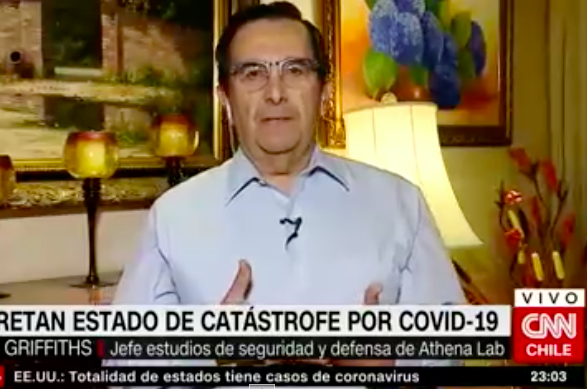
INTERVIEW: John Griffiths and the Role of the Armed Forces in the Face of Coronavirus: ‘The Military Have the Great Capacity to Articulate Support’
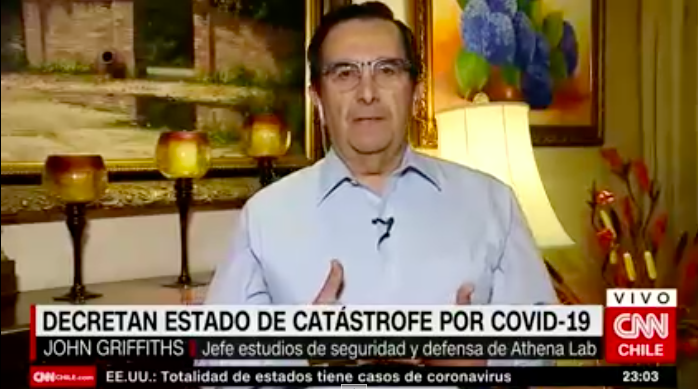
John Griffiths, Head of Security and Defense Studies at AthenaLab, comments on CNN’s ‘Última Mirada’ program about the role of the Armed Forces in the face of coronavirus, especially under the current State of Catastrophe in which Chile finds itself. – Click on the image to view the video.