Response to the “Military Forces Chile Needs”
This article was translated automatically and may contain differences from the original. For reference, read the original.
El Mostrador, Friday, September 25, 2020
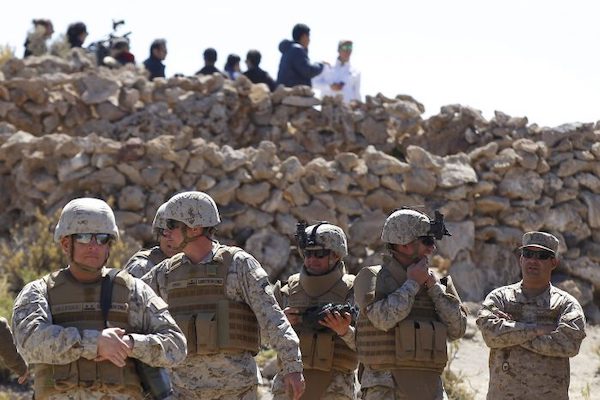
The members of the Armed Forces are Chileans from all social, ethnic, and religious backgrounds. They come from the far north to the extreme south. They are people from the mountains, the central valley, the deserts, the coast, and the insular Chile. Discrimination is not practiced in the Armed Forces, and everyone has a place within them. All that is needed is the vocation of service that Chile requires and the ability to swear or promise to give one’s life for the homeland if necessary. Therefore, I cannot understand the insistence on claiming that they do not know the reality of Chileans and the constant attempt to artificially introduce the concept of class struggle where it does not exist and is not relevant.
I appreciate the opinion column by Deputy Jorge Brito Hasbún from September 19, 2020. It reminded me of the efforts of Carlos Altamirano and others to secure the support of the Armed Forces for the socialist revolution they sought to implement in 1973, which they had longed for since Fidel and his Marxist revolution became the fashionable model to follow in the 1960s and 1970s in Latin America.
Deputy Brito makes a monumental strategic error by publicly revealing his efforts to persuade the Armed Forces and/or their members to adhere to his political ideology. He does this in a very subtle way, in order not to appear to be directly calling on the institutions or their members to rise up against democratically elected powers, but he makes the mistake of showing his cards and intentions, unless that was his intention as part of a political action that goes beyond what is specifically addressed in his column, or simply to achieve a total and absolute rejection of the participation of institutions in politics, as a result of the reading of his opinion column.
In an effort to be brief, here are some clarifications regarding the words of the honorable deputy:
1) He asserts that countries that have experienced dictatorships or wars subsequently agree democratically on the type of Armed Forces they need. Worldwide, the only cases that come to mind are Germany after the defeat of Nazism, Japan after its defeat in World War II, and to some extent, Argentina after the defeat in the Falklands or Malvinas, but where the exercise did not involve a democratic process as the deputy indicates, but rather primarily budgetary actions by the Executive to shape them as desired. What is observed as a common factor is that more than dictatorships, it is defeats in war that lead to a review of the purpose and organization of armed institutions.
2) Regarding the opinions of military personnel, I do not believe it is wise to ask for their views on current political issues. Without the possibility of being greatly mistaken, it seems to me that the general consensus and constitutional definition is that they should be apolitical, as possessing the power of arms could significantly influence the development of political events. We already have enough past experience on this matter, and it is not something we wish to see repeated.
Having said that, I find it difficult to understand why some politicians periodically seek to attract the attention of institutions in order to tilt the balance in their favor, disregarding the depth that the concept of apolitical, constitutional, non-partisan, and human rights-respecting has acquired within the Armed Forces.
3) The decision regarding the economic model of the late 1970s was not made by the military. It was a recommendation from economists that was decided upon as the only way, at that time, to foster growth in the country. The military that is criticized were the ones who demanded moderation in the implementation of the liberal economic model during the 1982 crisis, and it was only in the mid-1980s that they relaxed their position to stimulate Chile’s economic activity. At this point, it is worth noting that most of the economic groups mentioned were of recent creation, as almost all that existed at the end of the 1960s did not survive Salvador Allende’s government, and several of them did not successfully navigate the early 1980s crisis.
4) I am sure that many—if not the majority—of the members of the institutions are concerned about the problems of their compatriots, but they also understand that their resolution is a matter that politicians and experts in the field must address, and it is not something that should involve the power of arms. Can you imagine a country where things were managed in that way? That may be permissible in Cuba, Venezuela, North Korea, and others, where there are dictatorships supported by armed institutions.
5) The members of the Armed Forces are Chileans from all social, ethnic, and religious backgrounds. They come from the far north to the extreme south. They are people from the mountains, the central valley, the deserts, the coast, and the insular Chile. Discrimination is not practiced in the Armed Forces, and everyone has a place within them. All that is needed is the vocation of service that Chile requires and the ability to swear or promise to give one’s life for the homeland if necessary. Therefore, I cannot understand the insistence on claiming that they do not know the reality of Chileans and the constant attempt to artificially introduce the concept of class struggle where it does not exist and is not relevant.
6) Regarding the historical examples of 1830 and 1891, some clarifications are in order. The events of 1830, more than a revolution, were a confrontation between the pipiolos or liberals and the conservatives, both groups had their own armies including independence heroes under their command, and both groups included members of the aristocracy and economic power capable of sustaining a military effort. I find it difficult to characterize that conflict as one between the rich and the poor or the aristocracy against the people. Similarly, the revolution of 1891 was more of a struggle among members of the elite, fighting for the implementation of a political model rather than anything else. In 1891, something similar occurred. It was not the people against foreign capital; it was Balmaceda—a landowning aristocrat—willing to govern as a dictator, facing a hostile parliament that would not allow him to govern and supported by northern nitrate interests. Again, I do not see it as a case of the rich against the poor or the aristocracy against the people, despite the fact that it is often represented that way.
7) Regarding the participation of institutions in Constitutional States of Exception, including the current State of Catastrophe, as good hierarchical organizations that do not deliberate and are obedient, they follow orders from the Executive, orders that they do not question and carry out in accordance with existing laws and regulations.
8) Chile is integrated into the world, and its Armed Forces are part of the instruments of the State intended to support its foreign policy. If they participate in United Nations peace missions, in international exercises, or train with third countries, it is to support the work of the Foreign Ministry or to acquire operational capabilities that can only be obtained through that means, which have allowed them to achieve levels of excellence comparable to NATO countries.
The Army and the Air Force engage not only with the United States but also with many other Latin American, Asian, and European countries. A special mention should be made of the Navy, which seeks to ensure and protect the free transit of Chile’s exports and imports, a country whose foreign trade is primarily with the Asia-Pacific region and not with northern countries, as Deputy Brito indicates. The Chilean Navy aims to work with all those who have the purpose of ensuring free transit and stability of the seas and does not integrate coalitions aimed against a specific country. We are the closest thing to an island that trades with the rest of the world and has a vital dependence on what it exports and imports.
9) Undoubtedly, we cannot exclude the Armed Forces from defining the type of Defense that Chile needs for the future, particularly in light of modern, non-traditional threats that are emerging. However, we must involve them in the appropriate technical instances, not as part of a political party discussion or under the auspices of a political-economic project with a strong ideological component. The Armed Forces belong to Chile and all Chileans; they have clear purposes and roles, but above all, they understand that they are apolitical and owe their allegiance to the Constitution. They are aware of the power they hold, and therefore, along with the lessons of the recent past, now more than ever, they will not lend themselves to partial ideological political projects.
Like Deputy Brito, I leave the readers with the question of what kind of Armed Forces Chile needs, which may clearly differ from those desired by the honorable member of the Chamber.
Richard Kouyoumdjian Inglis
Vice President of AthenaLab


