The Armed Forces of Chile and Their Relationship with Internal Security
This article was translated automatically and may contain differences from the original. For reference, read the original.
El Mostrador, Friday, March 19, 2021
For those who still believe that the Army’s statement issued after the recent attack on the Baquedano monument and the Unknown Soldier was unconstitutional, it is recommended to read the definition and synonyms of ‘deliberate,’ which is not the same as expressing discontent with an event that they felt deeply affected them. They might have used different words to express the same sentiment, but it is another matter to assume we are dealing with a deliberative institution. This last point is particularly important if we continue down the path of increasingly involving the Armed Forces in public order and internal security issues, which are evidently matters of high political content, where any opinion from institutional leaders can be misunderstood and interpreted as an act outside the Constitution and the laws.
In recent times in Chile, we are not accustomed to the Armed Forces having a prominent role, but unfortunately, the political and social circumstances we have been experiencing for approximately 18 months place them at the center of the storm. Normally, apart from their own issues, they are seen supporting efforts related to disasters and forest fires that periodically affect us, or supporting the extreme areas of Chile or working in Antarctica, but not engaging in internal security and public order tasks, which are the responsibility of the police and state agencies dedicated to those matters, and which the institutions end up supporting either due to their versatile capabilities or because it is established in the Constitution regarding their participation in states of constitutional exception.
This excessive prominence not only recalls the period of military government but also the years leading up to September 11, 1973, when the authorities of the time increasingly involved uniformed personnel in political and police aspects, due to the political disorder that prevailed, which led to the regular presence of high-ranking officials in the presidential cabinet, something arranged by the Executive and not requested by generals and admirals.
The truth is that this new reality began a little earlier. It all started with Decree 265, which provides for the collaboration of military institutions with the police at the northern border in controlling drug trafficking that infiltrates Chile from that extensive part of the country’s geography, from Peru and Bolivia. Up to that point, everything was fine, as the Comptroller’s Office agreed, and it involved support operations at the border, which has a certain logical basis due to its nature as a border.
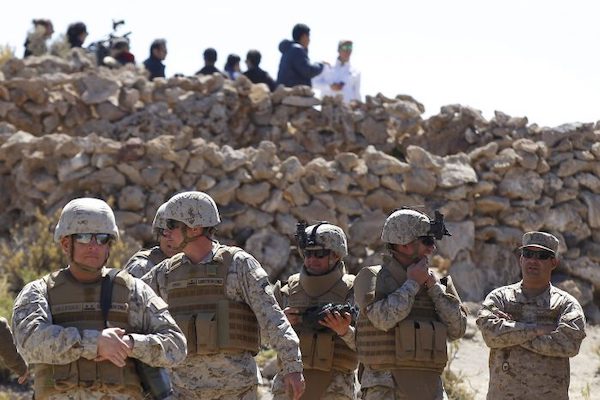
Shortly thereafter, they were asked to act under a state of constitutional exception, as on October 19, 2019, a State of Emergency was declared due to the social outbreak that occurred the day before. We were in that condition for 10 days, and the conclusion of the institutions was that, except for exceptional cases, they behaved very well, but they did not have the appropriate rules of use of force (RUF) for the circumstances we were experiencing in Chile at that time.
Thank you for watching
This was something that was made very clear to the Government and a point of discussion when the idea arose that they should also assume roles in protecting critical infrastructure, an initiative that gained traction due to the events of the social outbreak and which, after all this time, still has not achieved approval in Congress. Here again, the Armed Forces were asked to take on new roles, but these could not be salvaged through a decree and had to go to Parliament, as they required a constitutional amendment. Obviously, the institutions understood the Government’s problem, but they did not agree to be part of the solution, as it was not a primary role for them and represented an expansion of tasks in the realm of internal security.
From there, we moved to the state of exception generated by the pandemic, which has been in effect for a year and is known to require an additional 90 days after the approval granted by Congress by a majority. Much has been written about this topic, but from the perspective of this column, the most notable aspect is having the Armed Forces deployed for an extended period attending to police duties, health control, logistics, and the administration of state services dedicated to meeting the needs of citizens. Again, this has nothing to do with their primary duties, and it is striking that there are no other ways to address the impact of the pandemic other than through a state of constitutional exception that involves the Armed Forces and the designation of National Defense Chiefs (JDN) for the entire national territory, leaving the impression that all problems in Chile require a military solution.
The military solution for everything was further deepened with the request for uniformed institutions to support the police in controlling illegal immigration from Venezuela, which seeks to re-enter Chile from Peru and Bolivia, a situation that was resolved with the expansion of Decree 265, which again received the approval of the Comptroller’s Office.
The icing on the cake is the idea of several regarding the involvement of the Armed Forces in the conflict occurring in the Southern Macrozone, which is experiencing events of violence and terrorist acts accompanied by crimes and illegal activities. Clearly, the solutions are primarily political, economic, and police-related, but not military, as the latter are not tasked with addressing internal security issues unless there is a state of exception in effect that requires their use. Nevertheless, experts in the field and comparative experiences from other countries indicate that using military solutions for police and political problems is not the most appropriate. Hopefully, the idea of expanding Decree 265 to La Araucanía does not gain traction, and if the initiative does advance, it should not result in the full involvement of military personnel and marines in police duties.
One of the issues observed as a result of the experience of the last year and a half is the lack of knowledge and inexperience of the political establishment in understanding how the Armed Forces operate, the laws and regulations that govern them, the limitations under which they operate, and that their organizational design, equipment, and doctrine are not intended to address internal security problems, but rather to defend sovereignty, territory, and national interest wherever it may be located. The Armed Forces are not the same as police with greater military capabilities. It is true that they have more sophisticated weaponry, but it is not designed to pursue criminals, and if you don’t believe it, just ask the U.S. troops how they fared trying to control riots in Iraq and Afghanistan with tanks and fighter jets.
Surely, the time has come to have civilians prepared in defense matters, as perhaps, in that way, generals and admirals would not have to attend meetings accompanied by their legal advisors, and we could avoid misunderstandings and dialogues of the deaf.
The only reassurance observed, apart from the conduct of the members of the armed institutions, is the exemplary behavior and leadership of the Minister of Defense, Baldo Prokurica, who demonstrates an understanding of how things should be and has not missed an opportunity to set them straight and keep the ball on the ground. His years of experience in the Defense Committees of the Chamber and the Senate are evident in the way he approaches problems and the calm with which he acts. It is clear that he knows, and we should not have issues with the employment of the armed institutions while he is in charge, and something similar should be expected from the appointment of Pablo Urquízar, the new presidential delegate for security in the Southern Macrozone, as his years in the Ministry of Defense will surely help him understand the limitations of military solutions and that he must seek the use of other instruments of national power for the problems that have La Araucanía in flames.
And for those who still do not understand the logic and mindset of the military, I recommend reading the text of the Oath to the Flag, which clearly emphasizes that, under any circumstances, whatever is done will always be in accordance with the laws and regulations in force.
“I, (name, rank, etc.) swear by God and by this Flag, to serve my Country faithfully, whether at sea or on land or in any place, even to the point of giving my life if necessary; to fulfill my military duties and obligations in accordance with the laws and regulations in force; to obey promptly and punctually the orders of my superiors and to make every effort to be a brave, honorable soldier and a lover of my Country.”
And for those who still believe that the Army’s statement issued after the recent attack on the Baquedano monument and the Unknown Soldier was unconstitutional, it is recommended to read the definition and synonyms of ‘deliberate,’ which is not the same as expressing discontent with an event that they felt deeply affected them. They might have used different words to express the same sentiment, but it is another matter to assume we are dealing with a deliberative institution. This last point is particularly important if we continue down the path of increasingly involving the Armed Forces in public order and internal security issues, which are evidently matters of high political content, where any opinion from institutional leaders can be misunderstood and interpreted as an act outside the Constitution and the laws.
Richard Kouyoumdjian
Vice President of AthenaLab