"Shared Spaces": The Real Implications for Chile of the Term Used in the New Argentine Defense Policy
This article was translated automatically and may contain differences from the original. For reference, read the original.
El Mostrador, July 28, 2021
Common sense dictates that, while it is not logical to oppose the deepening of political collaboration with that country, it is also unreasonable to share the administration of national territory. This is why the recent “Defense Policy Directive” from Argentina, which aims to advance what it calls “shared spaces” with our country, is concerning. In this context, what remains to be done is, for example, for Argentina to respect the international status of the Strait of Magellan, and in the case of the “Sea of Hoces,” Chile must, without further delay, clarify the outer limits of its extended continental shelf.
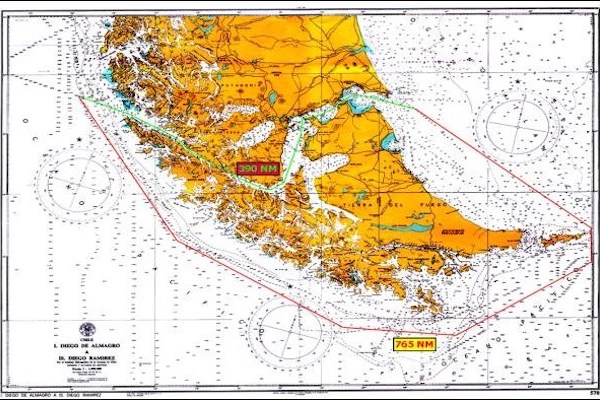
The recent “Defense Policy Directive” from Argentina (July 6, 2021) has raised concerns among sectors of the Chilean public opinion, as it seeks to advance in what it terms “shared spaces” with our country. This primarily involves the Strait of Magellan and, subsequently, the “Sea of Hoces.” The latter refers to the American sector of the Circumpolar Southern Ocean, specifically, the Drake Passage and part of the Cabo de Hornos commune (Puerto Williams). Specifically, these “shared spaces” involve Chilean sovereign territories.
This occurs in the context of Argentina’s analysis of the regional strategic scenario, in which Chile occupies the second priority after Brazil. In this framework, the document highlights the advances of recent decades in collaboration between Foreign Ministries and Defense Ministries, an aspect that, beyond any interpretation, constitutes a common success between both countries. This would be—one can deduce—the area to “share” the Strait of Magellan and the “Sea of Hoces,” including the Cabo de Hornos area, historically claimed by Argentina.
Common sense dictates that, while it is not logical to oppose the deepening of political collaboration with that country, it is also unreasonable to share the administration of national territory.
Some “friends of the bilateral relationship” dislike being reminded that the crisis between 1977 and 1984 originated from Argentina’s rejection of the ruling by five judges of the International Court of Justice, coordinated by the British arbitrator, which confirmed what had been obvious since 1881: that the islands “south of the Beagle Channel” (including Cabo de Hornos) are Chilean. We understand that these “spaces” are part of the “Sea of Hoces.”
They also dislike being reminded that, prior to that, in 1881, while Chile was dealing with Peru and Bolivia, Argentina hastily pushed through a boundary treaty whereby, in exchange for our unilateral renunciation of Eastern Patagonia and half of Tierra del Fuego, it recognized something historically and legally obvious: that the integrity of the Strait of Magellan has always been Chilean.
Regarding the “Sea of Hoces,” in 2009, the then-government of Cristina Fernández (now Vice President) altered the modus vivendi established by the Treaty of Peace and Friendship of 1984 (TPA) by claiming approximately 9,000 square kilometers of continental shelf over which, according to International Law of the Sea, Chilean rights preexist. Thus, south of Cabo de Hornos, Argentina unilaterally imposed a new limit on Chile. Very serious, very complex.
We must also remember that, during the crisis over the “islands south of the Beagle Channel” and the negotiations of the United Nations Convention on the Law of the Sea, Argentina attempted, unilaterally and unsuccessfully, to declare itself a “coastal state of the Strait of Magellan.”
Nevertheless, the TPA of 1984 included a clause that, in favor of Argentina, modified the original design of the Eastern Mouth of the Strait by establishing that it begins at the line connecting Punta Dúngenes with Cabo Espíritu Santo in Tierra del Fuego.
This was also part of the “price of peace” paid by Chile to a neighbor that, in addition to repeatedly resorting to the threat of the use of force (an act sanctioned under the United Nations Charter), on December 22, 1978, prior to the papal announcement, had already begun deploying forces toward the territory it now seeks to “share.” A fact of the matter.
Indeed, under the guise of deepening contacts between ministries, the Argentine Directive from earlier this month reveals how that country is once again attempting, nothing more and nothing less, than the “joint exploration, study, and control of the Strait of Magellan.” Absurd. One cannot declare a “shared space” an area of foreign territory over which sovereignty is not exercised.
In this context, what remains to be done is, for example, for Argentina to respect the international character of the Strait of Magellan, and to lift the restrictions it unilaterally imposes on vessels coming from the Falkland/Malvinas Islands that are heading toward the strait.
In the case of the “Sea of Hoces,” Chile must, without further delay, clarify the outer limits of its projected extended continental shelf from the islands of Cabo de Hornos and Diego Ramírez.
In accordance with International Law, we must assert our sovereign rights over valuable underwater territories, which are already attracting material interest not only from Argentina but also from other countries.
Only once this is firmly established will it be possible to determine in which areas cooperation with Argentina is feasible.