Southern Blow: Update of Maritime Boundaries in Magallanes and Antarctica Undermines Argentine Claims
This article was translated automatically and may contain differences from the original. For reference, read the original.
- by Jorge Guzmán
- Opinion
El Mostrador, August 27, 2021
The “update” of the southern maritime boundaries is a response grounded in International Law and geo-scientific applications to the Argentine claim of sovereignty over land, subsoil, and benthic ecosystems covering several thousand square kilometers that, according to Article 77 of the United Nations Convention on the Law of the Sea, are part of the Magallanes and Chilean Antarctica Region. From the Argentine perspective, the Decree and the Chilean Map of 2021 represent a structural setback for the geopolitical claims that Argentina has been attempting to establish in that region of the world since the early 20th century.
The “update” of the southern maritime boundaries is a response grounded in International Law and geo-scientific applications to the Argentine claim of sovereignty over land, subsoil, and benthic ecosystems covering several thousand square kilometers that, according to Article 77 of the United Nations Convention on the Law of the Sea, are part of the Magallanes and Chilean Antarctica Region. From the Argentine perspective, the Decree and the Chilean Map of 2021 represent a structural setback for the geopolitical claims that Argentina has been attempting to establish in that region of the world since the early 20th century.
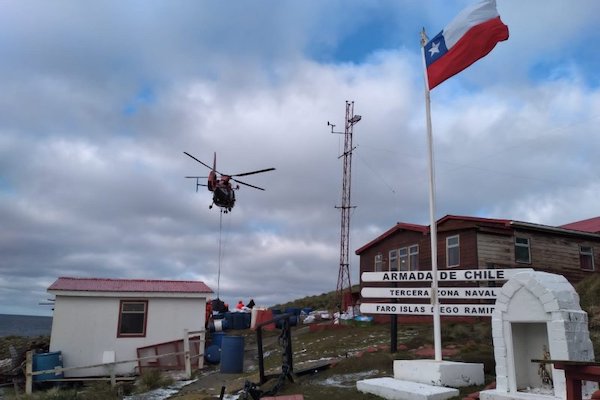
At the initiative of the Ministry of Foreign Affairs, the Ministry of Defense, and the National Navy, through a Decree aligned with the regulations of International Maritime Law, on August 23, 2021, the Government has updated the national maritime sovereignty areas of the Southern Zone. Among these areas is the update of the projection of the continental shelf of the Diego Ramírez Islands, extending to and beyond the meridian of Cape Horn.
Long awaited, this “update” should also be understood as a response grounded in International Law and geo-scientific applications to the Argentine claim that, since April 2009, asserts sovereignty over land, subsoil, and benthic ecosystems covering several thousand square kilometers that, according to Article 77 of the United Nations Convention on the Law of the Sea, are part of the Magallanes and Chilean Antarctica Region.
In this same context, the new Chilean Decree should be understood as a legal and diplomatic response to a recent Argentine Senate law that has sanctioned the 2009 claim, despite the fact that, at least since May 2020, Chile has detailed through diplomatic channels the legal and geopolitical impropriety of such a measure.
On this latter issue, the public is already familiar with the extensive claim of submarine territories presented in April 2009 by the government of Cristina Fernández de Kirchner to an international body in New York. This claim, along with the South Atlantic archipelagos administered by the United Kingdom, includes a core part of the Chilean Antarctica and, additionally, a “crescent” of approximately 9,000 square kilometers of land, subsoil, and Chilean benthic resources located within the legal projection of our Diego Ramírez Islands. This is because, although the Treaty of Peace and Friendship of 1984 imposes a restriction on the projection of our Exclusive Economic Zone, this limitation does not apply to our continental shelf (as defined in the Law of the Sea).
Evidence indicates that, although from the outset the Argentine government was aware that this claim over Chilean territories would, sooner or later, have a negative and direct impact on bilateral relations with Chile, it nonetheless decided to proceed. For this reason, we understand that Argentina was willing from the beginning to face the consequences of its unilateral action on the overall bilateral relationship with our country.
Until May 2020, the Argentine claim benefited from a contemplative attitude of Chilean diplomacy, which, content to assert that the Argentine territorial claim had “no importance” for our country, preferred to ignore that, while in strict legal terms this is indeed the case, in geopolitical and political terms our neighbors take for granted that “the United Nations” has validated their claim over those Chilean submarine territories.
At the beginning of the month, our Ministry of Foreign Affairs delivered a note to the Argentine government in which, in a firm tone, it reiterated that while the Argentine claim over the Antarctic continental shelf remains in statu quo (the Antarctic Treaty is fully in force), on the other hand, Buenos Aires’ claims over Chilean territories (which the map of the new Decree illustrates to dispel any doubt) have no effect on Chile’s sovereign rights.
While graphically the new official Chilean cartography depicts this reality supported by both International Law and the geological reality of the Circumpolar Southern Sea, it is inevitable that it will provoke a reaction from the neighboring government. Once again: at least since 2009, Argentina has known that this had to be the case.
The geo-legal projection illustrated in the new SHOA Map published in the Official Gazette makes it clear that, from its South American territories, Argentina has no direct projection towards the Southern Sea and Antarctica, and, on the other hand, it makes evident that Chile does have a geographical continuity that, using certain formulas of International Law, should allow for empirical verification of our natural projection to and from the Antarctic mainland.
From the Argentine perspective, the Decree and the Chilean Map of 2021 represent a structural setback for the geopolitical claims that Argentina has been attempting to establish in that region of the world since the early 20th century.
From the Chilean perspective, the political will represented by the Decree of March 23 should be understood as the starting point of an effort that must engage the entire Chilean society to, in accordance with International Law and the applied sciences of the 21st century, verify the geo-legal and geo-strategic concept affirmed by the Antarctic Decree of 1940: Chile is a continuity from its South American spaces to/from its polar spaces; therefore, the Chilean Circumpolar Southern Sea and the Chilean Antarctic Territory are a single unit understood under the political-administrative figure of our Antarctic Province. Good for Chile.
Jorge G. Guzmán and Richard Kouyoumdjian