The Southern Issue and the Next Government
This article was translated automatically and may contain differences from the original. For reference, read the original.
- por Jorge Guzmán
- Columnas
El Mostrador, January 6, 2021
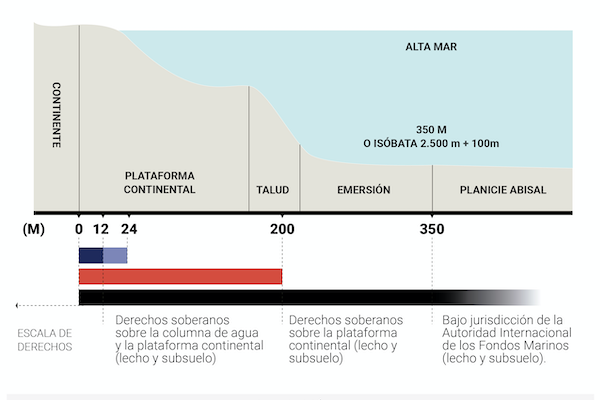
With the support of all political forces, in recent months the current government updated the projection of the continental shelf of the Diego Ramírez Islands and subsequently announced that Chile will submit geoscientific data and mapping of the extended continental shelf in the western sector of the Chilean Antarctic (Bellingshausen Sea and an area of the Chilean sector of the Southern Ocean) to the competent Commission. Therefore, it has become a task for the next government to complete this exercise, specifying the outer limits of our continental shelf in the Weddell Sea sector and, very importantly, the limits beyond 200 nautical miles of the continental shelf of the Diego Ramírez and Barnevelt archipelagos. All in accordance with International Law.

Beyond its “timeliness” or “untimeliness,” the “declassification” carried out by former Defense Minister Mario Desbordes regarding the formal support of the Piñera 2 administration for Argentina’s claim over the Falkland/Malvinas Islands (and, by extension, potentially other southern and polar territories) has brought to the forefront an old and complex issue: the future of coexistence with Argentina in the areas south and southeast of the so-called ‘Point F’ of the 1984 Treaty of Peace and Friendship, including American Antarctica.
It involves –literally– millions of square kilometers of maritime and Antarctic territories, with their respective living and non-living natural resources.
To abstract from this simple and concrete material reality in the name of any ideology or “solidarity sentiment” can only harm Chile’s permanent interest. The next government should avoid that temptation, especially considering that the next President of the Republic is of Magallanes origin.
With the support of all political forces, in recent months the current government updated the projection of the continental shelf of the Diego Ramírez Islands and subsequently announced that Chile will submit geoscientific data and mapping of the extended continental shelf in the western sector of the Chilean Antarctic (Bellingshausen Sea and an area of the Chilean sector of the Southern Ocean).
Therefore, it has become a task for the next government to complete this exercise, specifying the outer limits of our continental shelf in the Weddell Sea sector and, very importantly, the limits beyond 200 nautical miles of the continental shelf of the Diego Ramírez and Barnevelt archipelagos. All in accordance with International Law.
Unlike the exercise for the Chilean Antarctic (which, while the Antarctic Treaty is in force, will not be reviewed by the competent body), as has already been established, the projection of the continental shelf of Diego Ramírez has formalized a new territorial dispute with Argentina. This occurs because, in 2009, the Argentine claim of continental shelf in the South Atlantic and Antarctica included an area of the Southern Ocean located beyond the limit agreed upon in the Treaty of Peace and Friendship. Chile is not the one that has generated this new dispute.
The closeness that –we understand– exists between circles of the next President and circles of the current Argentine government should serve to channel this matter. This, however, keeping in mind that the defense of Chilean interests in the Southern Ocean and Antarctica is much, much more than “a matter for the Navy.”
For this purpose, the next government may draw inspiration from the doctrine applied in the Beagle Channel dispute by the government of President Salvador Allende. This doctrine was successful as long as it remained faithful to the tradition encapsulated in the Antarctic Decree of the government of President Pedro Aguirre Cerda.
The matter is, of course, complex, as Argentine claims in the South Atlantic, the Southern Ocean, and Antarctica –though cloaked in anti-colonialism and Americanism– obey a geopolitical concept characteristic of a 19th-century imperial project.
Chile must avoid being instrumentalized for that project, now reformulated from a maximalist interpretation of certain scientific-technical formulas of the United Nations Convention on the Law of the Sea. Failing to do so could have serious consequences not only for national interest but also for peace and security in the American South.
The elected President himself knows that, at least in Magallanes, this is a concern and matters across the board.
Jorge Guzmán
Associate Researcher, AthenaLab