Failures in disaster prevention and management: a national security issue
This article was translated automatically and may contain differences from the original. For reference, read the original.
El Líbero, August 7, 2024
Understanding that Enel deserves a significant penalty for its mistakes, and that municipalities, the regional government, central authorities, Senapred, and the SEC are not free from blame and responsibility in disaster prevention and management, it is incomprehensible that the Boric government has not declared a state of catastrophe in the Metropolitan Region.
The widespread power outage that affected the Metropolitan Region (RM) and much of central-southern Chile is a clear example that despite all the experience we have as a country in managing disasters, the absence of an integrated national system in this area capable of ensuring effective prevention and adequate disaster management is something we should work on, and we owe it to the millions who were without electricity for extended periods, with the significant impacts that entails.
It was expected that when Law 21.364 was enacted on July 27, 2021, which creates theNational System for Disaster Prevention and Response (Sinapred), and as part of it the National Disaster Prevention and Response Service (Senapred), which was to replace the old Onemi, we would be able to be effective in disaster prevention and management, which, obviously, three years after its enactment, has not yet occurred, as evidenced by the lack of foresight and the management of the Viña del Mar fires, as well as the extended power outage experienced in much of Chile. Without much thought, the government and mayors declared Enel the scapegoat, and to a lesser extent GCE, directing their anger and that of the affected public towards them, allowing for a villain to be blamed for what happened, and in no case assuming, if there were any, their own responsibilities in these matters, almost to the point of being mere spectators. It is clear that Enel and GCE are responsible for electricity distribution in the RM, that both companies bear the most responsibility for the extended power outage, and that particularly in the case of Enel, their communication management and customer service leave much to be desired, demonstrating that they were unprepared or untrained to deal with a crisis of such magnitude, raising doubts about their ability to manage operational risks.It is very likely that this electrical crisis could have been avoided or at least mitigated if the preventive measures had operated correctly.
Therefore, I refer to the understanding that the electrical distribution network qualifies as critical infrastructure; it would have been expected that Senapred would have inspected the metropolitan network, as well as those in the regions, and that as a result of those reviews, the vulnerability of the infrastructure would have been made clear, as well as the lack of capacity of the operators both in prevention and in recovering capabilities, including crisis management and communication.
A similar expectation applies to the
Superintendency of Electricity and Fuels (SEC), the regulator and supervisor of electricity companies, which is further aggravated by its role in defining the technical and operational characteristics of distributors, which, being monopolies, operate under the definition of model companies, models that obviously include operational aspects such as clearing power lines, tree trimming, and the capacity to manage contingencies.
I would also have expected that the municipalities,which are now so dedicated to accusing Enel, would have conducted their own risk assessments, demanding that Senapred, the SEC, and the electricity companies take the necessary actions to prevent or minimize damage to the critical infrastructure of their municipalities, sometimes leaving the impression that they act only when it suits them.
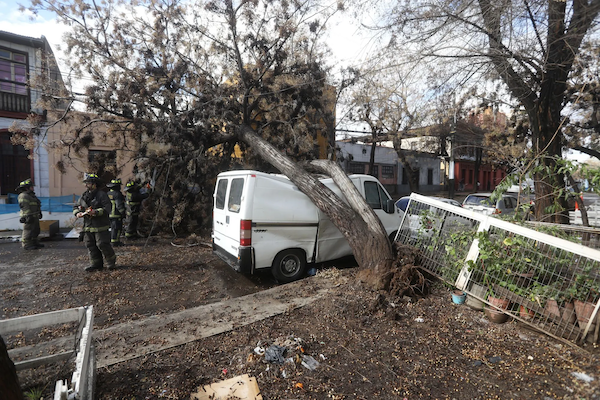
Many of us thought that wind would not be an issue. It is worth recalling what the news reports said days before, or the statements from Senapred on Tuesday, July 30,which did not mention significant problems in Santiago, only indicating that there would be about 34mm of rainfall, leaving meteorologists lacking in their preventive function. Only applications like
meteoblue showed what was coming our way.The storm that brought wind and rain was due to a very low-pressure area settling over central-southern continental Chile, resulting in winds that exceeded anything we have seen before in Chile, causing destruction wherever it passed, but generating more noise in Santiago than in the regions, which are more accustomed to harsh weather, are more resilient, and have greater recovery capacities than those demonstrated in the capital. Understanding that Enel deserves a significant penalty for its mistakes, and that municipalities, the regional government, central authorities, Senapred, and the SEC are not free from blame and responsibility in disaster prevention and management, it is incomprehensible that the Boric government has not declared a state of catastrophe in the RM, something they could have easily done once the level of damage caused was known, which far exceeded the recovery capacities of Enel and the municipal and regional resources employed for situations like these.
Declaring a state of catastrophe would have allowed the RM to be placed under the command of the general commander of the Santiago military garrison and to employ the military capabilities available in Santiago for security purposes and support to the affected population, as has been done with other natural disasters and, in particular, with the Viña del Mar fires.
Again, without absolving the electricity distributors of their faults and responsibilities,the reality experienced in Santiago since Friday clearly qualified as a catastrophe,
especially when we add what is not visible, the catastrophic absence of electricity in an increasingly electricity-dependent world, something that
Vivianne Blanlot indicates in her column in El Mercurio on Sunday, August 4.Surely many would have appreciated military security on nights without street lighting, in what is already a dangerous Santiago, where not all traffic lights were functioning, where the absence of electricity also meant that almost nothing was operational, and where the presence of military institutions would have helped distribute food, water, generators, medicine, and other vital supplies. It is hard to understand that a state like Chile, failing in prevention, also fails to deploy all its capabilities to support the recovery of normalcy in the RM, and that it only dedicates itself, along with the political world, to declaring Enel the public enemy number one, the scapegoat responsible for all ills, thereby diverting blame and responsibilities from those involved in the disaster prevention and response system, and more worryingly, demonstrating in the past that they do not favor anything private over public. I hope we do not have to experience new contingencies where both prevention and recovery fail, as the impact is directly suffered by Chileans, particularly the poorest, the elderly, and the most vulnerable, in what is clearly a catastrophic failure of national security, because that is what it is,
a national security issue.
Richard Kouyoumdjian
Vice President of AthenaLab Source:
El Líbero.