INTERVIEW | What are the types of nuclear weapons, how are they launched, and which are the most powerful today?
This article was translated automatically and may contain differences from the original. For reference, read the original.
- por Marcelo Masalleras
- Entrevistas
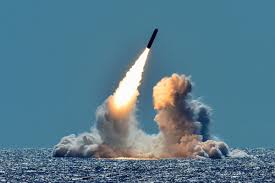
Here is a guide with the main classifications. From how they are detonated to the distances they can cover and their destructive capacity.
There are different types of nuclear weapons that have different characteristics..
Some nuclear-capable missiles can be launched from land silos, while others can be launched from aircraft or submarines located in strategic positions.
Some are designed to travel distances of several hundred kilometers.
However, there are also examples built to travel thousands of kilometers, with the aim of reaching other continents.
There are multiple elements to consider when analyzing a nuclear weapon, including factors such as the number of warheads they can carry and their potential destructive capacity.
Additionally, it should be noted that there are nuclear-capable missiles that can be loaded with conventional explosives and not necessarily with nuclear material.
But before delving into specific details about missiles, we will review some more general concepts about nuclear weapons.
Later in this article, you will also find information about the countries that possess this type of armament and which are the most powerful pieces currently.
Before we delve into those points, it is necessary to identify how nuclear weapons can be detonated.
How nuclear weapons are detonated
The researcher from AthenaLab and former officer of the Chilean Army, Marcelo Masalleras, explains to La Tercera that, in general terms, there are two ways to produce a chain reaction.
This is where the following main divisions appear: fission bombs and fusion bombs.
What are fission bombs?
The former officer explains that fission bombs “are those in which, normally, a core of uranium or plutonium is bombarded, causing the atoms to split”.
“The splitting of atoms releases other particles, generally neutrons, and that generates the chain reaction. So, what happens is a release of energy due to how the atoms are fractioned.”
Masalleras specifies that the first nuclear bombs developed were fission bombs.
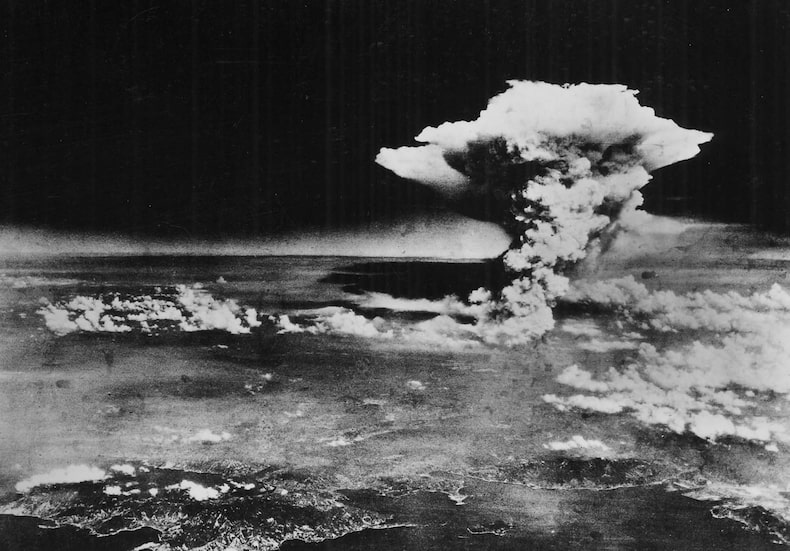
For reference, the bombs Little Boy and Fat Man that the United States dropped on Hiroshima and Nagasaki (Japan) in August 1945 were fission bombs.
The first was uranium-based, while the second was plutonium-based.
What are fusion bombs?
Fusion bombs differ from the previous ones in that “here the release of energy is due to the fusion of atoms, usually hydrogen”, states the expert.
These have greater power than fission bombs and require extremely high temperatures to trigger their destructive effects.
“Typically, the detonator of a fusion bomb is a fission bomb. In other words, a hydrogen bomb is detonated with a small nuclear bomb, but nuclear nonetheless,” adds Masalleras.
Due to their characteristics, fusion bombs are also known as hydrogen bombs.
“There are other derivatives that are not strictly nuclear bombs, such as neutron bombs or dirty bombs, but we are not talking about the same thing here.”
According to the researcher, a key premise of nuclear bombs is “the ability to generate a large amount of energy with a single device”.
How nuclear weapons are classified by their power
A second aspect to consider regarding nuclear weapons is their power and the ways they can be handled.
Here there are two main divisions: tactical nuclear weapons and strategic nuclear weapons.
What are tactical nuclear weapons?
Tactical nuclear weapons are those designed for use in a limited attack or battlefield.In turn,
they have a lower capacity for destruction , compared to strategic ones.The largest tactical nuclear weapons
reach up to 100 kilotons. Kilotons are a
unit of measurement referring to the amount of energy released by an explosive. One kiloton is equivalent to the energy released by the explosion of 1,000 tons of TNT
.For reference, the bomb
Little Boy dropped on Hiroshima on August 6, 1945 had a power of 15 kilotons .The
Fat Man dropped on Nagasaki on August 9 of the same year was 21 kilotons .This positions both
within the classification of tactical nuclear weapons .Tactical nuclear weapons
are also known as “non-strategic” .What are strategic nuclear weapons?
Strategic nuclear weapons
have greater power compared to tactical ones , thus also having a greater destructive capability.However,
in practice, the differentiation between the two terms has been questioned by various specialists and international leaders. During a hearing in the United States Congress in 2018, then-Secretary of Defense James Mattis stated:
“I don’t believe there is such a thing as a ‘tactical nuclear weapon'” .“Any nuclear weapon used at any time is a strategic game changer”
, he added during the session, according to statements reported byCNN .The researcher from AthenaLab tells
La Tercera in a similar vein that “no matter how small a nuclear bomb is, no matter how tactical it is, it will always have strategic repercussions” .“Regardless of whether you have a bomb with a more limited effect than others,
it is still a nuclear device, with great destructive power and having strategic repercussions in the international community.” “The effect of using a nuclear bomb
will extend far beyond the location where it detonates ,” adds the former officer.Russian Missile
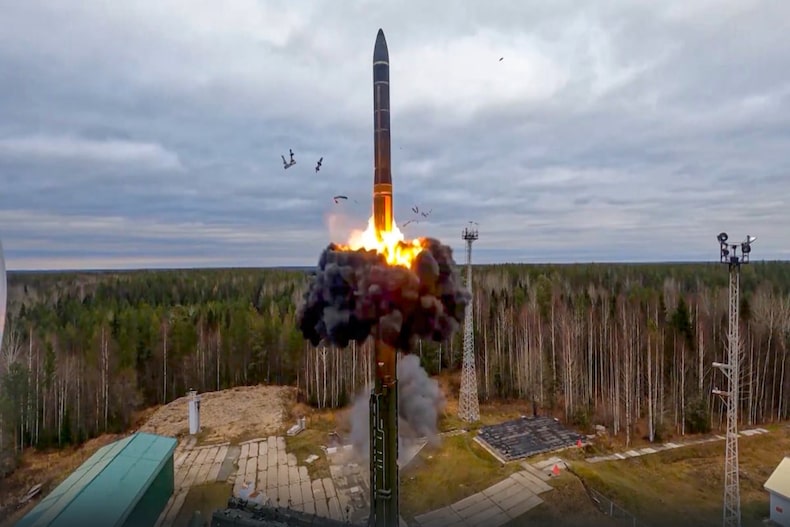
Nuclear weapons can be launched through
three distinct main avenues .The first is through land-based missiles
, which can launch from silos or mobile platforms.The second is through aircraft
, which launch projectiles from the air.The third is through submarines
with nuclear capability. If a country with nuclear weapons has the ability to use them
through all three means, it is said to possess a “nuclear triad” .“
The issue is not limited to a country having the capacity to builda nuclear weapon. That is only half of it. The other half is having the capability to project that nuclear weapon elsewhere,” comments Masalleras. How missiles are classified by the distance they can cover
Projectiles, regardless of whether they have nuclear capability,
can be classified according to the distance they can reach their targets .There are short-range ballistic missiles (SRBM), which can travel between 500 and 1,000 kilometers
. Then there are medium-range missiles (MRBM), which can travel between 1,000 and 3,000 kilometers.
Next are intermediate-range missiles (IRBM), which can cover distances between 3,000 and 5,500 kilometers .The ballistic missiles that can reach
the farthest are intercontinental ballistic missiles (ICBM) .As the name suggests, these can travel from one continent to another, with
a range of over 5,500 kilometers .Can nuclear-capable missiles carry multiple warheads?
An individual ballistic missile can carry multiple warheads through what is known as a multiple independently targetable reentry vehicle (MIRV). This type of payload makes itmore difficult for a missile defense system to intercept incoming threats
that approach.
“The missile, typically intercontinental, flies on a ballistic trajectory. It exits the troposphere, goes to a suborbital distance. When it re-enters,it deploys small vehicles or vectors that can be distributed across different targets
. They can be quite far apart from each other,” details the AthenaLab researcher. MIRVs do not necessarily have to carry nuclear warheads , as there are also examples that can operate with conventional explosives.
The doctoral researcher in the Oslo Nuclear Project (ONP), Fabian Hoffmann, previously explained to La Tercerathat
“basically it is a technology that comes from nuclear missile technology and allows individual missile systems to carry more than one warhead”.
“This can be very useful in the context of nuclear strategy, because if you have a missile and can carry multiple warheads, that means that with one missile you can destroy several cities or multiple military targets, or you can carry a bunch of real warheads and a bunch of decoy warheads , making it much harder to intercept them all, because you can confuse the enemy.” 13,000 kilometers per hour and intermediate range: what is the new Russian missile, Oreshnik, that threatens the West?What are the types of nuclear weapons, how are they launched, and which are the most powerful today?
Which countries have nuclear weapons? Estimates from theFederation of American Scientists
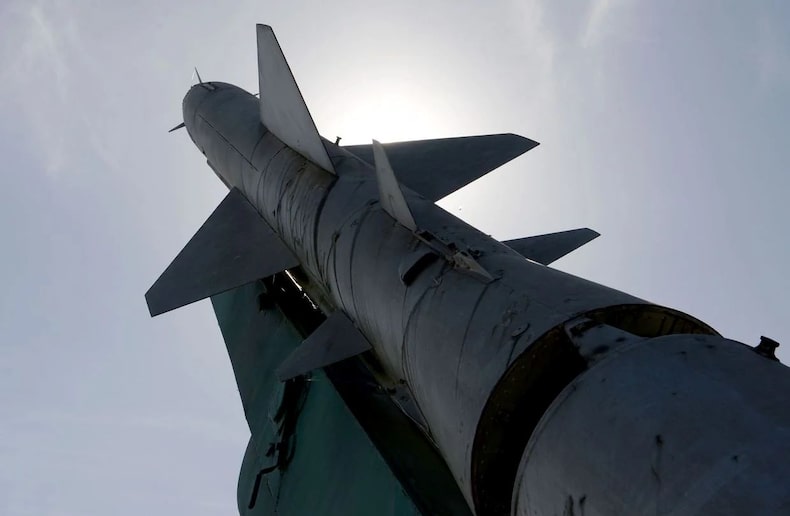
, of which about 1,710 are deployed or ready for use.
The United States, for its part, has about 3,708 operational warheads , of which 1,670 would be strategically deployed. In total, China has about 500 warheads, France around 290, the United Kingdom about 225, India around 172, Pakistan around 170, and North Korea about 50.
According to FAS analysis,Israel would have approximately 90 nuclear warheads
, although this has never been officially confirmed by Israeli authorities and they have remained rather reticent on this point.FAS estimates reflect that
Russia is the country with the largest number of nuclear warheads and that NATO member countries together reach a number similar to that of the Kremlin.The second power with the most warheads is the United States
. However, Dr. in International Studies and retired army officer, Hugo Harvey, specifies that there are substantial differences in the procedures
that the presidents of the United States and Russia must follow to decide on the use of a nuclear weapon. The also academic from the University of Las Américas states that President Vladimir Putin, “due to his characteristics and those of the Russian political system, has no checks and balances”
.“For example,
in the United States, if the president wants to carry out a nuclear attack or launch an atomic bomb, he must go through a series of approvals .” “In contrast,
in Russia, the president can do it alone .”Harvey adds that
the updates that Putin made to the nuclear doctrineof his country facilitate that decision-making power
. The nuclear doctrine is the document that establishesthe conditions under which he would consider the use of nuclear weapons
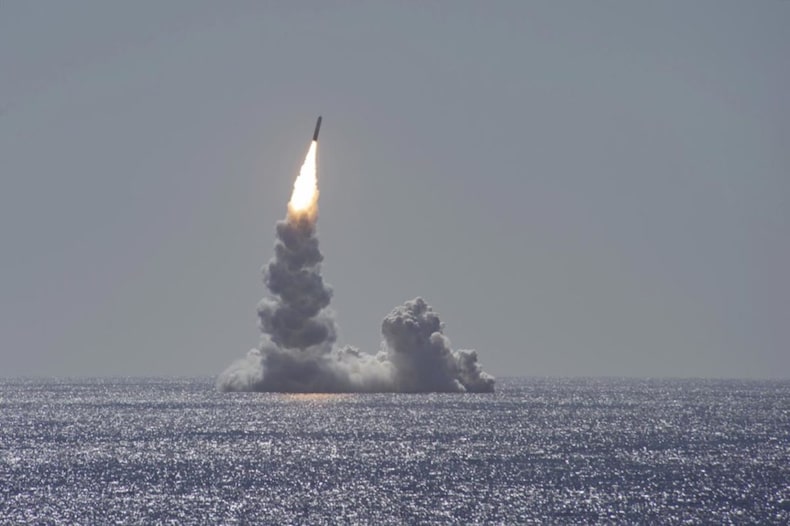
. What are the 4 most powerful nuclear weapons in the world today? Among the most powerful nuclear weapons today are the Trident II missile possessed by the United States and the United Kingdom, and the DF-5C possessed by China.
Also included are the R-36 and RS-28 Sarmat projectiles, both from Russia .What is the nuclear missile Trident II possessed by the United States and the United Kingdom?
The
Missile Defense Project of theCenter for Strategic and International Studies
(CSIS) describes the UGM-133 Trident II D5, which is manufactured in the United States, as“a three-stage intercontinental ballistic missile, powered by solid fuel and launched from submarines”
.
“It is deployed by both the United States and the United Kingdom on their respective Ohio and Vanguard-class nuclear submarines” . The Trident D5 or Trident II, as it is also called, has a maximum range of 12,000 kilometers and can carry a payload of up to 2,800 kilograms. “Its payload carries a post-boost vehicle (PBV) that can transportup to 12 reentry vehicles (RV), although the
NEW STARTtreaty limits the number to eight.”
These reentry vehicles can contain the W76 warhead of 100 kilotons or the W88 of 475 kilotons , details CSIS.
For reference, the latter has a power approximately 31 times greater than the bomb Little Boy that was dropped on Hiroshima in 1945, which was 15 kilotons.
“This firepower makes the Trident D5 the first U.S. submarine-based missile capable of destroying hardened targets,” states the Washington-based expert group.
The missile is 13.42 meters long, 2.11 meters in diameter and weighs about 59,090 kilograms at launch. What are the types of nuclear weapons, how are they launched, and which are the most powerful today?What are the types of nuclear weapons, how are they launched, and which are the most powerful today?
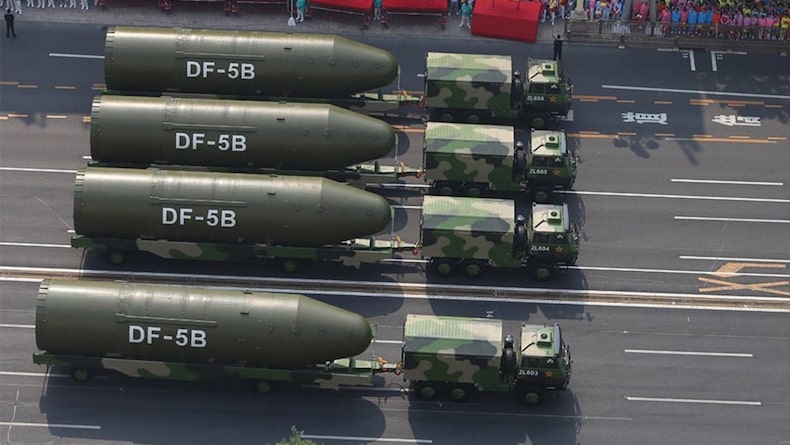
What is the nuclear missile DF-5C from China? The DF-5, also known as Dong Feng-5 or CSS-4,is an ICBM launched from silos.
It was the first intercontinental ballistic missile developed by China and has the longest range of all the projectiles currently in the giant’s arsenal. There are different variants, such as the DF-5A, DF-5B, and the most recent DF-5C.
, while the previous version could deploy three warheads and the first a single warhead, according to CSIS.
The range of the DF-5 is about 12,000 to 13,000 kilometers , while it can carry a payload of approximately 3,000 to 4,000 kilograms.Its length is about 32.6 meters
and its diameter is about 3.35 meters. The launch weight of the missile is 183,000 kilograms and it uses a two-stage liquid-fueled engine.
Its characteristics allow for thepossibility of launching large nuclear payloads across the United States and Western Europe
. The power of the DF-5 is between 1 and 3 megatons, according to the Washington-based expert group.
Megatons are aunit of measurement referring to the amount of energy released
by an explosive. One megaton is equivalent to the energy released by the explosion of one million tons of TNT
. What are the types of nuclear weapons, how are they launched, and which are the most powerful today?What are the types of nuclear weapons, how are they launched, and which are the most powerful today?
What is the nuclear missile R-36 from Russia? CSIS describes the R-36, also known as SS-18 Satan or R-36M, as“a liquid-fueled intercontinental ballistic missile based in silos”
, which was initially developed by the Soviet Union.It is a key piece of Russia’s arsenal and, it is presumed,
there have been about six versions since the program began. Currently, only the Mod 6 version remains operationally deployed.
This has arange of 11,000 kilometers
750 kilotons is equivalent to
about 50 times the power of the bomb dropped on Hiroshima in 1945.According to CSIS,
the R-36 Mod 6 uses two levels in its instrument section to house that ten.“Both the Mod 5 and Mod 6 received
enhanced protection against the effects of nuclear warheads, improved decoys and penetration aids, greater MIRV coverage and rapid re-targeting capability.”These missiles are expected to remain
in service until their successor, the RS-28 Sarmat, becomes operational .What are the types of nuclear weapons, how are they launched, and which are the most powerful today?
What are the types of nuclear weapons, how are they launched, and which are the most powerful today?What is the nuclear missile RS-28 Sarmat from Russia?
The RS-28 Sarmat from Russia, also known as SS-X-30 Satan II, is a three-stage liquid-fueled ICBM that is currently under development and aims to replace the R-36.
The program began in the 2000s, while according to CSIS, the first prototype was completed in late 2015 .
However, deficiencies in its operation have been reported over the years
, leading to several of its tests being canceled or delayed. Initially,the Kremlin planned for it to enter service in 2018
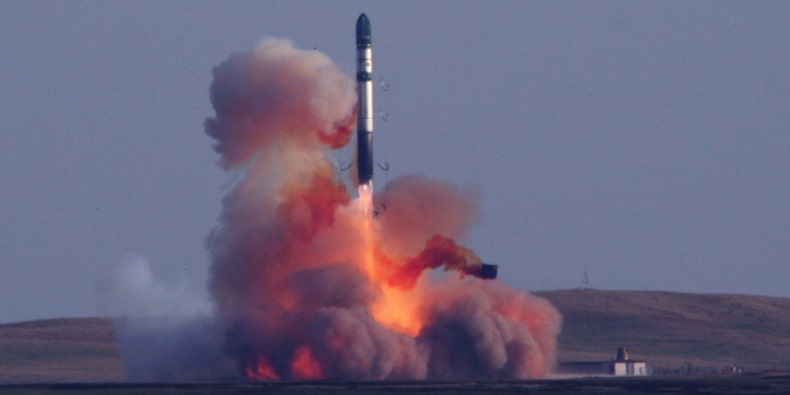
in March and May of that year, “were apparently successful”
. Subsequently, it was confirmed that on April 20, 2022, it had a successful flight test.
The Sarmat has a range of between 10,000 and 18,000 kilometers , while its length is 35.3 meters and its diameter is 3 meters.Its launch weight is 208,100 kilograms and it can carry a payload of 10,000 kilograms.
Russian state media claim that it can transport 10 large nuclear warheads or 16 smaller ones with independent targets , as well as hypersonic glide vehicles like Avangard. No further details have been shared about the power of the nuclear warheads it can carry, althoughfrom Russia, it has been anticipated that it would be their most powerful nuclear weapon
.