COLUMN | Taiwan, Global Security at Risk
This article was translated automatically and may contain differences from the original. For reference, read the original.
- by Juan Pablo Toro
- Opinion
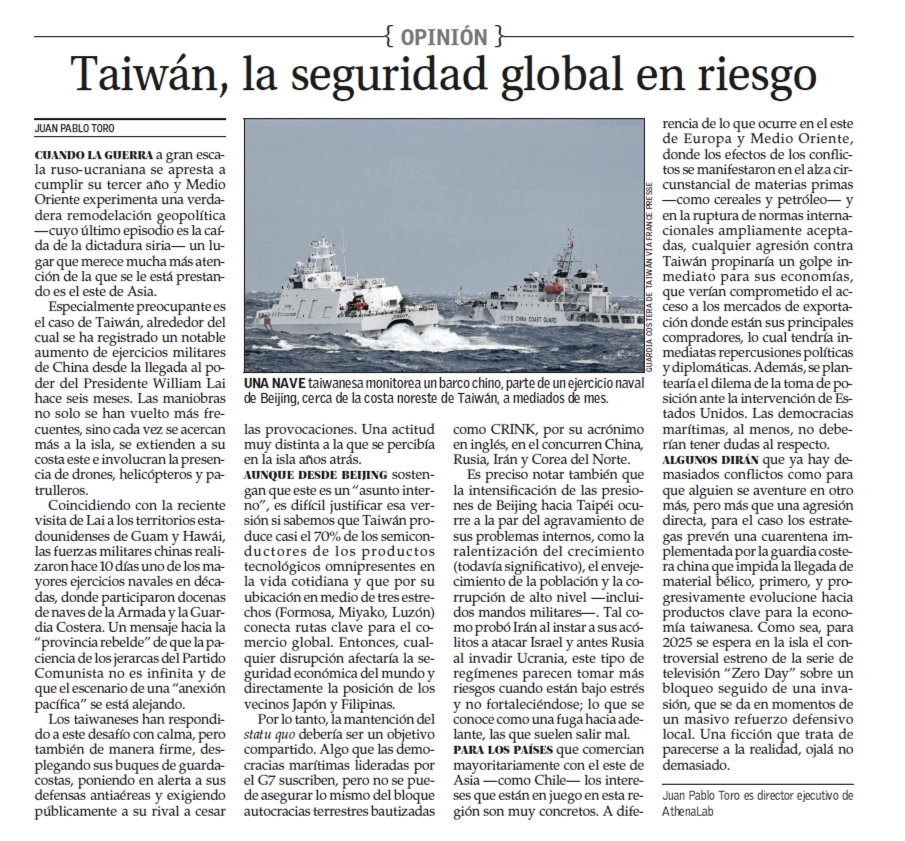
Una nave taiwanesa monitorea un barco chino, parte de un ejercicio naval de Beijing, cerca de la costa noreste de Taiwán, a mediados de mes. Guardia Costera de Taiwán vía France Presse .
As the war in Ukraine approaches its third year and the Middle East undergoes a significant geopolitical reshaping —the latest episode being the fall of the Syrian dictatorship— a region that deserves much more attention than it is currently receiving is East Asia.
Particularly concerning is the case of Taiwan, around which there has been a notable increase in military exercises by China since President William Lai took office six months ago. The maneuvers have not only become more frequent but are also increasingly close to the island, extending to its eastern coast and involving the presence of drones, helicopters, and patrol vessels.
Coinciding with Lai’s recent visit to the U.S. territories of Guam and Hawaii, Chinese military forces conducted one of the largest naval exercises in decades just ten days ago, involving dozens of ships from the Navy and Coast Guard. This sends a message to the ‘rebel province’ that the patience of the Communist Party leaders is not infinite and that the scenario of a ‘peaceful annexation’ is receding.
Taiwanese have responded to this challenge calmly but firmly, deploying their coast guard vessels, putting their air defenses on alert, and publicly demanding that their rival cease provocations. This attitude is very different from what was perceived on the island years ago.
Although from Beijing they maintain that this is an ‘internal matter,’ it is difficult to justify this version when we know that Taiwan produces nearly 70% of the semiconductors for the ubiquitous technological products in daily life and that its location among three straits (Formosa, Miyako, Luzon) connects key routes for global trade. Therefore, any disruption would affect the economic security of the world and directly impact the positions of neighboring Japan and the Philippines.
Thus, maintaining the status quo should be a shared objective. This is something that maritime democracies led by the G7 endorse, but the same cannot be assured for the block of land autocracies known as CRINK, which includes China, Russia, Iran, and North Korea.
It is also important to note that the intensification of Beijing’s pressures on Taipei occurs alongside the worsening of its internal problems, such as slowing growth (still significant), an aging population, and high-level corruption —including military leadership. Just as Iran demonstrated by urging its followers to attack Israel and previously Russia by invading Ukraine, such regimes seem to take greater risks when under stress rather than strengthening; a phenomenon known as a forward escape, which often ends poorly.
For countries that primarily trade with East Asia —like Chile— the stakes in this region are very concrete. Unlike what occurs in Eastern Europe and the Middle East, where the effects of conflicts manifested in the temporary rise of commodities —such as grains and oil— and the breaking of widely accepted international norms, any aggression against Taiwan would deliver an immediate blow to their economies, which would see compromised access to export markets where their main buyers are located, leading to immediate political and diplomatic repercussions. Additionally, the dilemma of positioning in response to U.S. intervention would arise. Maritime democracies, at least, should have no doubts about this.
Some may argue that there are already too many conflicts for anyone to venture into another, but more than a direct aggression, strategists foresee a quarantine implemented by the Chinese coast guard that would prevent the arrival of military supplies initially, and progressively evolve to include key products for the Taiwanese economy. In any case, by 2025, the island anticipates the controversial premiere of the television series ‘Zero Day’ about a blockade followed by an invasion, coinciding with a massive local defensive reinforcement. A fiction that tries to resemble reality, hopefully not too closely.
Juan Pablo Toro is the Executive Director of AthenaLab