COLUMN | Why Naval Construction in Chile?
This article was translated automatically and may contain differences from the original. For reference, read the original.
- por Richard Kouyoumdjian
- Columnas
Chile has a strong business case that justifies having a well-equipped Navy with good ships. We are a country with an extensive exclusive economic zone, with tricontinental interests, and we depend on foreign trade for our survival.
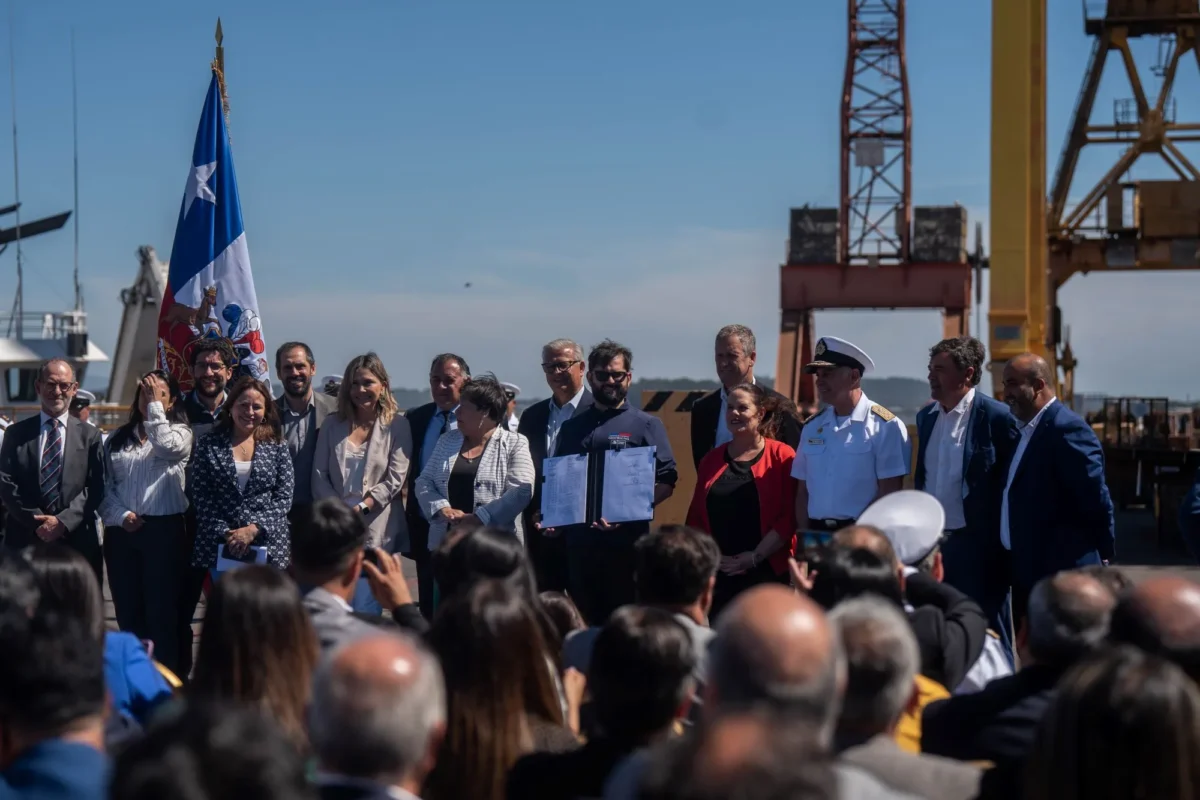
On Friday, January 10, 2025, the President Boric signed at the ASMAR Talcahuano plant the “National Continuous Naval Construction Policy”, transforming what was until recently essentially a Navy plan into a national policy on the matter, which implies significant support for naval construction throughout Chile, as this policy is not limited to ASMAR’s activities but includes all national naval construction.
That said, being a policy does not mean it has guaranteed funding, which in the case of the Navy is provided by the law on financing strategic capabilities, which replaced the previously called copper law. It does imply that it has the support of the current government, running the risk of losing importance if the next administration is not interested in the matter.
These policy documents, also known as “policy papers,” are common in important national strategic matters, such as ocean policy, Antarctic policy, and defense policy, with some having a greater impact, such as defense or Antarctic policy, and others that were introduced at an inopportune time, such as ocean policy, which, despite being very good, was published on the last day of Bachelet’s second term, not receiving the expected support from Sebastián Piñera’s second administration, which did not implement ocean governance and control of what various ministries and state services were supposed to do, something that Boric’s government also did not pursue.
Nothing guarantees the success of the naval construction policy, but it has something in its favor: the Navy needs ships for its combat, logistical support, and maritime service purposes, seeking for this policy to ensure that the main part of naval needs is met locally in national shipyards.
To provide a sense of scale, the Navy needs to maintain its core current capabilities , which include approximately 8 frigates, 4 submarines, 2 fleet oilers, 4 amphibious multipurpose ships, 4 or more offshore patrol vessels (OPVs), and others such as tugs, icebreakers, oceanographic vessels, patrol boats, and patrol craft, among others. This, in addition to the naval and marine infantry assets required.
The most recent deliveries from ASMAR include the icebreaker Viel, the oceanographic vessel Cabo de Hornos, and the OPV-type ocean patrol vessels, which is complemented by a long history in the field, and also adds to the beautiful ships built by ASENAV in Valdivia, along with the work done by smaller shipyards located in the north and south of the country, and the capabilities that these same shipyards provide in terms of repairs, upgrades, maintenance, and dry-docking of national and foreign vessels, whether commercial or naval, including complex platforms such as submarines and units of the national fleet.
Currently, ASMAR is focused on constructing two amphibious multipurpose vessels that are part of the project “Escotillón IV”, which later considers two more, but which have not yet been authorized, thus replacing the Aquiles, the Aldea, and the two Batral-type barges currently in use, all for a cost of just under US$1 billion. This will keep ASMAR occupied for at least another four years, and where ASENAV also plays an important role in the project’s development, as well as multiple local suppliers that ensure approximately 50% of the cost remains in Chile, along with the consequent labor that this entails.
The Navy’s idea, which is not necessarily shared by all specialists, is to locally construct the 8 frigates that would replace the current ones in use, with each estimated to cost US$400 million, and perhaps also the replacement of the submarines.
I say not shared because some argue that frigates and submarines should either be built abroad or acquired second-hand, with the arguments being the cost of new combat units that would push for used units in good condition, and secondly, that ASMAR and ASENAV do not have the economies of scale that allow for more reasonable costs and avoid risks in construction, something that has happened previously in other countries, including some very developed ones, but not necessarily locally.
Chile has a strong business case that justifies having a well-equipped Navy with good ships. We are a country with an extensive exclusive economic zone, with tricontinental interests, and we depend on foreign trade for our survival, something that is evidently conducted by sea and places pressure on the Navy, which must ensure that this occurs. This is understood by sailors and experts in the field, but not necessarily by the politicians who must decide on the Navy’s capabilities.
The right always approaches the issue from an economic perspective, meaning they buy or build where it is most efficient. The left and center-left do not focus as much on this; they love local industrialization, and what generates jobs, even better if it occurs in the Biobío region, which in some measure leaves the fate of the construction policy in the hands of whoever leads the Executive, the political forces that measure up in Congress, and the press.
The Navy is more practical; it needs ships because without ships, it is not a navy. If they are built locally, that is good, and if they come from abroad, that is also good, but that said, there is a tendency for them to be built locally because it allows and helps local shipyards maintain their capabilities in repairs, upgrades, and maintenance.
An example of the above is the acquisition in 2020 of two used Adelaide-class frigates from Australia, which were in optimal condition, while, in parallel, the Viel, a world-class icebreaker, was being built locally, reflecting what we are capable of doing locally.
For now, efforts are focused on the 4 amphibious multipurpose vessels that are part of the Escotillón IV project, but an interesting discussion is looming regarding the renewal of the ships of the Fleet and the Submarine Force, something that could cost US$5 billion, but that would be spread over several years. Navies are not cheap, and their equipment is always a matter of discussion, so prepare for what is to come.