COLUMN | Why is the Issue of General Baquedano Important?
This article was translated automatically and may contain differences from the original. For reference, read the original.
- by Richard Kouyoumdjian
- Opinion
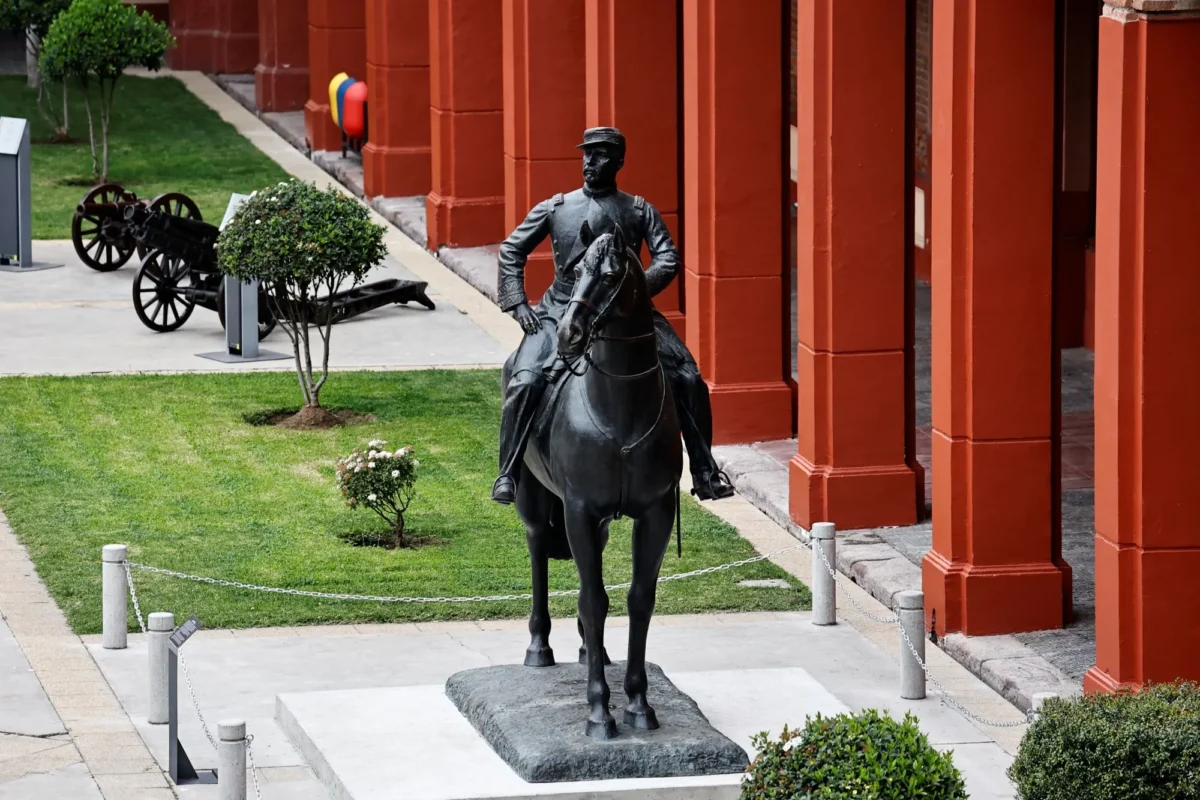
Baquedano in 1880s Chile was the equivalent of a rockstar, despite being quite the opposite as a person. He was offered not only a Senate seat but also the presidency. He was essentially a military man who never ceased to be one.
The issue of the monument to Baquedano goes far beyond its location, the law 4328 of 1928 that allowed for its erection and funding in Santiago, or the powers of the National Monuments Council (CMN) to decide on its location or relocation, something that Article 19 of the law regulating it allows.
I mention this because some seek to reduce the problem to the aforementioned points, or to what it represents or symbolizes in the confrontation that Chile has experienced since October 2019, and therefore, there are still those who do not want it to return to Plaza Baquedano, also known as Plaza Italia, and others who seek to have it reinstated alongside the unknown soldier and the horse Diamante in the square that sheltered them for nearly 100 years.
Baquedano is the typical military figure of 19th century Chile, who fought in the war against the Peruvian-Bolivian Confederation, who had to defend the governments in power during the revolutions of 1850 and 1859, the soldier sent by the government to take control of Araucanía, and who concluded his 43-year military career as the commander of the Chilean Army in 1881 after defeating Peru in the bloody battles of Chorrillos and Miraflores, entering victorious into Lima on Tuesday, January 18, 1881.
The epic of the Pacific War is militarily depicted in the anthem of the Chilean Army -Los viejos estandartes- an anthem inspired by General Manuel Baquedano’s return to Valparaíso in 1881. The lyrics say it all, so I recommend reading it, and I attach it for those interested in this link , and for the purposes of this column, I highlight:
“They cross under triumphal arches, behind their brave generals, and although they march wounded, they march with martial pride, smiling valiantly, and return undefeated.”
Chile during the 19th century constructs its narrative and Chilean nationality, a narrative primarily built on a history of military victories that cover mainly from the wars of independence including the liberation of Peru, the war against the Peruvian-Bolivian Confederation, and obviously, the Pacific War where Peru and Bolivia were again defeated.
Baquedano is the one who dealt the most significant defeats to the Peruvians. He does so after replacing Erasmo Escala at the helm of the Army and concludes his military career after his triumphant entry into Lima and subsequent return to Chile, where, once retired from the Army, he was elected senator twice, and also temporarily held the presidency for a few days after Balmaceda’s suicide.
Baquedano in 1880s Chile was the equivalent of a rockstar, despite being quite the opposite as a person. He was offered not only a Senate seat but also the presidency. He was essentially a military man who never ceased to be one, and more importantly, he avoided getting involved in the before and after of the Civil War of 1891.
Baquedano, as I mentioned earlier, represents the military of the 19th century, one who served the State and its interests, who was permanently on the front lines, who led the Chilean Army in combat, and crowned it with the laurels of victory. He is one of the military figures who shaped the Chile we know today, stretching from Arica to the South Pole.
It is natural for Chile to seek to honor his memory and that of the unknown soldier, one of the soldiers who served under his command. We had done so with Prat and the naval heroes, but the same had not been done with Baquedano and what he represents, the military victory over Peru in the Pacific War. We had done it with generals of the War of Independence, or with those who led us to victory in the War against the Confederation.
The Chilean Army, always victorious and never defeated, created by Carrera, later led by O’Higgins, passing through Freire, Prieto, Bulnes, and many others, reaches its peak in Chorrillos and Miraflores commanded by Baquedano, a general who gave us victories and the defeat of the enemy, a general to whom we should be eternally grateful.
What blame does Baquedano have for what has occurred in Chile in recent years? Merely being in the wrong place at the wrong time. Should we leave him alongside Diamante and the unknown soldier in the place where they have rested for the last 100 years? Everything seems to suggest yes, but more importantly, it is to not forget who Manuel Baquedano was and what he did, the Chilean Army and its soldiers, represented by that nameless soldier, who temporarily rests in the General Cemetery, but who should be accompanied by those who have guarded him since 1928.
To conclude, and this is an opinion, the Chilean Army, just as the Navy does with the resting place of naval heroes, should be responsible for the custody of the monument to Baquedano and the tomb of the unknown soldier. They must be visible for all of Chile to see, as peoples that forget their history lose their way and their identity. We cannot accept attempts by some to rewrite history, to erase our heroes and the brave soldiers who yesterday, today, and tomorrow defended or will defend Chile and Chileans.
Baquedano represents for many the final attempt to reduce the Chilean Army to insignificance. They have already managed to cut its budget, imprison old soldiers from ’73 who are still alive, and legally pursue those who took to the streets to defend us from the looting and destruction we experienced from October 2019 until the end of Piñera’s second term.
I hope that the future president of Chile will be inclined to defend and protect its Army and its military, to protect not only democracy but primarily the Rule of Law. This should be a fundamental issue in the upcoming election.
*In memory of General Manuel Baquedano and the soldiers of the past, present, and future.