COLUMN | The Rules of Use of Force
This article was translated automatically and may contain differences from the original. For reference, read the original.
- by Richard Kouyoumdjian
- Opinion
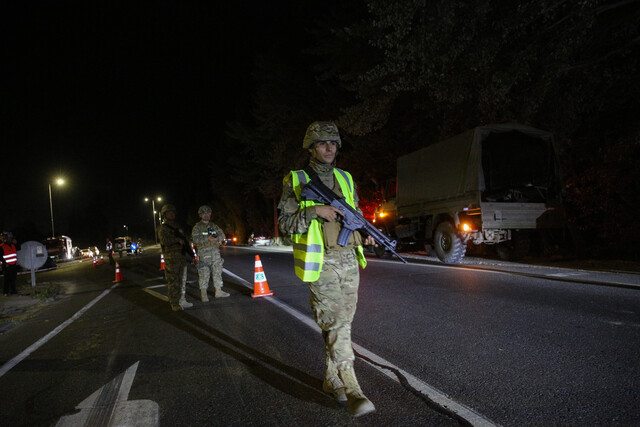
Politicians in general must understand that there are police for certain matters and Armed Forces for others, and they must also understand that using defense institutions as scarecrows in the southern macrozone and at the borders with Peru and Bolivia is neither efficient nor effective.
On Tuesday, March 4, the joint Security and Defense committees of the Senate approved a catalog of eight Rules of Use of Force (RUF). There were seven votes in favor and two against.
The approved catalog of RUF closely resembles the one generated during Sebastián Piñera’s second government, which was approved by decree. This was something that was sought to be corrected by passing it through Congress, as, if approved, it would have the force of law. Therefore, both the Executive and Parliament hope to encounter fewer problems when it is used as legal backing in courts for actions that required the use of military force.
Let us see what will happen with the RUF catalog in the rest of its approval processes and if it will ever see the light of day. However, as it stands, it does not fulfill any of the purposes one would expect from a document of this type, something that Vice Admiral (ret.) and Senator Kenneth Pugh, a member of the Senate Defense Committee, made clear when he argued his vote against it.
Admiral Pugh’s vote against it, as the only member of the joint committees with command experience and a clear understanding of the nature and purpose of the Armed Forces, is key to understanding where the main problem with the RUF lies.
Senator Pugh essentially argues that the Armed Forces are meant to act, not to deter. Their existence, preparation, training, experience, command and control systems, equipment, doctrine, and operational capabilities are what generate deterrence.
Peru and Argentina do not attack Chile because our Armed Forces are permanently deployed at the land and maritime borders. They do not do so because they know we have the capacity to act and react to any attempt to affect our sovereignty, and it is not necessary for us to be permanently deployed to generate that deterrence, which can obviously be diminished if we lack the political will to use them, something that also applies to the matter at hand.
Admiral Pugh summarizes it masterfully by stating that the Armed Forces are not scarecrows, a point made clear by old axioms in specialized literature, which recommend that if troops are to be used, they should be employed with their full potential, with overwhelming and decisive force. If they cannot be used in that manner, do not use them and keep them stored away.
The genesis of the problem lies in the fact that our national political leadership does not understand the significant and profound difference between the Armed Forces and the Law Enforcement and Security Forces. The Armed Forces are conceived, designed, equipped, trained, supplied, and doctrinated to break the will to fight of an adversary by inflicting damage, destruction, and death. The Law Enforcement and Security Forces exist to enforce the law, that is, to deliver the criminal or offender to another organization that will impose a sanction or punishment.
The current RUF do not reflect this basic reality and seem to consider that the Armed Forces and the police are the same, just with more weapons, with the only similarity being that they wear uniforms, are disciplined, and are hierarchical. Their doctrines and concepts of use are very different.
Unfortunately, for the readers, I will detail what the joint committees approved and ask you to place yourselves in the mindset of a soldier, sailor, marine, or aviator, trained for war and not for public order duties, which they will have to follow in a scenario similar to those that occurred in Plaza Italia or Baquedano, or if they were in charge of protecting a Metro station that is under attack.
Clearly, those who wrote and approved them, except for Pugh, have no military experience and have not played Call of Duty on a PlayStation.
Rule 1: Deployment of forces, vehicles, ships, or aircraft, devices, or other institutional means and carrying of weapons in a deterrent manner.
Rule 2: Action through communication techniques and the use of verbal persuasion means, such as dialogue, mediation, and negotiation.
Rule 3: Manual use of less-lethal deterrent elements such as smoke, pepper spray, tear gas, sound, light, water, batons, or others.
Rule 4: Use of devices or systems that do not constitute lethal weaponry, intended for launching projectiles containing paint, pepper spray, tear gas, water, or other less-lethal means, never applied in a direct manner or aimed directly at the face, head, or torso above the lower abdomen of any person.
Rule 5: Use of force for physical control, reduction of the offender, to subdue their resistance, immobilize them, handcuff them, or apply other means of immobilization. Once reduced and immobilized and without resistance, similar forces are prohibited against them. The use of handcuffs or similar devices is permitted for this purpose.
Rule 6: Military personnel may use blank ammunition in a deterrent manner.
Rule 7: Use of shotguns with riot ammunition only to prevent or repel a serious and imminent danger to the life or physical integrity of others or of police or military personnel.
Rule 8: Use of lethal weaponry only against individuals who are using or are about to use lethal weapons or other means that endanger the life of police or military personnel, or of others, or may cause significant harm to physical integrity, especially if they are holding the weapon. Likewise, lethal weaponry may be employed against anyone who, upon order from the aforementioned personnel, does not relinquish a lethal weapon.
Furthermore, the document states that “the personnel assigned to protect critical infrastructure will use force in accordance with the provisions of this article. They may use potentially lethal force when it aims to prevent serious and imminent damage to critical infrastructure that poses a danger to life or significant harm to the physical integrity of personnel or others.”
It also states that “the resolutions indicated in the first paragraph will be exempt from the process of taking notice and must be registered with the Ministry of National Defense. The rules of use of force defined in this article do not represent a sequential order, as the use of force may decrease or increase in relation to the aggression or resistance encountered.”
There are still aspects to be seen, such as exemptions from responsibility and the jurisdiction of military justice, two issues that are of extreme importance and fundamental if it is decided to use the Armed Forces for public order control or the protection of critical infrastructure.
Clearly, if I were a military commander, I would not go out onto the street with these RUF. Regardless of the good intentions of legislators to find ways to avoid it, I would surely end up in court if I had to use force.
The Government, Congress, and politicians in general must understand that there are police for certain matters and Armed Forces for others, and they must also understand that using defense institutions as scarecrows in the southern macrozone and at the borders with Peru and Bolivia is neither efficient nor effective, just as pushing forward bills like this one or the one on critical infrastructure, which have the problem at their origin, in poorly conducted diagnoses, and therefore provided with ineffective solutions, is not effective.
In conclusion, if we want to use the Armed Forces against insurgents and terrorists, that is another matter, but using them for public order control or in defense of critical infrastructure that is being attacked by criminals or individuals seeking to destroy and attack as part of a social protest requires other solutions, police solutions. At the end of the day, it all comes down to the old saying: baker to your pastries.