COLUMN | The Cynical Discussion of Municipal Security
This article was translated automatically and may contain differences from the original. For reference, read the original.
- by Richard Kouyoumdjian
- Opinion
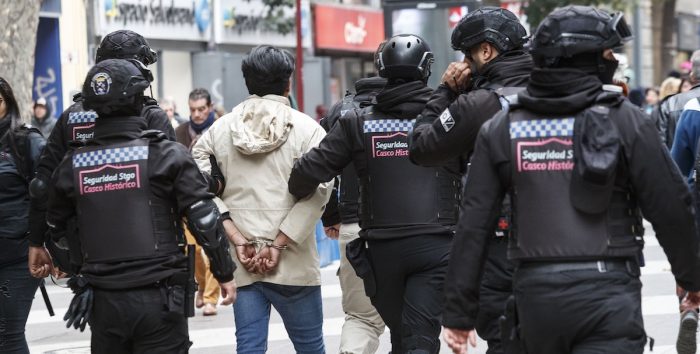
The time has come for the 2.0 municipal security law to advance in Congress, which would help address part of the problem, a problem that cannot be fully resolved unless the number of Carabineros is increased or municipalities are allowed to have their own police forces.
In the coming days, the municipal security law will be discussed in Congress. It is a cynical discussion, as all participants know that it does not adequately address the underlying issues faced at the municipal level, namely: the insecurity of residents, the safety of municipal officials working on the issue, and the fact that Carabineros de Chile is not fulfilling its constitutional role of ensuring order and security in the national territory at the community level.
The ingredients of the municipal security problem are:
- An increase in the quantity and complexity of criminal and delinquent activity.
- People living in fear, altering their habits due to crime, whether real or perceived.
- Insufficient personnel and capabilities, primarily in Carabineros and to a lesser extent in the PDI, the Public Prosecutor’s Office, and other entities involved in public security processes.
- Increasingly broad roles and functions performed by security departments and their inspectors, guards, or municipal patrols in the absence of Carabineros.
- The risks taken by municipal officials in the performance of their duties.
- A lack of specific intelligence regarding what occurs in each municipality, as well as a lack of prospective studies.
- An overreliance on the security provided by camera systems and license plate readers.
- Poor coordination with other municipalities and regional authorities.
The first issue needs no explanation. Despite the Central Government’s efforts to present more favorable numbers, the reality indicates that the level of criminal and delinquent activity is not decreasing throughout Chile, regardless of the location of the municipalities, which translates into consistently high levels of fear and insecurity, especially among women and the elderly, affecting individual freedoms and citizens’ rights.
This is reinforced by the State’s abandonment of municipal matters and its focus on national criminal and delinquent issues, resulting in reduced personnel primarily in Carabineros, the PDI, and the Public Prosecutor’s Office. In this regard, all mayors, regardless of their municipality, complain about the few Carabineros assigned to them, shifting that absence onto the services of their respective municipal security departments.
The absence of police is increasingly being filled by municipal security departments, which have personnel who directly perform pseudo-police roles beyond what is understood as the function of a municipal inspector or patrol officer.
In some cases, they are personnel from the municipalities or from corporations specifically developed for that purpose, such as the Union of Neighborhood Councils, which manages almost half of the patrols and vehicles operating under 1402 in Las Condes, creating a mixed model that is not always easy to manage and that should be under the municipality due to the importance and critical nature of the tasks they perform.
The security departments also have—depending on available resources—surveillance cameras, monitoring and control centers, and license plate readers, which, combined with installations distributed throughout the municipality and programs developed in conjunction with residents, create a network of alert and control that helps to enhance the level of security and the response of their own resources and police in emergency situations.
The work of human and technological resources has its limits, as there are aspects that municipalities cannot legally address, since the teams in the security departments are not police and, therefore, cannot—in theory—perform police duties, which does not always happen, as security circumstances demand it, along with the limited availability of Carabineros, which is perhaps the main problem that many do not want to acknowledge.
Citizens require police services that are supposedly provided primarily by Carabineros de Chile, an institution that has the constitutional role of ensuring order and security in the national territory, something it is currently unable to fulfill due to a lack of necessary resources.
If there are no Carabineros, someone has to do the job, and as I mentioned earlier, that is being done by the security departments of the municipalities, with varying degrees of success depending on the resources they have available and, evidently, the respective communal criminal situation, allowing them to immediately deduce which ones are better or worse off.
That said, the time has come for the 2.0 municipal security law to advance in Congress, which would help address part of the problem, a problem that cannot be fully resolved unless the number of Carabineros is increased or municipalities are allowed to have their own police forces. There are no other intermediate solutions, such as assigning electroshock devices to municipal inspectors or patrol officers, or actions of that nature.
Carabineros will argue that they were created almost 100 years ago to replace municipal police, but that was—as I just mentioned—100 years ago and in a different context.
It is obvious that we would all like to be assigned the Carabineros we need, but that is a utopia, as we would be talking about increases that could mean doubling or tripling the personnel of the uniformed police, which we know will not happen, making it easier to convert and allow municipal inspectors and patrol officers to become police who could carry weapons, act immediately in situations requiring police intervention rather than inspectors without authority, who would be supported by the technological capabilities and command and control that the security departments have, and in the past, could adequately defend themselves against criminals.
For this to be effective, it requires the creation of intelligence units or intelligence fusion centers to understand what is happening in the municipality, carry out preventive actions, and make good use of existing resources. This, combined with effective coordination and integration with the municipalities they connect with, significantly elevates the level of security.
Even municipalities like Las Condes, of which I am a councilor, need to review their security strategy and organization. It may be safer than others, but that could well be because the very dangerous individuals have not yet arrived in significant numbers or are taking advantage of other municipalities with fewer capabilities to defend themselves. The worst thing that can happen is to become complacent and think that we are fine with what we have.
In this regard, placing retired general officers from the Armed Forces, Carabineros de Chile, or the PDI in charge of security departments is a wise decision, to prepare for managing more complex future criminal scenarios and, on the other hand, to lead the respective municipal police due to their prior experience.
I hope there are no fatalities among officials before we properly address the issue of municipal security, the role of municipal police, and the real or perceived insecurity of residents. If we want effective municipal security, we must start by providing our officials with the tools they need to do their jobs well and to avoid ending up dead or injured while performing their duties. The reality on the streets is complex, and they are the ones who are exposed.


