COLUMN | The Use and Abuse of the Armed Forces of Chile
This article was translated automatically and may contain differences from the original. For reference, read the original.
- by Richard Kouyoumdjian
- Opinion
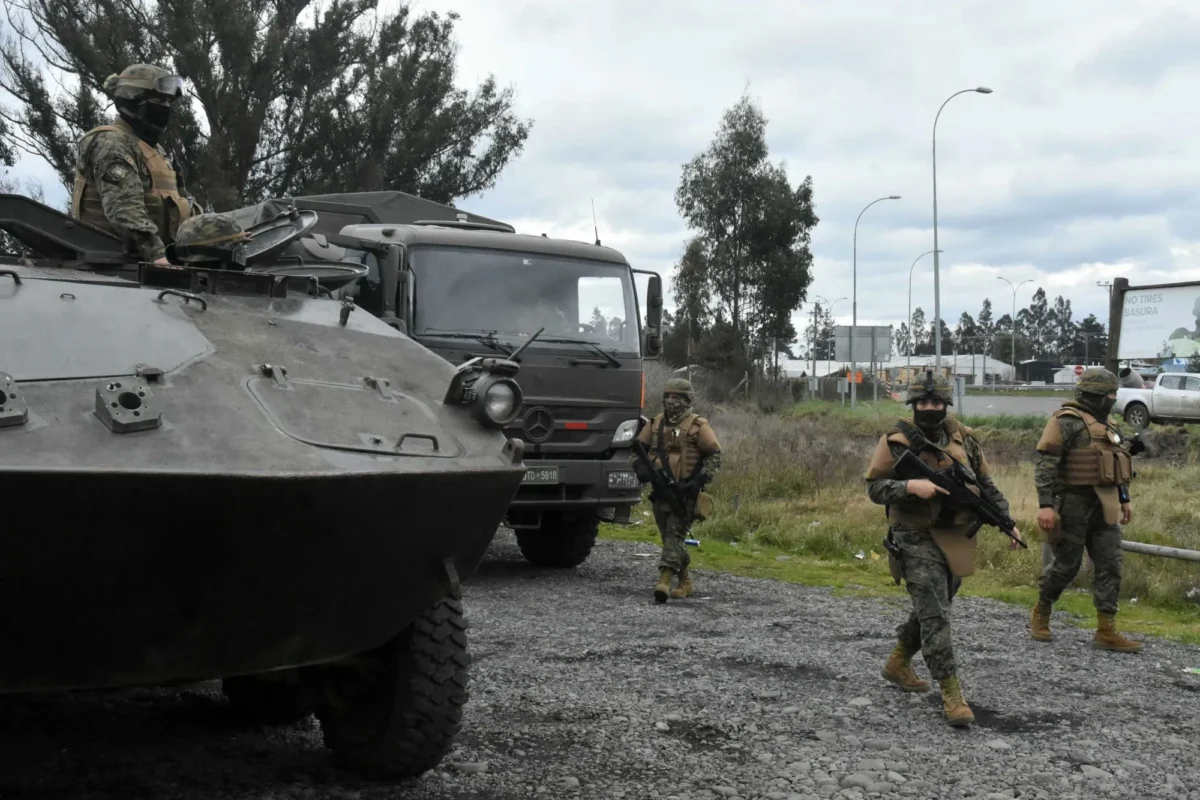
The solution to the incorrect use or, alternatively, the abuse of the Armed Forces lies in having more Carabineros and PDI, leaving the issue of insurgency and terrorism in the Southern Macrozone to the Armed Forces.
It is important to be clear about the purpose of the Armed Forces, what they are for, what they are not for, and therefore, what can be reasonably expected of them.
According to the current Constitution of the Republic of Chile, they primarily exist for the defense of the homeland and are essential for national security, a concept that allows for their use in protecting critical infrastructure, as well as in constitutional states of exception, aspects also addressed by the Constitution.
Some would like to define more precisely what is meant by the defense of the homeland, but for the purposes of this column, we will understand it as the defense of national territory, Chilean maritime spaces, the respective airspace, as well as national interests, wherever they may be located.
The notion of being essential for national security is obvious, but it has a problem, the Constitution does not define what national security is, which in itself creates an issue because it is from this perspective that abuses or uses for purposes other than the defense of the homeland arise.
Abuse occurs both because constitutional states of exception become habitual, something that both chambers of the National Congress allow when they approve their extensions, permitting, in cases such as the insurgency and terrorism occurring in the Southern Macrozone, that the underlying problems causing it are not addressed.
Abuse, again with the permission of the political system, has become more extensive by allowing its use in the protection of critical infrastructure, which, in an interpretation by the Executive and accepted by Congress, includes borders, which by definition is not infrastructure, but rather where our limits with neighboring countries are located.
In the case of constitutional states of exception, the purpose is clearer, regardless of the abusive use given to it, but what exceeds all logic is the issue of critical infrastructure, both that which qualifies as such and the case of borders, since it is unclear who or what is being protected. One thing would be to protect it from enemy forces, and another is from the actions of Chileans themselves, which some may qualify as essential for national security, but which places them in a role for which they are not equipped, trained, or indoctrinated.
The issue of borders deserves a separate chapter, as the use given to them regarding illegal migration and potentially the entry of criminals and delinquents is unclear. They are supposed to assist the police and state services responsible for migration, but in practice, it is nothing more than detecting them, potentially detaining them, and leading them to the places where migration authorities and the PDI receive them, entering national territory, with no immediate redirection or detention in ad hoc camps. Clearly, they are being used for a police activity, where they do not defend national territory from any attack, and evidently, even less so from critical infrastructure that is at risk.
Their use in states of exception or in the supposed protection of critical infrastructure generates the need to define rules for the use of force, something that goes against the logic and nature of how the Armed Forces are designed to operate, which by definition does not include the gradual or measured use of force, and that once their use is decided, it seeks to be of such magnitude that it eliminates or neutralizes the enemy to the point that they cease to be a danger or cause us harm.
Another area of abuse is when the mission areas assigned to them go beyond the defense of the homeland or the fact that national security is at risk. Therefore, I refer to their use in aspects such as brigades to control forest fires, or support for extreme, isolated, or insular areas.
Given that we have been effective in deterring potential external threats, the political world and, to some extent, the institutions themselves become creative in generating mission areas beyond what is defined in Article 101 of the Constitution, as a way to give the Armed Forces a role in peacetime, which leads to losing sight of what is primary and what is secondary, something that is sometimes reflected in the equipment purchases they make, often seeking that these be multipurpose, losing value or priority for what can strictly only be used in combat, such as tanks, F-16 type aircraft, or submarines.
Defining the purpose of the Armed Forces is critical; if they are for the defense of the homeland, that has implications for equipment, staffing, and training. Seeking to make them multipurpose or to also have the capacity to be employed for internal security purposes in a non-exceptional manner affects the former, and takes us back to the broad and unclear definition of the 1925 Constitution, where they were part of the public force, something that the 1980 Constitution precisely separated, leaving some in charge of the defense of the homeland, sovereignty, and territory, and the police as the public force that must maintain and guarantee order and security in the territory of the Republic of Chile.
This is why it concerns me how the political system makes use and abuse of the Armed Forces, something that also occurs in the commands of presidential candidates, who promise deployments of more troops to the border or similar actions, something I would hope is not supported or endorsed by the retired general officers who are part of them, as they should understand better than anyone what I mean in the previous paragraphs.
Understanding that the problems that primarily affect us are of a criminal nature, the solution to the incorrect use or, alternatively, the abuse, lies in having more Carabineros and PDI, leaving the issue of insurgency and terrorism in the Southern Macrozone to the Armed Forces, provided that the problem is intended to be resolved, as otherwise, it is better to place Carabineros, so that they, with their training and capabilities, keep the situation controlled and without escalation.


