COLUMN | The Challenges Facing Minister Cordero in Public Order and Security
This article was translated automatically and may contain differences from the original. For reference, read the original.
- by Richard Kouyoumdjian
- Opinion
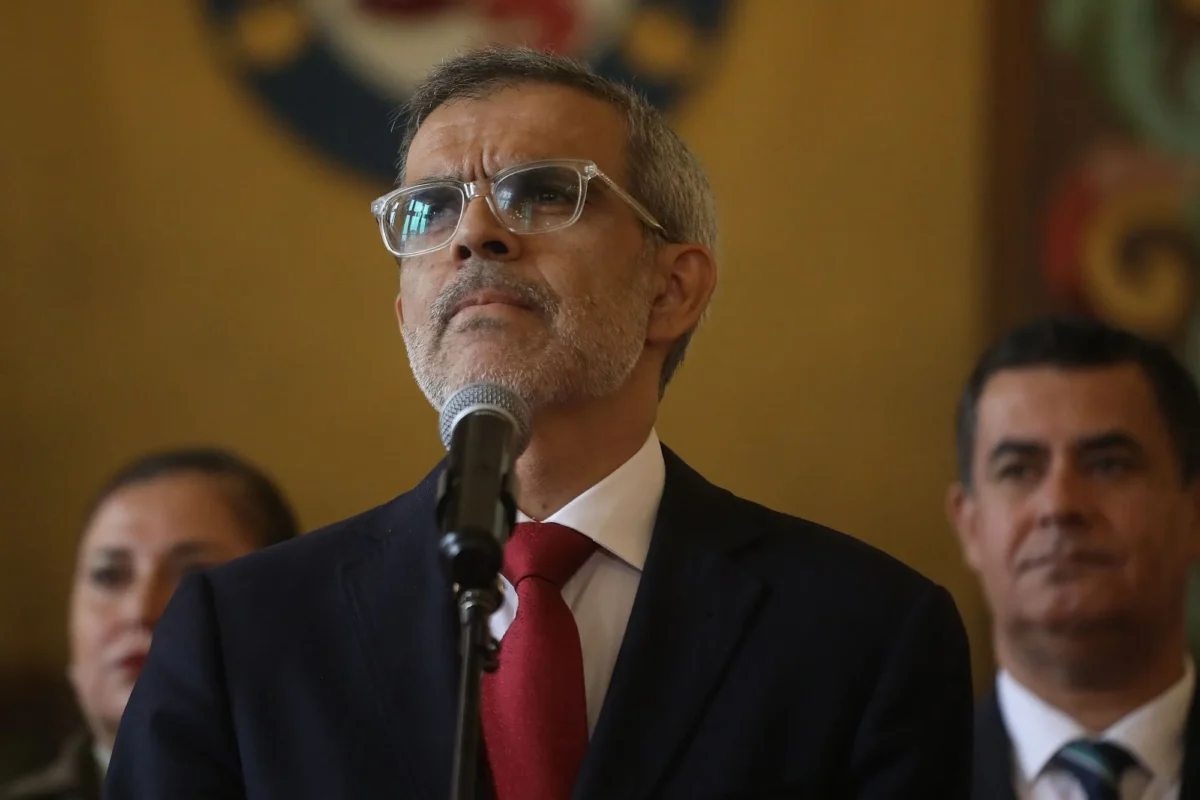
Is Minister Cordero aware that we do not have a public security system that functions as such, and that the powers granted to him by law are primarily for coordination rather than for leading the system?
Chile is a country that has had to navigate recently between scenarios of public disorder and high insecurity.The first represented by the period of criminal unrest, misleadingly called social unrest, from October 2019 and the following months, and the second by what we have strongly experienced during the current administration in terms of high criminal activity, which clearly did not arise now, but has been incubating for several years—something we did not foresee or chose not to see, but which has seriously affected Chileans.
We could also add to our main ills the insurgency and terrorism of Mapuche origin occurring in the Southern Macrozone, but since it is of a higher order, one that seeks to replace the State of Chile, where we cease to be sovereign, its solution escapes what is proper to public order and security, being one that must be addressed militarily, and therefore will not be the subject of this column.
On April 1, 2025, the Ministry of Public Security is formally established, a ministry that, according to the Executive, will be responsible for collaborating with the President of the Republic on matters related to the safeguarding, maintenance, and promotion of security and public order, crime prevention, and the protection of individuals in security matters. For more details, it is recommended to see the law 21730 promulgated in February 2025.
The Ministry of Public Security does not bring additional resources upon its creation, and essentially, apart from the two undersecretariats, it is only in charge of the police forces, Carabineros de Chile and the PDI. It is supposed to be inter-agency, but that is a euphemism for saying that it only has coordination powers regarding matters outside its direct command.
It does not oversee Gendarmería de Chile, which remains under the Ministry of Justice along with the Legal Medical Institute, nor does it oversee the Public Ministry and the courts, which obviously maintain their independence and autonomy; it does not oversee Customs and the UAF, which remain under the Ministry of Finance, nor does it oversee the Armed Forces when they are operating under constitutional exceptions, or in the safeguarding and protection of critical infrastructure, which includes the borders with Peru and Bolivia, through which many of our problems enter.
It also does not oversee the National Intelligence Agency (ANI), as it was determined that it should continue under the orders of the Ministry of the Interior, remaining exclusively with the intelligence provided by the police and the reports sent to it by the ANI and Gendarmería.
What governments and legislators, those responsible for shaping this new ministry, never understood is that public order problems are primarily of a political nature, but by placing them as a responsibility of Public Security, they assume they are of a police or criminal nature, and therefore of a technical type, which can be solved with police resources.
To better understand the above, a couple of examples: starting April 1, the management of events such as the “Day of the Young Fighter” recently occurred, or the actions of violence exercised by artisanal fishermen to prevent the docking of ships at the Port of Valparaíso, or the terrorist attacks they carried out against Carabineros on Route 5 South, all supported and instigated by the Communist Party, aimed at affecting the “Fraccionamiento” law being discussed in Congress, should be the responsibility and concern of Minister Cordero, not of Minister Elizalde, the political minister of the government.
I mention this because, apart from not understanding that it is a political problem and differentiating it from one of a purely police nature, the usual practice in Chilean politics is to pass the problem to another and not exhaust oneself in its solution. This is something that is already happening in the Southern Macrozone, a part of Chile where the Executive does not want to understand that it is facing an insurgency, or on the other hand, insisting on using military troops to stop an apparent Venezuelan invasion coming through the northern and northeastern borders.
More than the problems generated by the existence of the regional secretaries of Public Security, their relationship with presidential delegates, governors, and central authorities of the ministry, and the police—all issues that can eventually be resolved, the main problem lies in where the responsibilities of Minister Cordero begin and where those of Minister Elizalde end, something that will surely not be resolved in this government but in the next one.
This is not something that the right should observe from a distance. We are 11 months away from a change of government, a government that, if it is right-wing, will have to face public order problems, something that occurred in both of Sebastián Piñera’s governments, and for which there are not enough Carabineros, who are barely managing the existing insecurity, and who will be even less able to address both problems simultaneously. Whoever replaces Luis Cordero will have a nice challenge, which includes potential constitutional accusations to which ministers are subject, and in this case would be for failing to guarantee order and public security in the territory of the Republic, something that Carabineros de Chile is obligated to do both in the Constitution and in its organic constitutional law, as stated in Article 1 of law 21730.
I hope that Minister Cordero and his team understand that resolving the administrative installation problems only leaves us even with what existed before, and that he must be vigilant not to be held responsible for public disorder of a political origin, something for which he has no resources without necessarily neglecting other fronts such as the high insecurity caused throughout Chile by criminals.
Is Minister Cordero aware that Carabineros has abandoned many communes in Santiago, and that, were it not for the municipal security directions, which often operate without the necessary legal powers, wrongdoers would reign and roam freely?
Is Minister Cordero informed that communes like Las Condes and others operate with less than one-third of their authorized Carabineros personnel, and that this has forced the privatization of security for residents and businesses, and that were it not for the resources available to them, and for the existence of municipal inspectors, we would be in the “Wild West”?
Is Minister Cordero in agreement with the creation of municipal police forces that can carry firearms, rather than with the self-deception that means like “Taser” are the solution?
Is Minister Cordero aware that what is truly lacking in public security is strategy, management, intelligence, police, and prosecutors?
Is Minister Cordero aware that we do not have a public security system that functions as such, and that the powers granted to him by law are primarily for coordination rather than for leading the system?
Good luck, Minister Cordero; you are a kamikaze, and I hope for the good of Chile that this ministry results in something that adds value. I opposed its creation tenaciously, but now that it exists, I hope it functions, because otherwise we will be worse off, much worse.


