COLUMN | Reflections on National Security
This article was translated automatically and may contain differences from the original. For reference, read the original.
- by Richard Kouyoumdjian
- Opinion
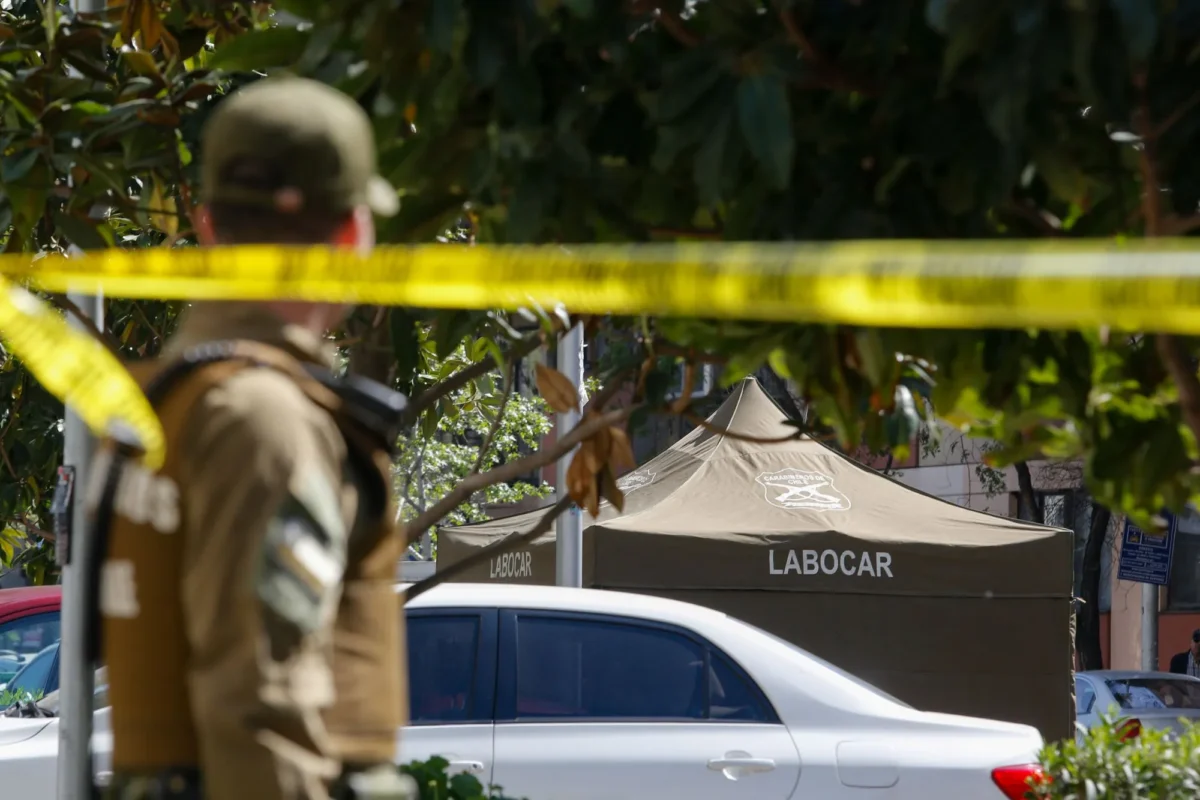
A significant part of the national security problem lies in the absence of an intelligence subsystem that analyzes the environment and threats.
In recent weeks, I have discussed various types of incidents that have occurred recently with congressional members and campaign team members of some candidates, which our precarious or informal national security system has been unable to manage adequately or prevent.
We see this in the public security subsystem with the tragic deaths of two young people at the Monumental and related incidents of violence, something that could have been avoided if the security for the event had been properly planned; the destructive attack carried out by insurgents in Rucalhue reminds us that despite the prevailing state of emergency, the Mapuche insurgency remains active; the daily murders occurring in the capital, which no longer surprise us despite exceeding ten each week; and in international relations, issues with China arising from the fact that the company affected by the attack in Rucalhue was state-owned Chinese in a strategic industry affected by insurgency, in other words, everything is going wrong. Additionally, but unrelated to the above, in response to complaints from the United States, we put the development of an astronomical observatory in northern Chile, which was dual-use military-civil, on hold, which obviously did not sit well with them, but should never have been authorized in the first place. Alongside these examples, and as a demonstration of our lack of professionalism, is that the issue of tariffs caught us by surprise, and we were unable to address the problem through the existing institutional framework, whether through the National Security Council or that which the Foreign Ministry has for these purposes. In summary, everything is going wrong, and hopefully next time we will be better prepared.
In the aforementioned cases, the system was unable to manage adequately or prevent occurrences because, on one hand, it does not operate as a formal system, nor does it have an administrator. On the other hand, we do not think in terms of national security, much less as an integrated system that manages, prevents, and acts in response to occurrences that affect us, defends us from what is harmful to Chile, or seeks to protect national interests. A significant part of the problem lies in the absence of an intelligence subsystem that analyzes the environment and threats, anticipates potential occurrences, and, if necessary, provides us with the tools to eliminate or mitigate threats either preventively or reactively.
That said, this time, rather than focusing on the latest contingencies and related failures of the system, I want to address some more structural issues that the national security system has also been unable to resolve. These include the capabilities of intelligence, which involve the megatakes of land such as those in San Antonio or Alto Hospicio; the Mapuche insurgency in the Southern Macrozone; illegal immigration and transnational crime that arrive through the porous and complex borders we have with Peru and Bolivia; the insufficient number of Carabineros de Chile to fulfill their constitutional obligations, and the available personnel from the Chilean Army and Marine Corps for internal security tasks, whether because they must support Carabineros or the nature of the threat requires military solutions, as could be the case with the Mapuche insurgency.
- Intelligence Capabilities: We have been operating for nearly 20 years with a precarious intelligence subsystem, with insufficient resources, limited to being an analysis office that operates Monday through Friday and only from 8 AM to 6 PM. The exception was the period under Admiral Jordán’s leadership, from November 2019 to March 2022. The results speak for themselves, with the “Criminal Outbreak” of October 2019 being its main and most evident failure.
The law currently being discussed in Congress addresses some of the shortcomings, but is far from shaping something akin to what Spain or the United Kingdom has. To be clear, we need an ANI that operates 24/7, has the capacity to integrate the information generated by the intelligence services of the armed forces, police, SII, Customs, Gendarmerie, and the foreign service, and also has the ability to conduct special intelligence operations. Its personnel clearly need to exceed the currently authorized 100, and they cannot be the type of officials regulated by administrative statutes and rules that apply to public employees.
- Megatakes: It seems that no one dares to address what the megatakes like those in San Antonio or the one in Alto Hospicio imply. The responsibility is passed between municipalities and ministries, and no one resolves the issue. Time passes, and they grow in size and complexity. These are territories where the rule of law does not apply and where we do not exercise sovereignty. Anything could be happening in these occupations, and since we have precarious or nonexistent intelligence, we truly do not know what occurs in those places or how many people live there.
It is clearly, and in every way, a national security problem. It is like having a tumor that grows and grows, allowing it to grow without doing anything about it.
- Mapuche Insurgency: Every time there is an attack in the Southern Macrozone, we are reminded of what is happening in that part of Chile. To be clear, in the regions of Bio-Bio and Araucanía, we have Mapuche insurgent groups with territorial and autonomy claims against the State of Chile. Often, they manifest as rural violence, terrorism, or crime, all things that these groups allow to exist, or that exist because the absence of state and control permits them to occur.
Some thought that with the dismantling of the CAM things would calm down, but events like the one that occurred in Rucalhue or the murder of three Carabineros in 2024 remind us that reality has not changed. The constitutional state of emergency that has been in effect for nearly three and a half years is merely a paracetamol that lowers the temperature but does not correct or resolve the violence or terrorism perpetrated or sponsored by insurgent groups.
We need to think of more definitive solutions, which are primarily of a political nature, although a definitive military solution to eliminate or neutralize the insurgents should not be ruled out.
- Illegal Immigration and Transnational Crime: This problem has been known and identified since Sebastián Piñera’s second government, but despite this, the actions of that government or the current one have never addressed the root causes that generate it or allow it to continue existing. Addressing illegal immigrants or criminal activity at the border is already too late, especially considering the characteristics of the border in terms of length and height.
Being considered a police problem rather than a national security issue, solutions begin and end at the border, without seeking ways to interrupt or affect the immigration flow earlier, the organizations that facilitate it, the logistics, and the places from which they depart. The same applies to transnational crime.
If declared a national security problem and affecting national interests, one could perfectly consider special intelligence operations to be conducted in Peru and Bolivia, and if necessary, beyond. Acting only at the border is too late and implies operating under national legislation, with the complication that, in practice, the rerouting to Bolivia or air repatriations to Venezuela do not work. This is why the problem must be resolved before it reaches national territory.
- Personnel of Carabineros de Chile: A national security system would identify early on that one of the main means to achieve its public security objectives is the effective and available personnel of Carabineros. For some reason, it decides that the solution to the problems is the creation of the Ministry of Public Security, which is merely more bureaucracy, as it does not come with greater command and control capabilities or strategic analysis.
Carabineros has a severe personnel problem. They have high absenteeism rates, of 20% or worse, and their capacity to create new police officers only allows them to cover vacancies due to retirements or voluntary resignations. Additionally, there is a lack of legal and political support for effective action.
The system does not react to the lack of Carabineros, pretends the problem does not exist, and only reacts when they realize they do not have resources for high-risk events, indicating that it is a private problem.
The beauty of analyzing things systemically, like engineers, is that the solutions are evident, as are those that do not resolve the problem.
- Personnel and Budget of the Armed Forces: Just like in the previous case, a system that has clarity in the objectives to be achieved would realize that there are not enough soldiers or marines available to maintain current efforts at the northern borders or in the Southern Macrozone. This is due to the fact that our armed forces are not personnel-intensive but are technology-intensive.
It would also realize that we are not using them effectively, as we are using them in a scarecrow mode and not to solve problems, something we could do in the Southern Macrozone given the nature of the insurgent problem, but not at the northern border, which is not of a military nature, but rather police.
The incorrect and non-exceptional use of military personnel in internal security tasks additionally drains the already tight institutional budgets, affecting their training and combat capabilities, which reduces their deterrent capacity or potential use if necessary or if national interests are affected. This is something that a National Defense subsystem, if it existed, would identify and feed back into the national security system, reducing or mitigating the problem.
Before closing, have you thought about what you will do with the military personnel from 1973 who are imprisoned in Punta Peuco, Colina 1, and other prisons? What do you think about a humanitarian solution to the problem of the old soldiers of Chile?
Do you know that this year, if lucky, only 4,500 citizens will enlist for military service, despite the higher salary they will receive? Do you know that there are fewer than 1,500 professional soldiers? With those numbers, forget about solutions like closing the border or establishing states of emergency in the RM to control organized crime, or expanding what exists in the Southern Macrozone. Think in a systemic, strategic manner, with clarity in the means and methods of use. Let us start by establishing a National Security System and its respective strategy. Think in terms of concepts like effectiveness and efficiency.


