INTERVIEW | What lies behind Boric's decision to withdraw military attaches in Israel on the eve of the Public Account
This article was translated automatically and may contain differences from the original. For reference, read the original.
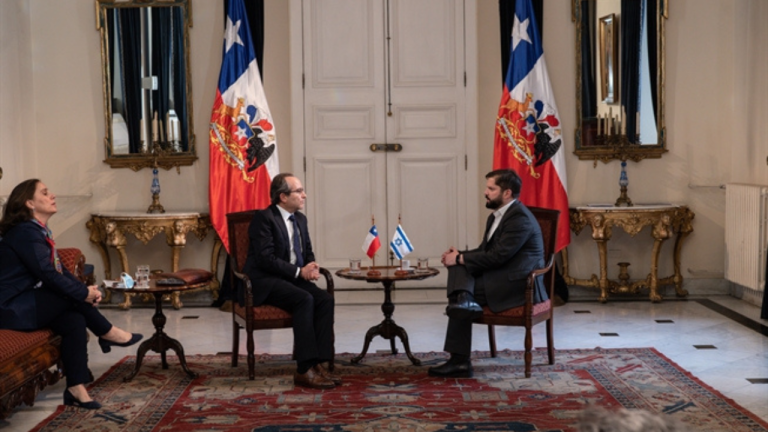
Four days before his last Public Account, Boric decided to withdraw the two military attaches from Chile in Israel. According to experts, this decision could jeopardize the supply of weapons and technology, given that country's strategic dependence. Israel has not responded, and the Foreign Ministry denies that Boric is considering announcing the cessation of diplomatic relations with that country, despite the topic circulating in the public agenda.
Public statement. On Wednesday, the Foreign Ministry announced the Government’s decision to withdraw the two military attaches, one for defense and one for air, from Chile in Israel, who were serving in the Chilean mission in Tel Aviv. The determination was communicated today to Benjamin Netanyahu’s government.
- The measure was coordinated by the Ministries of Defense and Foreign Affairs and, according to sources from La Moneda, responds to “the grave humanitarian situation currently faced by the Palestinian population in the Gaza Strip, due to the disproportionate and indiscriminate military operation of the Israeli army, as well as the constant obstacles to allowing humanitarian aid into the aforementioned Palestinian territory.”
- In the statement, the Foreign Ministry adds: “The Government of Chile demands that Israel cease its military operation in the Occupied Palestinian Territory, allow the entry of humanitarian aid, and respect international law and international humanitarian law.”
- The Defense and Air Attaché, Colonel Christian Stuardo, and the military attaché, Colonel Marcelo Eló, are scheduled to return to Chile this Friday.
- The Foreign Ministry announced the decision four days before President Boric’s last Public Account, during which his government has faced issues stemming from the public licenses scandal and the ProCultura case. La Moneda has also raised the abortion project, which, like the case of Israel, resonates with its political base.
- In 2024, also during his Public Account, the President announced that Chile would participate in referring the situation of Palestine to the International Criminal Court and that it would support the case presented by South Africa against Israel in The Hague.
Diplomatic relations. However, the Foreign Ministry indicates that the decision regarding the attaches in Tel Aviv was made last week following an escalation of Israel’s offensive 19 months into the conflict in the Gaza Strip and the problems in delivering humanitarian aid in Gaza, which is being provided by a U.S. foundation.
- The Israeli embassy in Chile has not yet responded to Boric’s decision, which adds to a series of hostile acts with that country, such as not receiving the credentials of its ambassador Gil Artzyeli in 2022 or excluding that country from Fidae in 2024.
- Last December, moreover, the President also did not attend the traditional Hanukkah ceremony held since 2008 at La Moneda. Instead, he participated in the Christmas celebration of the Palestinian community, where he stated that “what Benjamin Netanyahu is doing is undoubtedly a war crime, a crime against humanity” and justified the exclusion of Israel from Fidae by saying: “As President, in good conscience, I could not allow weapons that were being used to massacre a people to be displayed at that fair. It was unacceptable.”
- When consulted by Ex-Ante, the Foreign Ministry denies that Boric is considering announcing the cessation of diplomatic relations with Israel in this weekend’s Public Account, despite the topic circulating in the public agenda. The PC candidate Jeannette Jara, for example, indicated that she would sever all diplomatic ties with that country.
- In Latin America, both Colombian President Gustavo Petro and Bolivian President Luis Arce severed relations with Israel following the outbreak of the conflict in Gaza in October 2023.
What it implies. Among the functions of a military attaché is to serve as a liaison between the Chilean Armed Forces and those of the host country, establishing diplomatic relations, as well as sharing and gathering military, strategic, technological, and defense information, and advising the head of mission on security and defense matters.
- One of their main tasks is to facilitate the strategic relationship with the country regarding platforms, supplies, logistics, training, modifications to the weapon system, among other aspects. Therefore, according to military relations experts, the withdrawal of attaches may imply a deterioration and slowdown in that supply chain.
- Israel, these sources say, is a significant country in the manufacturing of materials for the military industry, with which Chile has a strategic dependence. The country has supplied Chile in areas such as communication technologies, command and control, and observation. Additionally, it has participated in Chile’s satellite policy, providing technology for the development of a link that will replace the French satellite launched into space in 2010.
- At the same time, analysts point out that it is important to consider how Israel’s allies, starting with the United States, might react to Boric’s decision.
“National interest must be weighed.” John Griffiths, former Chief of the Army General Staff and Head of National Security and Defense Studies at AthenaLab, states: “I hope that the decision was made considering all the factors for and against, and the national interest of the country. The national interest must be weighed against other considerations that may be very valid, but that need to be assessed and evaluated.”
- “When military capabilities are acquired, a strategic relationship is created with the country, and a dependence on the supplier is generated,” he adds.
- For Griffiths, withdrawing the military attaches amounts to “sending a message to Israel. The point is what their reaction will be and the degree of commitment that other elements of our national interest will have. That must always be in the equation. No one will affect their national interest for free.”