COLUMNS | The Admiral and the State of Emergency in the Southern Macrozone
This article was translated automatically and may contain differences from the original. For reference, read the original.
- by Richard Kouyoumdjian
- Opinion
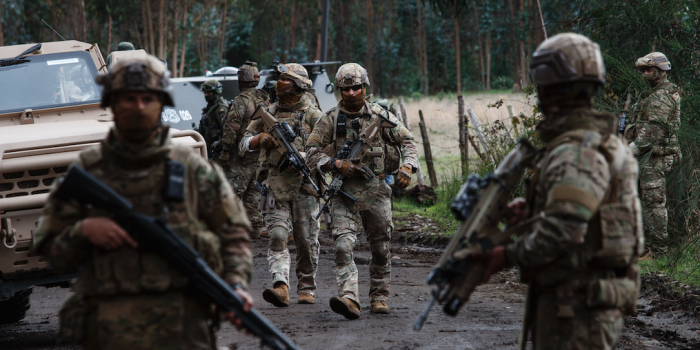
An admiral is speaking who leads one of the most prestigious institutions in Chile, who has no political ambitions, and who only wants the Navy he has led for the past four years to focus on its duties rather than on exceptional circumstances.
In El Mercurio on Sunday, June 15, an interview appeared with the Commander-in-Chief of the Navy, Admiral Juan Andrés De La Maza, in which he expresses a hope that the State of Emergency in the southern macrozone, which will reach four years in November, will come to an end.
The Constitutional State of Emergency began in November 2021, during the final phase of Sebastián Piñera’s second government, and after a brief interruption in the second quarter of 2022, it has been religiously renewed to this day, making it clear that it is no longer exceptional.
Admiral De La Maza speaks just days before handing over command and speaks solely for the Navy. He indicates that these nearly four years have taken a huge toll on the Marine Corps due to the permanent deployment of personnel in that area, which should clearly only be exceptional and for which the infantry is not designed, with the consequent impact on their resources and the stress this entails for institutional logistics.
Evidently, some local deputies did not appreciate what the Commander-in-Chief stated. In fact, one opposition member referred to his comments and the admiral himself in derogatory terms, demonstrating a lack of understanding of the constitutional order and the rule of law that governs in Chile (and obviously, the deputy’s statements were not well received in naval circles).
Politicians who comment on the issue condition the end of the State of Emergency and, consequently, the participation of the Chilean Army and the Navy’s Marine Corps on the termination of terrorism, something the Chilean state has addressed ineffectively, as it declares insurgency, terrorism, and rural violence as criminal acts, and consequently, as part of the work that the Public Ministry must carry out, which, constrained by resource limitations and the investigative procedures it must follow, does not progress at the speed desired by those suffering the impacts of criminal and terrorist actions.
It is not that the work of the Prosecutor’s Office does not yield results. It does yield results, certainly, but if we want to end the problem of violence in the southern macrozone, we will not resolve it solely with agreements like those recently achieved. We may need a more concrete action from the entire state of Chile, involving, in addition to the Public Ministry, the police and the Armed Forces, the SII, the ANI, and other agencies related to the issue. Having the Armed Forces deployed as scarecrows only allows the temperature to drop, but does not resolve the problem, as it merely reduces the effects and does not address the root causes of the issues.
There are already those who accuse the admiral of being on the verge of deliberation. Nothing could be further from the truth. He is simply indicating that the current way of addressing the problem generates negative externalities for the Navy and, in particular, for the Marine Corps. If a Commander-in-Chief cannot say that, then we have a problem of cancellation.
An admiral is speaking who leads one of the most prestigious institutions in Chile, who has no political ambitions, and who only wants the Navy he has led for the past four years to focus on its duties rather than on exceptional circumstances.
I hope that the interview with Admiral De La Maza serves to advance the resolution of the problems affecting the southern macrozone and, in particular, the Chileans who live in that part of Chile, whether they are Mapuche or not, a region that Juan Andrés De La Maza knows well, as his family is from the area and lived there before he joined the Navy at the age of 15.


