INTERVIEW | Is it possible that a third world war could arise after the United States' attack on Iran?
This article was translated automatically and may contain differences from the original. For reference, read the original.
- by Juan Pablo Toro
- Interviews
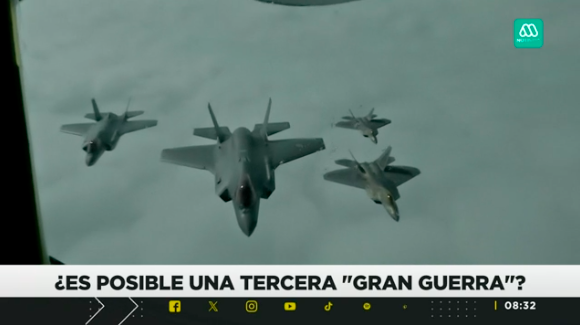
During the early hours of Monday, June 16, various flight geolocation platforms reported the takeoff of 32 tanker aircraft from the United States heading east. This was the first indication of the military actions that the North American nation would undertake days later.
Although Washington asserts that it was not a declaration of war against Iran, many view with skepticism that this is the beginning of a conflict that could escalate into a third world war.

Is a third world war possible?
The U.S. attack has raised questions about a potential military escalation on a global scale. Guillermo Holzmann, an international analyst, suggests that “today, the possibility or probability of a third world war, on a scale from one to ten, I would say that it is at three or four.”
He explains that the main global actors – the United States, China and Russia – agree that Iran should not gain access to nuclear weapons. “It is unknown how they might use it given the theocratic mindset of the Shiites who govern Iran,” he states.
The executive director of AthenaLAB, Juan Pablo Toro, dismisses the notion that the U.S. attack is aimed at escalating the conflict.
“Basically, it launches an operation to neutralize their nuclear program and thereby prevent them from ever having an atomic bomb, a nuclear bomb. So, it is a very calculated, very specific operation, not intended to open a larger war,” he asserts. So far, no attacks on civilian or military facilities have been reported.
Reactions from Iran and possible reprisals
The Iranian response to the attack remains uncertain. An advisor to the Supreme Leader Ali Khamenei stated: “The political and operational initiative is now on the side of those who play intelligently and avoid blind attacks. Surprises will continue.”
Juan Pablo Toro notes that “Iran has been saying a lot that there will be greater reprisals, threatened by Israel, but we are not seeing those reprisals“. He also highlights the lack of reaction from defense systems: “Iran was unable to detect this impending attack, its air defense did not react, and it seems its early warning and control radars no longer exist”.
Toro adds that Iran could attempt to block the Strait of Hormuz, a strategic route for oil transportation. “China, Turkey, India, they are the ones who should primarily seek some diplomatic avenue, I believe that China and India,” he suggests.
Developing scenario and diplomacy as a pathway
For now, there is no clear intention from international powers to intervene directly. “Iran has been cautious, it has been prudent, so prudent that just a few days ago it sent its own foreign minister to negotiate with European countries, precisely in Europe,” states Guillermo Holzmann.
The analyst warns that the coming days will be crucial: “We are in the next 72 hours of heightened tension regarding how that negotiation is channeled. First, what Iran needs is for the regime to remain in power; second, there needs to be a ceasefire, for Israel to stop attacking it; and third, Iran needs to continue enriching uranium.”
Uncertainty persists as the decisions of world leaders will determine whether the conflict remains a regional episode or escalates into a larger confrontation.


