COLUMN | The Armed Forces and Domestic Security
This article was translated automatically and may contain differences from the original. For reference, read the original.
- by Richard kouyoumdjian
- Opinion
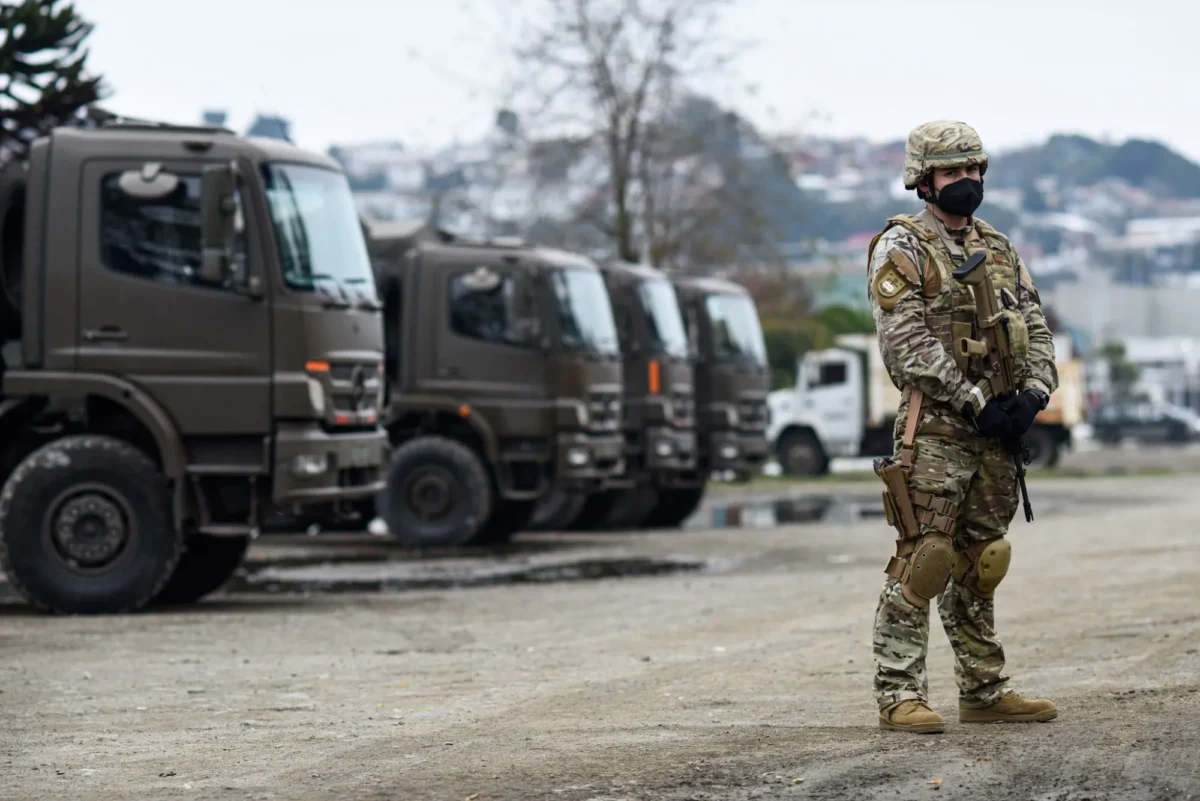
The situation in the Southern Macrozone is a national security issue, as is the vulnerability of our northern and northeastern borders against the entry of undocumented individuals and criminals. However, it is another matter to suggest that the only solution is the use of the Armed Forces as a scarecrow, which is the solution that politicians typically prefer.
Recently, the Ministry of National Defense ordered an increase in territorial control operations related to the security of critical points, mass patrols, and integration with aerial and police resources in the Southern Macrozone, specifically in the La Araucanía region, which includes the provinces of Malleco and Cautín. These provinces have been under a state of constitutional emergency since May 2022, marking the longest period of exceptions on record, possibly surpassing those during the military government. This indicates that it is very likely we will reach March 11, 2026, under a leftist government in this condition.
The increase in operations is a response to the murder of a security worker from CMPC in Victoria. On Saturday, August 23, after 10:00 PM, an incident occurred in which a colleague of the deceased was also injured. Available information suggests that the motive was not robbery, but rather a terrorist action by one of the various Mapuche insurgent movements seeking territorial claims and sovereignty over the area.
As previously indicated, in the Southern Macrozone, and sometimes in its broader version, which includes the regions of Los Ríos and Los Lagos, we have activity from Mapuche insurgent groups seeking to displace the State of Chile,, replacing it as the representative of the sovereign people of those territories. Those inexperienced in these matters mistakenly refer to it as rural violence, crime, and more recently, terrorism, failing to recognize that the violence is permitted or instigated by the aforementioned insurgent groups, which, in order to survive economically, allow the existence of criminal organizations engaged in illicit activities, requiring them to leave part of their profits in the insurgents’ coffers, similar to how the FARC collected from drug traffickers’ earnings.
Traditionally, those who suffer the most are non-Mapuche farmers and the forestry companies operating in the La Araucanía region. The insurgent movements aim to expel them from the area and take their land, a matter that was unfortunately not well addressed by the Peace and Understanding Commission, which focused more on historical Mapuche grievances and less on seeking to reduce insurgent violence.
Now, if we do not want to acknowledge that we are facing insurgents but rather believe we are dealing with criminals who occasionally commit terrorist acts, the question is why do we use the Armed Forces as part of the state’s resources employed to address problems that we declare to have a criminal or terrorist nature, rather than necessarily a military one?
The answer is simple, because we do not have other resources available, and to do so, we exploit the loophole of the state of emergency that allows their use in domestic security tasks. We do this with the approval of the entire political system, from both the left and the right, which accepts and allows us to remain in this condition for four consecutive years, approving the renewals requested by the Executive every 15 days. We do this because we do not have enough police officers, and because the Armed Forces in a frightened Chile convey confidence and tranquility to both the right and the left.
Some problems that arise from using the Armed Forces for extended periods in public security tasks are:
-Their design and capabilities are not oriented towards domestic security in the Southern Macrozone or the northern and northeastern borders. The Armed Forces are designed and equipped to defend territory and sovereignty against military threats, not to be part of the public force, which is composed of the two police forces we have. For this reason, after each rotation, we must retrain them for military purposes, and before each deployment, we must prepare them for this unusual task.
-The Armed Forces of Chile in 2025 are high in technology and low in manpower,, which is something that is required for operations in the regions of La Araucanía, Biobío, and the borders with Peru and Bolivia. Conducting domestic security with military personnel requires them to be trained for it, and due to its legal complexity, it is not something for which we can use conscripts or the substantial reserves we have. Military personnel do not join the Armed Forces to perform domestic security duties. If they had that vocation, they would have joined one of the prestigious police forces we have.
-The rates of personnel retirements related to these deployments have been increasing. We are losing qualified and trained individuals for warfare due to their frequent use in atypical tasks, which affect their family and personal lives, with some retiring even before qualifying for a pension after 20 years of service. They prefer to work in private security rather than endure the wear and tear that comes with being frequently deployed in the Southern Macrozone or northern borders.
-They are not police forces and therefore lack the legal authority that they possess, which diminishes their effectiveness. Their preparation, training, and doctrine are oriented towards warfare, not combating criminal or delinquent organizations.
If, in an act of political honesty and courage, we acknowledge that we are indeed facing insurgents, and that therefore the only solution must necessarily be military in nature, and understanding what that entails, we decide to act, accepting that there will be casualties, we will have taken a significant step towards solving the problem.
We are talking about conducting a very rapid armed surgical intervention, one that seeks to prevent the Southern Macrozone from entering a state of greater social agitation due to armed action. We can perfectly dismantle and imprison most of the active insurgent groups in a short time, using the Special Operations Brigade and the Marine Infantry. We would only need to update the information and prepare the counterinsurgency operation. This would resolve the problem and end the ineffective states of emergency that are nothing more than a panadol or an aspirin to reduce fever by using the Armed Forces as a scarecrow, something the insurgents are aware of, which is why they continue to operate.
It is clear that the situation in the Southern Macrozone is a national security problem, as is the vulnerability of our northern and northeastern borders against the entry of undocumented individuals and criminals, but it is another matter to suggest that the only solution is the use of the Armed Forces as a scarecrow, which is the solution that politicians typically prefer, as it allows them to wash their hands of the issue and avoid addressing the problem of the insurgents who kill police officers and civilians, deaths intended to generate panic and despair among the populace.
I do not expect much to come from the increase in operations by the Army in the La Araucanía region. We are not changing the concept of operations; we are merely increasing the dosage of panadol or aspirin. With this announcement from the Ministry of National Defense, we are not seeking to resolve the underlying issues, but rather, in my opinion, they aim to appear tougher and action-oriented at a time when the government and its continuity candidate need to show that they are doing something—something that sounds good and looks good, but is nothing more than increasing the number of scarecrows deployed along the main routes of the Southern Macrozone, leaving the resolution of the problem to the next government, which has been the trend in recent Chile, leaving the “mess” for the one that follows.
If we want to give a different use to the Armed Forces and incorporate them into the public force, let us have the debate, and if that decision is made, let us incorporate it into the Constitution and in the mission areas, we assume the costs, review the equipment and personnel we would need, and ultimately put an end to the cynicism of having them dedicated to exceptional tasks that are no longer exceptional.


