COLUMN | Do We Need More Soldiers, Marines, and Carabineros?
This article was translated automatically and may contain differences from the original. For reference, read the original.
- by Richard Kouyoumdjian
- Opinion
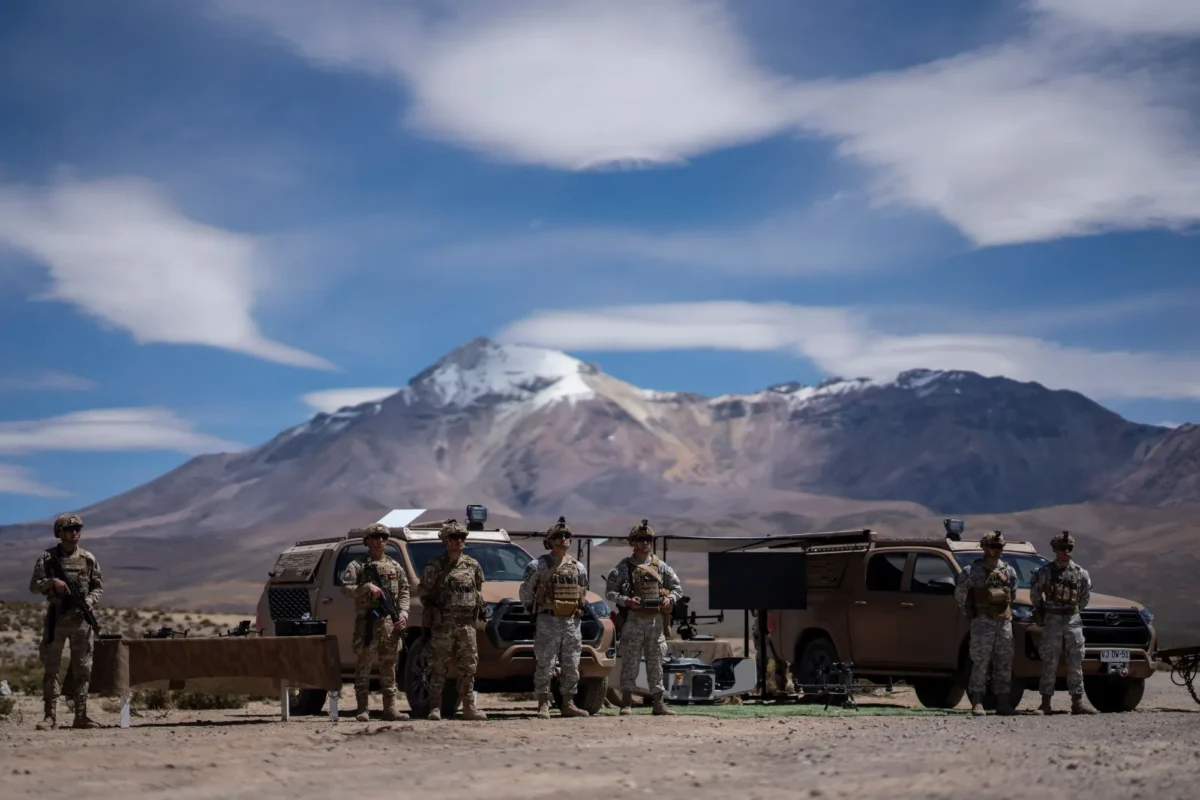
The primary role of the State is to provide security to its citizens. The priority is not to be a welfare state. Not being clear about this has led us to our current situation, which requires investment in security and defense.
The strategies of all presidential candidates are based on the premise that more Carabineros, Army soldiers, or Navy Marines are needed, but none of them are very precise in indicating where they will come from, how they will be financed, or when they will be available for deployment in safeguarding the northern and northeastern borders, or in the Southern Macrozone. Everything may be planned and clear, but if it is, it has not been communicated to the public, nor to the specialists who could review whether it is feasible and logical.
On Thursday, October 16 at 09:30 hours, the AthenaLab research center will hold a seminar in which the three main candidates will present their programs on international relations, national security including public safety, and national defense. The conclusions of this seminar will be public and will be available in video format on the website after its completion.
All programs address public safety issues, insurgency in the Southern Macrozone, and safeguarding the northern and northeastern borders with a combination of human and technological means, but they differ in their strategies for use and objectives. For now, everyone assumes that the Army and the Marine Corps will continue to be deployed in the Biobío and La Araucanía regions, as well as, in the case of the Army, at the borders with Peru and Bolivia. Carabineros will obviously continue to be present in both locations.
It is not that I want to repeat myself, but it is important to remember that both the current Army and Marine Corps are high in technology and low in human resources, unlike in the past when they were exactly the opposite, low in technology and high in the number of soldiers. In the case of the Army, it should also be noted that they are no longer distributed across all major cities in Chile, but rather in locations that make strategic sense for their primary function, the protection and safeguarding of national sovereignty and territory. It is also worth noting that it has ceased to be a conscript Army, with conscripts now representing no more than 25% of the force, or 30% if we include professional soldiers (conscripts who can serve for a couple of years or more in the institution).
We must not forget that the budget for the Army and Navy for 2026, which is similar to the original budget for 2025, barely covers existing salaries and general expenses. We are already aware of the significant current deficit, a deficit that is not fully corrected for 2026, since, if the cuts made in January are restored, the deficits generated by the higher allowances now received by law conscripts persist, and this will increase even more as we approach 2026, along with unreimbursed expenses for deployments in the south and north for internal security tasks.
The Army currently has fewer than 9,000 conscripts across the two contingents. The days when annual conscription exceeded 10,000 or military service was only one year are long gone. Professional soldiers do not exceed 2,000, despite the original plan for them to number 7,000. Professional soldiers are a cost-effective solution. They are conscripts who stay for an additional period in the Army, are already trained, and are capable of performing more sophisticated tasks such as deployments to the macrozone or the borders. The problem is that their salaries are low, and additionally, because they are very good, they are sought after by private companies.
The Marine Corps is structured as an expeditionary amphibious brigade. Having permanent deployments in the Southern Macrozone is challenging for them because they are few in number, as, like the Army, they have Marines deployed in the field, they have personnel on deployment who need to retrain for their primary role, and they have those preparing to go south. All of this over nearly four years is very exhausting, especially without special economic compensations and support for the lower ranks. Their families suffer, and they suffer even more knowing that they are essentially being used as scarecrows. It is not surprising, then, that retirements, particularly among the lower ranks, are above the average for a normal year. The project to increase salaries for the lower ranks is sitting in the drawer of the Minister of National Defense due to lack of funding from the Treasury. The
Carabineros are always present, and we all want more of them. The problem is that those who come in replace those who leave. The effective number of Carabineros has not increased despite government plans to boost the force. Increasing their numbers requires training facilities that do not exist, as well as nonexistent budgets and equipment. Increasing the force by 10,000 could easily take about four years if we are very diligent, fund what that entails, and dedicate significant efforts to make it happen. It would help, however, to remove them from palace guard duties, parades, equestrian presentations, musical events, and event security. They should focus on their primary responsibilities: public order and safety. By doing this, we could free up a couple of thousand, but it is likely that they will not like it, as it affects their traditions and the fact that they are a military-style police force. With all this preamble, it should be clear that any day-one solution involving the intensive use of military troops and Carabineros must be carefully analyzed.
Of course, it is possible to increase the numbers of the Army, the Navy Marine Corps, or Carabineros, but this requires time to complete the desired force levels and funding both for the new positions and to improve the conditions of those currently in service, particularly for the lower ranks. One candidate indicated that within a year, the problem in the Southern Macrozone could be resolved, which is already a step forward both in addressing and solving the issue, as well as in freeing up personnel who are not being used efficiently. To do this, it must be recognized as a national security problem, involving insurgents, and therefore, the solution is more military-political than police-oriented, which obviously requires military troops, police, intelligence, and all state agencies. It could also be done in two weeks, but it must be clear that there will be casualties on both sides. Obviously, it will require support from Congress because any major solution involves declaring a state of emergency and guarantees for the military and police that they will not be unjustly prosecuted. Obviously, the intervention would be under military justice, with specialized troops from the Army (BOE), Marine Corps, and GOPE.
There is consensus among specialists that the Army should return permanently to the borders and, moreover, that a specialized unit should be created for the northern and northeastern regions.
This should be incorporated into their mission areas, but first, it must be reviewed what is expected of them and where the difference lies with the tasks performed by the police. Maintaining the current situation, under the guise of critical infrastructure, similar to the application of a state of emergency, is not appropriate both because it ultimately affects the capabilities of other military units and because, although it is producing results, it is not designed for permanent application. It is clear that any definitive solution takes time. Perhaps the most appropriate solution would be to create a unit similar to Argentina’s Gendarmerie or a border protection force like that in the United States.
It is an effective solution, but it requires personnel and funding. If it were to exist, it should report to the Ministry of Public Security. This would free Carabineros and the PDI from that task and would be supported by the Armed Forces for anything more complex. Returning to possible immediate emergency solutions that are currently in vogue, which require soldiers or Carabineros. They do not exist unless the reserves are called up or schools are taken to the streets. For this, a state of emergency would need to be declared, with support from Congress, and obviously, funding, because everything costs and nothing is free. I raise this because, aside from the issues already mentioned that concern us,
there is a significant possibility that the left will take to the streets as they have in the past. Being prepared for this is important , especially considering that the Carabineros of Chile do not have the capacity to simultaneously address public order issues while also managing the public safety aspects that currently overwhelm us.In summary, what I have sought in this column is to shed light on solutions that require soldiers, Marines, and Carabineros. We have too few of them, and they are neglected, and therefore, any strategy that considers their employment, whether in the current form or in more intensive forms, must start by understanding where we stand. This will allow us to determine how many we need and what the cost is, something relevant in a Chile that wastes resources and is underfunded.
The Southern Macrozone has solutions, but they require political support. The northern and northeastern borders face more permanent phenomena, and therefore their solutions must be long-term.
We cannot neglect them and go through the experience of losing control over those who enter Chile illegally again.It is the return of the left to the streets that concerns me; I am very worried because currently, we have no alternative unless it is schools or reserves. To conclude, please do not forget that the primary role of the State is to provide security to its citizens. The priority is not to be a welfare state. Not being clear about this has led us to our current situation. This requires investment in security and defense, which involves soldiers, sailors, Marines, aviators, Carabineros, and investigative police.


