COLUMN | José Antonio Kast and National Defense
This article was translated automatically and may contain differences from the original. For reference, read the original.
- by Richard Kouyoumdjian
- Opinion
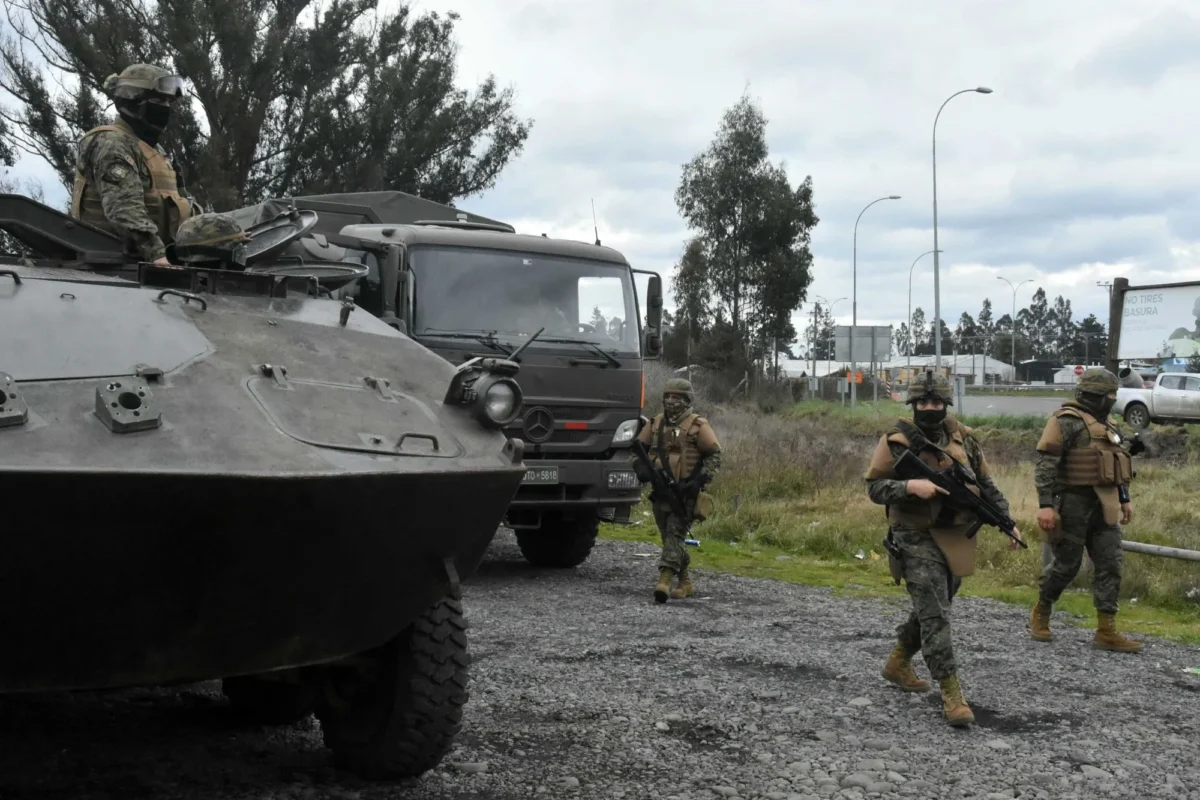
Considering the limitations of resources and the need for political and legal support, the Armed Forces can and are capable, for limited periods, of assisting in addressing the security emergency.
The column from last week focused on Chile’s internal security, this week’s on National Defense, and the next will address Chile’s foreign relations strategy, all strategic topics that are the main components of what is understood as National Security.
The challenge for José Antonio Kast’s government regarding National Defense is that, with the expectation of significant participation from the Armed Forces in addressing the security emergency we are experiencing, the essence and constitutional purpose of Defense and the institutions that comprise it should not be lost, which is the protection of the territory, sovereignty, and political independence of Chile, as well as safeguarding the national interest wherever it may be located.
During the current government, which is nearing its end, National Defense and the Armed Forces were not a priority, just as they were not in previous administrations. It is one thing to use them to address the problems we have at the northern and northeastern borders, and in the Southern Macrozone, or to manage and resolve frequent natural disasters, and another to have a genuine concern for maintaining their strategic capabilities and operational capacity, so that we can generate credible and sustainable deterrence over time, something that is currently debatable due to many years of ‘continuity’ budgets and a lack of rigor regarding force development, which was supposed to be addressed by the law on financing strategic capabilities.
Can the Armed Forces be used for the security emergency? It is not ideal, but they can clearly do so, and they can do it from day one of the government, which will likely be led by José Antonio Kast. A significant part of the Squadron and the Submarine Force of the Chilean Navy can be deployed to the north and support all aspects of vessel control aiming to ensure that drugs, drug traffickers, criminals, and illegal immigrants do not enter Chile by sea.
They can do this for a limited time due to budgetary constraints, but they can do it. Their presence would enhance the effectiveness of the limited resources currently available to the maritime police assigned to the north. The Army can do something similar at the northern and northeastern borders with its modern brigades located in Arica, Putre, Iquique, Antofagasta, and Calama, which, although designed to address and resolve issues with foreign armies, can exceptionally perform border functions, as they must not forget that they are combat military forces, a capability that must be trained and maintained.
The units just mentioned are currently sustaining the bulk of the ongoing effort, but they could clearly, for a limited time, help achieve a more airtight closure of the borders if they are fully dedicated to this task rather than partially. To make it sustainable over time requires professional soldiers, who are very scarce, with only 1,000 out of a total of 7,000 that we should have. Calling up reserves is not an option as there are not large numbers with the appropriate level of training.
Clearly, much has been learned since the Army began supporting border activities. They have evolved from being little more than a scarecrow to a border force that has been improving its effectiveness day by day due to having learned to operate in high-altitude conditions and being equipped with appropriate technologies for the high plateau, both in quality and quantity.
Sustainable border efforts require not only the technology and means provided and operated by the Chilean Air Force (FACH), but also manpower, soldiers. This is the weak link that must be addressed by completing the authorized personnel levels, something that may take a couple of years.
With political will and declaring the issue of terrorism in the Southern Macrozone a national security problem, the Special Operations Brigade (BOE), along with the Expeditionary Brigade of the Marine Infantry, can be employed to neutralize the insurgent groups operating there. This can be done quickly and surgically, but it requires intelligence, and above all, political will and legal protection for the troops operating in the area. This is because an operation of this nature potentially involves casualties on both sides.
In any case, after four years of wear and tear, of employment under states of emergency not designed to do more than lower the temperature, but which did not seek to resolve the problem, their use to attack the root cause of the issue is not a bad idea, rather a very good one.
In conclusion, considering the points made in the previous paragraphs regarding the limitations of resources and the need for political and legal support, the Armed Forces can and are capable, for limited periods, of assisting in addressing the security emergency. To make this more permanent, financial and material resources are needed, and above all, soldiers who currently do not exist or are not in the budget.
Surely the Republican team responsible for National Defense matters has all of this in mind and perhaps more. Knowing them, I am very confident that this is the case, and moreover, everything must be planned. Seeking resources and soldiers will be their priority, as will ensuring that the security emergency does not mean that the Armed Forces lose their combat and deterrent capabilities, such as the ability to defend our sovereignty and the national interest wherever it may be located.
For all military efforts to be effective, it is recommended that the leadership of National Defense include ministers and undersecretaries with experience and knowledge in the field. Just as in public security, these are not the times for individuals who lack expertise. It is the time for professionals. If they also have some political experience, even better, but the main thing is that they know and have some command experience. There is no time to learn; we are talking about an emergency, and emergencies require qualified and prepared authorities, ready to act.
The good news is that there are professionals available in National Defense matters, both among the Republicans and the right in general. The time has come for generals and admirals; let us be bold, just look at Argentina, where the current army chief is soon to assume as the Minister of Defense of that country, a good idea, but even better if the chosen one has been retired for a few years to avoid conflicts of interest or noise, as was the case with Admiral Arancibia, a situation that still unsettles some.


