Rearmament of Argentina and Peru?
This article was translated automatically and may contain differences from the original. For reference, read the original.
The Peruvian Air Force is finalizing a contract to purchase new, state-of-the-art F-16s, which could eventually jeopardize our air superiority if we do not ensure that our own aircraft are adequately modernized.
In some Chilean circles, there is concern about the investment in strategic capabilities being undertaken by our Argentine and Peruvian neighbors. What they are doing is more of a recovery of capabilities, after years of disinvestment or lack of concern for the defense material and capabilities of those countries, rather than a rearmament.
The most dramatic case is that of Argentina, a country that has lost the capabilities it had in the 1980s, to the point of being practically stripped bare. With the tragic sinking of the ARA San Juan, they are left without submarines, with modern French maritime patrol vessels, but few operational combat ships and naval air force assets; without supersonic fighter-bombers, little or nothing in terms of armored material, and with very complex morale and working conditions.
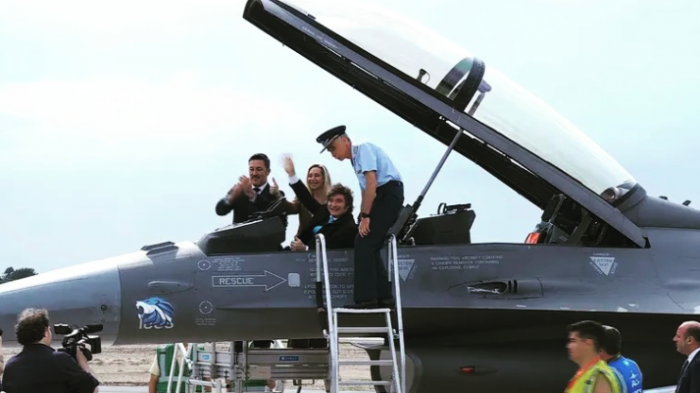
Under Milei’s administration, a recovery has begun that includes the purchase of 26 second-hand F-16s, which are in good flying condition and relatively modernized. The reception of the first six, a couple of weeks ago, resembled when their national team returns victorious from a World Cup. The remainder will arrive in the next two years, and for now, in terms of air capabilities, that is what is planned. Getting the machinery up and running to operate the 26 is not free, as it requires a significant logistical investment, since their bases were not prepared to operate the purchased aircraft.
In parallel, they have received American assistance to equip themselves with P-3C maritime reconnaissance aircraft, which adds to the purchase of European-origin helicopters. The fleet is currently a secondary priority, as what matters to them in naval terms is to regain submarines. They are negotiating a contract with France for three Scorpene submarines, the same ones that Chile has. This would be under a future payment modality and for several billion dollars, as they will be new.
The army is seeking to recover its TAM tanks and recently received from the United States a shipment of just over 20 used 8×8 M1126 Stryker armored vehicles, which is already an advance, but insufficient for their needs, which are estimated at just over 200. Being close to the Americans has clearly helped them in this re-equipping effort, which, although heavily based on second-hand material, is already a notable advance compared to where they were positioned.
On the other hand, Peru is making efforts in naval construction. In this area, they are being supported by shipyards from South Korea, with which they are building logistical vessels and a first frigate. The idea is to completely replace their fleet and support ships with locally built naval construction at their SIMA shipyards, with the aforementioned Korean support, which, if successful, will be used to renew their entire navy, including their submarine force, something recently announced by Peruvian naval authorities and their Korean partners.
The submarine force is quite old, despite having been modernized several times, but reaching the limits of what engineering can do to keep them operational. Their renewal, like that of Chilean submarines, is not cheap, but any navy worth its salt requires them, as they provide significant strategic capabilities that only submarines can offer.
The partnership with the Koreans includes the renewal of armored material and artillery, which distances the Peruvians from the Russians, historical suppliers of that type of material. It is a good example of Peru’s realignment in defense and foreign relations.
The Peruvian Air Force is finalizing a contract to purchase new, state-of-the-art F-16s, which could eventually jeopardize our air superiority if we do not ensure that our own aircraft are adequately modernized. Chile has enjoyed strategic capacity in this area for years, providing us with peace of mind and neighborhood security. Allowing Peru to get ahead is not something we want.
In conclusion, the efforts our neighbors are making have a logic of recovering lost and neglected capabilities over the years. This is something we cannot allow to happen in Chile, as if we do, we will find ourselves in the position they are in now. The security of Chile rests on having modern, effective, and credible deterrent capabilities. We still have that, but it is something we must invest in. Maintaining our air, armored, naval, and submarine capabilities must be one of the strategic objectives of the new administration.