Chile and Argentina: Towards a New Aspiration and Regional Identity?
This article was translated automatically and may contain differences from the original. For reference, read the original.
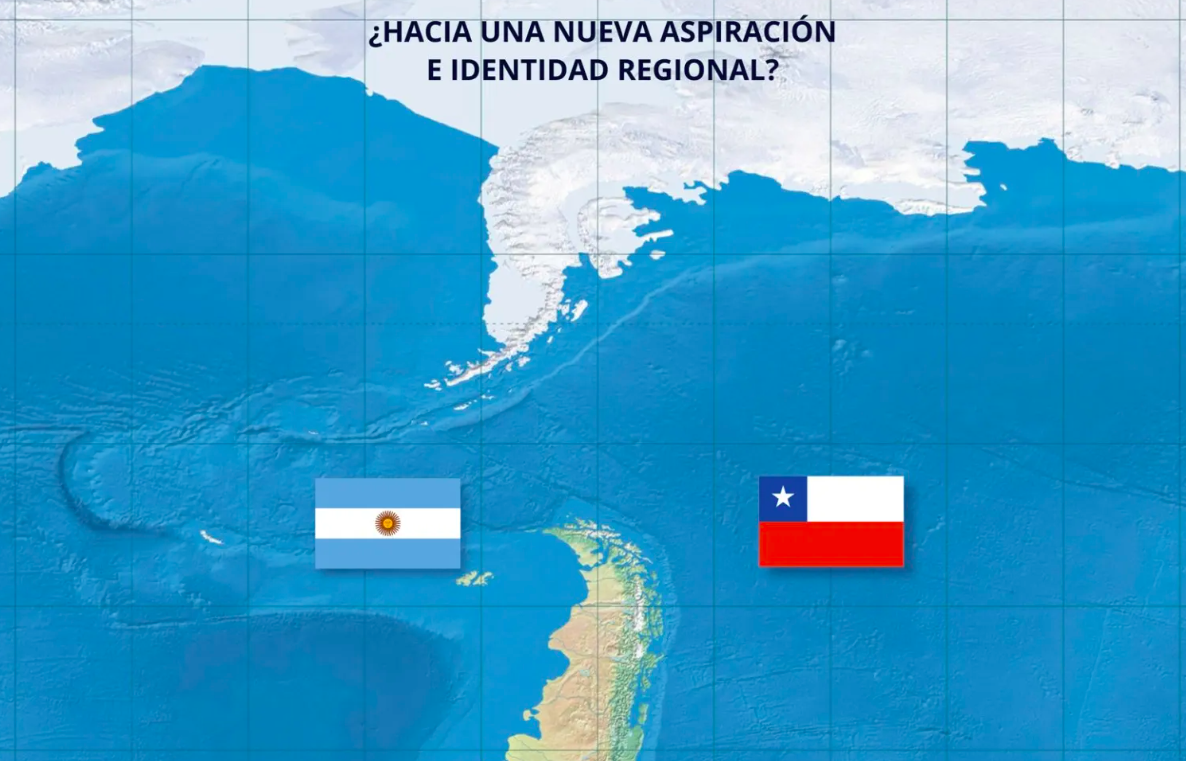
I invite you to view the map of the Southern Cone of South America from a different perspective, one that strongly unites and connects us with Antarctica and the surrounding seas.
One of the main current challenges, if not the most important in Chile’s foreign policy, is to establish a very good and stable relationship with its neighbors, particularly with Argentina.This is a country with which we share a very long border of over 5,000 kilometers, which, due to its length, sometimes divides us more than it unites us. However, for reasons of history, culture, and religion, it can certainly take on another value and significance—one where the whole is greater than the sum of its parts, where the economy, with the help of politics, can regain value as it had years ago when Chile ventured out in search of investments beyond its territory.
It is normal to have disagreements with neighbors, especially if those governing the countries have very different political ideologies or if the shared borders are very long, increasing the likelihood of friction points. The issue then is how these differences are managed and resolved, and if possible, how to transform the relationships between countries from problematic and noisy to constructive and positive.
In recent times, only during the governments of Menem and Frei were we closer to establishing fuller relations between both countries,a period in which investments were significant, we connected energetically, and made progress in defense matters. Unfortunately, the economic deterioration and disinvestment experienced by Argentina during Néstor Kirchner’s government affected the positive trajectory of our relations, a situation that persisted during the eight years of Cristina’s presidency and the government of Alberto Fernández that followed Macri’s, years during which Argentine foreign policy was dominated by hawks with expansive visions that necessarily went against Chile’s national interest, as they represented historical perspectives that always pointed south and west.
Evidently, we will not be able to immediately resolve the issues that separate us in the Southern Ice Field, or the overlaps that occur between the Chilean continental shelf and the extended Argentine shelf in the Austral Sea and southern maritime spaces,as well as the fact that both countries have overlapping sovereign spaces in Antarctica. These issues must be addressed professionally and in accordance with international law. The years when we were on the brink of war are behind us, but that does not mean we should do nothing. Issues must be handled under the principle of not coveting what belongs to others, the neighbor’s goods. If this is fulfilled, we have already made significant progress in a matter that quickly restores mutual trust and dispels ghosts of the past.
We cannot miss the fact that for the first time in a long time we will have right-wing governments in both countries, with common challenges in security, and with a desire for their economies to grow, to attract investments, to eliminate restrictions on entrepreneurship and business activity. Having Milei’s government rapidly fixing the Argentine economy, opening it to the world, and placing it on a level similar to that of Chile allows us to think big, to develop joint initiatives, in states of development and integration that were previously impossible to envision.
Beyond the economic realm lies the challenge of maintaining and increasing what has been achieved in previous years to bring both countries closer together. It is not that nothing has been done in the past; on the contrary, we already have initiatives such as the Combined Antarctic Naval Patrol,which has been operating since 1998, or search and rescue naval exercises in the Beagle Channel, which have been ongoing for 25 years, along with frequent equivalent activities at the level of the armies and air forces of both countries. There is clearly an effort at the institutional level to come closer and get to know each other, including participation in staff courses and officer specialties, with the greatest manifestation of integration being the Binational Peace Force Cruz del Sur,a joint binational unit created 20 years ago for United Nations purposes, which has never been used, but through its existence and training allows for a living connection between both bordering countries despite its apparent uselessness.
At one point, the idea of President Milei recreating the glorious Argentina of Julio Argentino Roca concerned Chile, but time has shown that this idea is more related to economic recovery than to the expansion efforts that Roca once represented. The recovery of strategic capabilities they are undertaking is not particularly worrisome, as it is more about reacquiring what has been lost through years of neglect and disinvestment in their national defense. Having a defenseless Argentina benefits no one.
The first trip of the elected President was to Argentina, a strong signal of what may come and of the spirits that inspire the relationship between both countries. A unique opportunity to address the issues that occasionally entangle us, as well as to tackle joint initiatives in security and economics, as experienced in the 90s.
Chile and Argentina are much stronger when looking at things united and operating as San Martín and O’Higgins did over 200 years ago when they together liberated Chile and subsequently Peru. Something that sounds easy, but will require strong political will, a perspective of the glass being half full, and neutralizing local and international voices that seek to separate us and keep us apart.
For now, I invite you to view the map of the Southern Cone of South America from a different perspective, one that strongly unites and connects us with Antarctica and the surrounding seas.


