The Cablegate Case and the Absence of National Security
This article was translated automatically and may contain differences from the original. For reference, read the original.
- by Richard Kouyoumdjian
- Opinion
Credit: @EmbajadaEEUUcl
The ones who failed were the Chileans. China and the United States are not to blame or responsible for what happened on Friday, February 20, 2026, or for the ills affecting Chile. We failed by not having a Chilean national security system that allows us to manage the challenges and threats of the 21st century.
The case of the Chinese cable that would eventually connect Valparaíso with Hong Kong has generated political and communication controversy, but above all, it is an example of the problems that arise when there is no national security system and architecture in place, and worse yet, when we navigate the world without strategic thinking, failing to understand what is happening in the global and hemispheric context, without a clear understanding of our own national interest and that of third parties with whom we interact, as well as the risks and threats we face.
Let us start with the fact that Chile, despite having a National Security Council, does not have a proper system, it lacks an architecture that addresses the issue, and there are no formal communications and coordination among the Ministries of the Interior, Foreign Affairs, National Defense, and Public Security. It also does not have a robust and effective intelligence system, something that the new law seeks to improve, nor does it have a presidential advisor responsible for security in its broadest sense, who ensures that we have a coherent and logical approach, allowing us to avoid beginner’s mistakes and meet the expectations of a medium-sized country like Chile, a tricontinental power in the Eastern South Pacific, with a soft power that exceeds its physical size, population, and GDP.
While it is true that the case of the Chinese cable is worthy of analysis, there are much more complex issues that no one at the government level is concerned about. Let us start with the economic dependence we have on China, both in exports and imports. Many talk about diversifying our export matrix, but nothing effective is being done. We speak of opening up to Asia and India, but we do not do so with much strength and conviction. We are an open economy to the world, the kings of trade agreements, but also the kings of inaction and complacency, lacking strategic vision.
We know that we are champions in copper, lithium, and rare earths, but we do little or nothing to regulate investments in the mining sector. In current times, the possession of such raw materials provides a dominant position. I am not talking about their processing and marketing, but mere ownership already grants power. If we were consistent, we would be seeking to understand what sources of power Chile has, how we regulate them, and how we protect them.
Over 90% of our foreign trade is conducted via maritime routes, yet the investments and budgets allocated to the Chilean Navy, its capacity for projection, and the protection of Chile’s interests are minimal, merely for continuity. We assume, and wrongly so, that someone will take care of protecting our national interests beyond our territory, seas, and air and space domains. The naivety with which we navigate the world is very concerning.
We have reached such a level of naivety that it is the major powers of the world that today express opinions and tell us what we Chileans should be concerned about. It is fortunate that the issue of the Chinese cable arose. It is fortunate that Secretary Rubio revoked the visas of three officials from the current government. Otherwise, we would still be under the lethargy of February’s heat that puts the capital to sleep at this time.
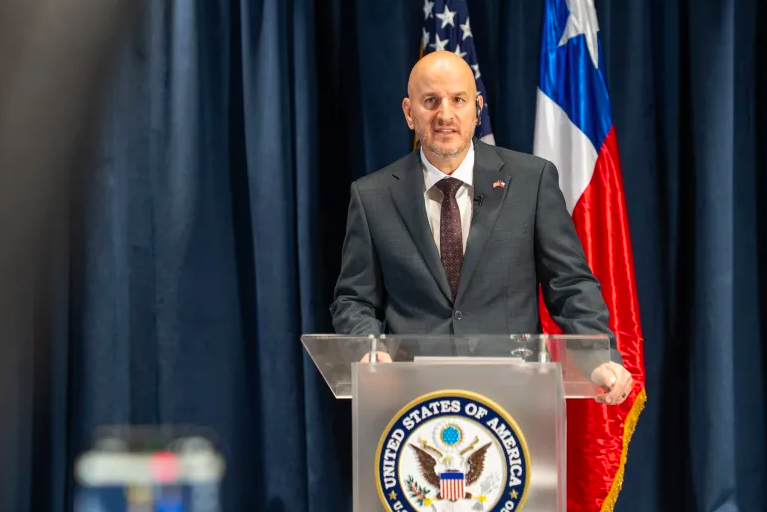
Ambassador Brandon Judd has done us a tremendous favor by reminding us of the issues we need to be concerned about, including the protection of data from the Civil Registry, the real capacity to prevent cyberattacks, and understanding the risks we face when opting for various technological solutions in telecommunications and data transmission. A submarine cable with Chilean oversight, like the Humboldt case, is very different from one proposed by China Mobile International, which lacks Chilean control over what enters and where everything is managed and monitored by the service provider.
Australia has approximately eight cables running directly from that country to China, but it has one of the strongest organizations for telecommunications and digital control in the world. The United States does not object to Australia having direct cables with China because it has the capacity to control what enters. If they have a structural dependence on having all their cables with China, which can be cut or disconnected at will, at least they know what information is transiting through them. Solutions like the Humboldt cable, which passes through their territory, allow them to mitigate their strategic communication dependencies.
Ambassador Judd indicated that we could eventually lose the Visa Waiver program, but he did not say it maliciously, he said it because we cannot assure them that the information they provide us is protected and free from cyberattacks. It has nothing to do with the Chileans, but if we do not provide assurances that their interests are protected, they will have no choice but to terminate the program that so many Chileans value. They recognize and understand what their national interests are and what affects their national security. For a better understanding, I recommend reading their recently published national security strategy.
A national security analysis begins by understanding who we are, our economic capabilities, with whom we trade and the dependencies we have, our geographical location, our energy supply, what interests and motivates us, who wants us and who does not, the objectives of our neighbors, our own military capabilities and those of others, the intelligence, counterintelligence, and diplomatic capabilities we possess, the challenges, risks, and threats we face, the capacity to manage public order, data protection, cyber defense, critical infrastructure protection, crime prevention and prosecution, and many other things.
National security is much more than public safety or national defense. It involves an architecture, a system, someone to manage it, a corporate governance structure, policies, and regulations. For more information, I recommend clicking here.
For now, let us thank the United States and China for opening our eyes and making us aware of our shortcomings. We got off easy. It only cost us three official visas. The challenge is to learn from what happened and understand that we cannot navigate this complex world without the compass provided by a national security system.
The ones who failed were the Chileans. China and the United States are not to blame or responsible for what happened on Friday, February 20, 2026, or for the ills affecting Chile. We failed by not having a Chilean national security system that allows us to manage the challenges and threats of the 21st century.


