War in the Middle East: the keys to a conflict that threatens to expand and prolong
This article was translated automatically and may contain differences from the original. For reference, read the original.
- por John Griffiths
- Entrevistas
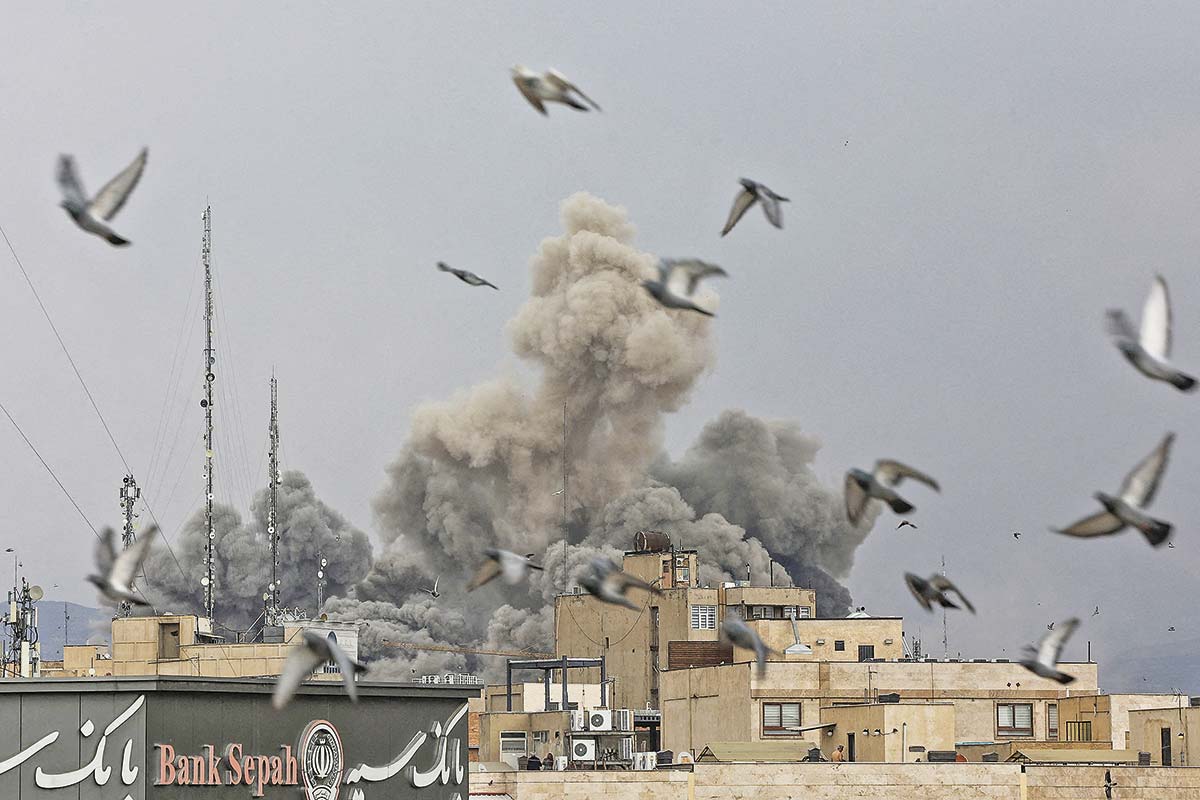
Teherán fue blanco de nuevos ataques de las fuerzas conjuntas de Israel y EEUU este lunes. La Media Luna Roja cuantifica más de 500 víctimas fatales. Fotos: Reuters
The joint operation by the U.S. and Israel aims for the definitive end of Iran's nuclear plans and the fall of the Islamic Republic. Iran has been able to respond forcefully even while in survival mode.
As Israeli and U.S. missiles continued to fall on Iran this Monday—on the third day of tension in the Middle East—Tehran persisted with attacks that broaden the number of actors involved in the conflict. A gas refinery in Qatar, another oil facility in Saudi Arabia and a British military base in Cyprus were part of the new targets of the Islamic Republic. Tel Aviv, for its part, also directed its artillery against Lebanon.
The survival of the Iranian regime after the decapitation of its leadership last Saturday changed the initial perspectives of its adversaries, opening the possibility for the prolongation of the conflict and, with it, a deepening of its economic effects. “We project four to five weeks, but we have the capacity to go much beyond that (…) Whatever the time, it is fine,” stated U.S. President Donald Trump this Monday at the White House.
The high levels of uncertainty correspond to “a world that has changed. We no longer have the Cold War international order, nor the perspective of relevant global institutions, nor international law as we knew it,” we are in a “transition” scenario that is accompanied by an increase in armed conflicts, posits the executive director of AthenaLab, John Griffiths.
1. What led the U.S. and Israel to decide to use force
The United States called it Epic Fury, while Israel referred to it as Lion’s Roar for the large-scale joint military operation they are conducting against Iran. Despite the different names, both nations share objectives: the definitive end of Iran’s nuclear plans and the fall of the Islamic Republic.
Tomahawk cruise missiles, one-use attack drones, and fighter jets such as the F-22 Raptor and F-15E Strike Eagle have been part of a deployment that, according to AthenaLab’s executive director, John Griffiths, seeks to stop “nuclear Iran.” He argues that “this attack undoubtedly reflects that the objectives set last June did not fully deter or destroy the political authorities (in Iran) from continuing with the nuclear program.”
A report from the U.S. think tank Atlantic Council emphasized the goal of regime change. Its Middle East researcher, Nate Swanson, stated that “by launching a massive joint attack with Israel against Iran, Trump bets that he can inflict enough damage on the fundamental political and security institutions of the Islamic Republic to bring down the regime.” In this context, he recalls that “Trump has defined a successful campaign as one in which the Iranian people rise up and end the Islamic Republic,” which he believes is not easy to achieve. “Without ground troops or an armed opposition, this requires significant defections within the Iranian security apparatus. Is there a plan to achieve this?” he poses as a question.
Another interest of Washington is to avoid getting embroiled in a prolonged conflict in the region. “The U.S. cannot wear itself out in a secondary theater of operations, no matter how relevant it is, because if it does, it will end up extremely weak or compromise its capacity in the event of a potential confrontation with China, which is its main adversary,” explains Griffiths.

2. Iran’s response and resistance
Iran has been able to respond forcefully even while in survival mode, after the initial attacks it received resulted in the death of its supreme leader, Ayatollah Ali Khamenei; the commander-in-chief of the Islamic Revolutionary Guard Corps (IRGC), Hossein Salami; and the chief of staff of the Armed Forces, Mohammad Bagheri.
On the same Saturday, the Islamic Republic launched a broad campaign of counterattacks with ballistic missiles, drones, and other munitions directed at multiple military targets and regional territories. According to the latest reports, Iranian attacks have impacted Israel, several military bases, and U.S. allies in the region.
The persistence of its strategy in recent days indicates that “the Iranian leadership has regrouped (…) There was a change in the actors, but that does not mean a regime change. Iran still has the capacity to articulate decisions,” analyzes Griffiths, who is also a former officer of the Chilean Army.
In a similar vein, Atlantic Council researcher and former national intelligence officer for the Middle East at the U.S. National Intelligence Council, Jonathan Panikoff, indicates in the cited report that “neither protests nor airstrikes alone will end the regime’s control. History suggests that it will be necessary for the various Iranian security forces to step aside, as happened in 1979, or at least for part of the security apparatus to join the opposition.”
Nonetheless, the economic crisis preceding the attack, which led to massive protests, had already put the country in crisis. This, combined with the decapitation of its leadership, over 500 civilian deaths from the attacks, and the weakening that a war effort entails, leaves Iran “in its most complex political moment,” indicates Griffiths, who argues that Iran must be the most interested in negotiating an exit from the conflict for reasons of survival.
Paradoxically, it is that same vital objective of the regime that is at stake in the insistence on nuclear development, which could hinder a successful dialogue between the parties and, therefore, the end of hostilities.
3. The possibility of regional and global expansion of the conflict
Despite Bahrain, Kuwait, Qatar, the United Arab Emirates, Saudi Arabia, Jordan, Iraq, and Cyprus being the scene of attacks by Iran, mostly targeting U.S. military bases in those countries, there are doubts that the conflict will fully develop regionally. In fact, as of the closing of this edition, none of the mentioned nations had retaliated.
“Regionalizing the conflict, I believe, does not go in the right direction of the interests of those who decided to use force. That would affect the political objectives defined for the use of military force,” indicates Griffiths. “I believe the U.S. will make every effort to ensure that, despite the Iranian reaction, this does not mean expanding the conflict regionally,” he adds.
He sees it even more difficult for actors outside the Middle East to take on a belligerent role. In his view, Europe and NATO are more concerned about the conflict with Russia, a country that, in turn, would have difficulties supporting Iran given the four-year effort it has required in the war in Ukraine. Meanwhile, China “understands that its main future contender is the U.S., so it sees itself benefiting from U.S. participation in any conflict that diminishes its capacity not only economically but also militarily.”
4. Oil supply at risk. Is this an opportunity for Venezuela?
Beyond the geopolitical analysis, to date, three ships have been attacked near the Strait of Hormuz, through which 20% of the world’s oil supply passes. This Monday, international maritime transport in the area came to a halt.
This is in addition to the closure of the state oil company Saudi Aramco, located in Ras Tanura, after it was attacked by a drone, causing a fire at the facilities. For its part, Qatar Energy announced this Monday that it halted its liquefied natural gas production due to attacks on the Ras Laffan and Mesaieed plants, located in the same industrial city that houses the oil company.
The energy impact does not stop there. Companies DNO, Gulf Keystone Petroleum, Dana Gas, and HKN Energy, located in Iraqi territory, have also halted their operations as a precaution. Meanwhile, the Israeli government ordered Chevron to temporarily close the Leviathan gas field.
Regarding whether this could be an opportunity for Venezuela, whose oil production is developed in partnership with the U.S. following the operation that led to the capture of Nicolás Maduro earlier this year, experts believe that it will depend on whether oil prices remain high in the coming months.
In the short term, energy expert at the Baker Institute of Rice University, Luis Pacheco, indicated that the most evident outcome would be that “investors will view Venezuelan risks more generously because they will seem less risky compared to the Middle East.”
5. The economic footprints of the conflict
Amid the enormous disruptions in the oil and gas market, experts estimate that the global economic consequences will depend on the duration of the conflict.
This is because, if military activity keeps energy prices high, the global economy would begin to suffer inflationary effects with rising prices in sectors such as food, agriculture, and industrial goods.
A reflection of these concerns was the movement in Treasury bonds. Although they had just recorded their best month in a year, thanks to the search for refuge amid losses in stocks, that position evaporated abruptly. The two-year yield rose by 10 basis points to 3.48%, while the ten-year yield rose by the same magnitude to 4.03%.
The result is that traders are now preparing for a Federal Reserve that will keep rates high for a longer period. “There is a risk of more inflation than is believed, and that could be a disaster,” declared JPMorgan CEO Jamie Dimon in an interview with CNBC on Monday.
6. Local alerts
At the local level, this Monday, in the context of the conference with analysts following the presentation of its results, Empresas Copec was asked about the implications of the current situation in Iran for its fuels division.
The company’s CFO, Rodrigo Huidobro, stated: “This is still a developing story, but in previous episodes, we have seen increases in oil prices in general, and this has a double impact on our business.”
“I would say, first of all, that a price increase usually means a revaluation of inventories, which is a short-term effect. But in the long term, it certainly means that if the increase is sustained, if it is significant and lasts for a long time, it generally means a decrease in demand and economic activity overall, which, of course, is detrimental both to the company and to consumers. So let’s hope this is resolved quickly.”