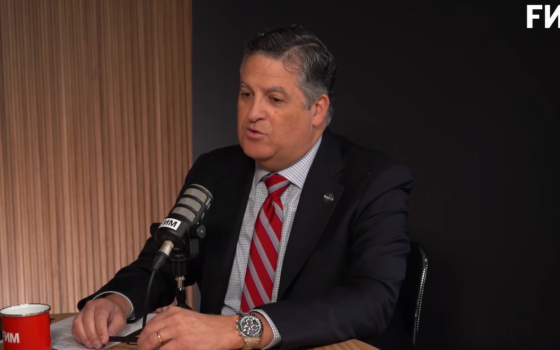
Richard Kouyoumdjian: "Sovereignty Requires Means, Not Just Will"
This article was translated automatically and may contain differences from the original. For reference, read the original.

Following the "Cablegate," Kouyoumdjian warns that Chile faces a structural dilemma: without capabilities in intelligence, cybersecurity, and regulation, digital sovereignty is merely declarative in an increasingly competitive global scenario.
The crisis triggered by the so-called “Cablegate” not only exposed an unprecedented diplomatic tension between Chile, the United States, and China, but also opened a deeper discussion about digital sovereignty, data control, and critical infrastructure.
In his column “Strategic Lessons from the Chinese Cablegate,” published by El Mostrador, the security and intelligence expert from AthenaLab, Richard Kouyoumdjian, warns that the conflict transcends economic issues and is at the heart of national security, where information control acquires a value equivalent to that of traditional strategic assets.
Based on this diagnosis and considering that the bulk of global data traffic flows through submarine cables – not satellites – Kouyoumdjian argues that Chile faces a turning point: to define whether it has the institutional, technological, and regulatory capabilities to exercise control over its own digital infrastructure..
In this context, we wanted to delve deeper into his main ideas.
-You argue that the conflict is not economic but about data control: what concrete implications does this have for Chile’s digital sovereignty in the short term?
-In both the case of the Humboldt cable and the China Mobile cable, the control of the cables lies with the operators. Chile could have digital sovereignty if it had the institutional framework and organization to control what goes up the cable, as is the case in Australia. To exercise sovereignty, not only will is required, but also means.
-If the United States considers a direct cable to Hong Kong without control unacceptable, what real margin does Chile have to make autonomous decisions regarding critical infrastructure?
-Chile has all the margins, but it must understand that in today’s world, one cannot serve two masters. We cannot, as the popular saying goes, please both God and the Devil. We must be clear about what our national interests are, as without that definition, we will not know how to address the issues we will have to decide upon.
-What cybersecurity and intelligence capabilities should Chile develop to be considered a “reliable partner” by the United States?
-State-of-the-art capabilities in data intelligence, counterintelligence, and cybersecurity. In this regard, we should resemble Australia and Canada, which are countries with which the United States collaborates on intelligence matters. Additionally, we must be aware of what is happening in Chile, and issues like the Chinese cable or the observatory at Cerro Ventarrones cannot come as surprises.
Moreover, with an ANI that has only 100 people and limited intelligence capabilities, we will not get very far. Intelligence is key to defending Chile.
-You mention that Chile lacks regulations on strategic infrastructure; what are the main regulatory gaps that currently leave the country exposed?
-What we have is very basic. There is no definition of what is strategic, and if there were, how to address it. We are champions in environmental matters, but not in issues that can pose a risk to national security.
-Is it possible to reconcile a deep economic relationship with China without straining relations with the United States, or does the current scenario force clearer definitions?
-We can perfectly maintain a deep economic relationship with China. They need our exports, but what we need is to have regulations for foreign investments when they touch on issues of data processing, storage, and transmission, such as telecommunications. The United States is interested in us continuing to trade with China, but not in allowing China to have influence in areas they consider sensitive.
In this sense, having clear rules for investments helps. It is also essential to have the necessary control capabilities to exercise digital sovereignty. With it, the Chinese cable would be a viable option. Without capabilities, issues like the Visa Waiver, which involve data connections, are at risk.
-In light of this case, what lessons does the “Cablegate” leave for future decisions in ports, energy, or lithium, where Chinese interests are also involved?
-That we must have control capabilities, as well as rules and institutions to manage strategic investments, not only from China but also from the United States, European countries, or any other. It is the only way to navigate a complex world. Amateurism is no longer acceptable.