COLUMN | Security and Defense Agreements with the United States
This article was translated automatically and may contain differences from the original. For reference, read the original.
- by Richard Kouyoumdjian
- Opinion
It is mutually beneficial and entirely logical for the entire region of the Americas, including the countries that did not attend last week's meetings in Miami, to act collectively against drug trafficking and other forms of organized crime.
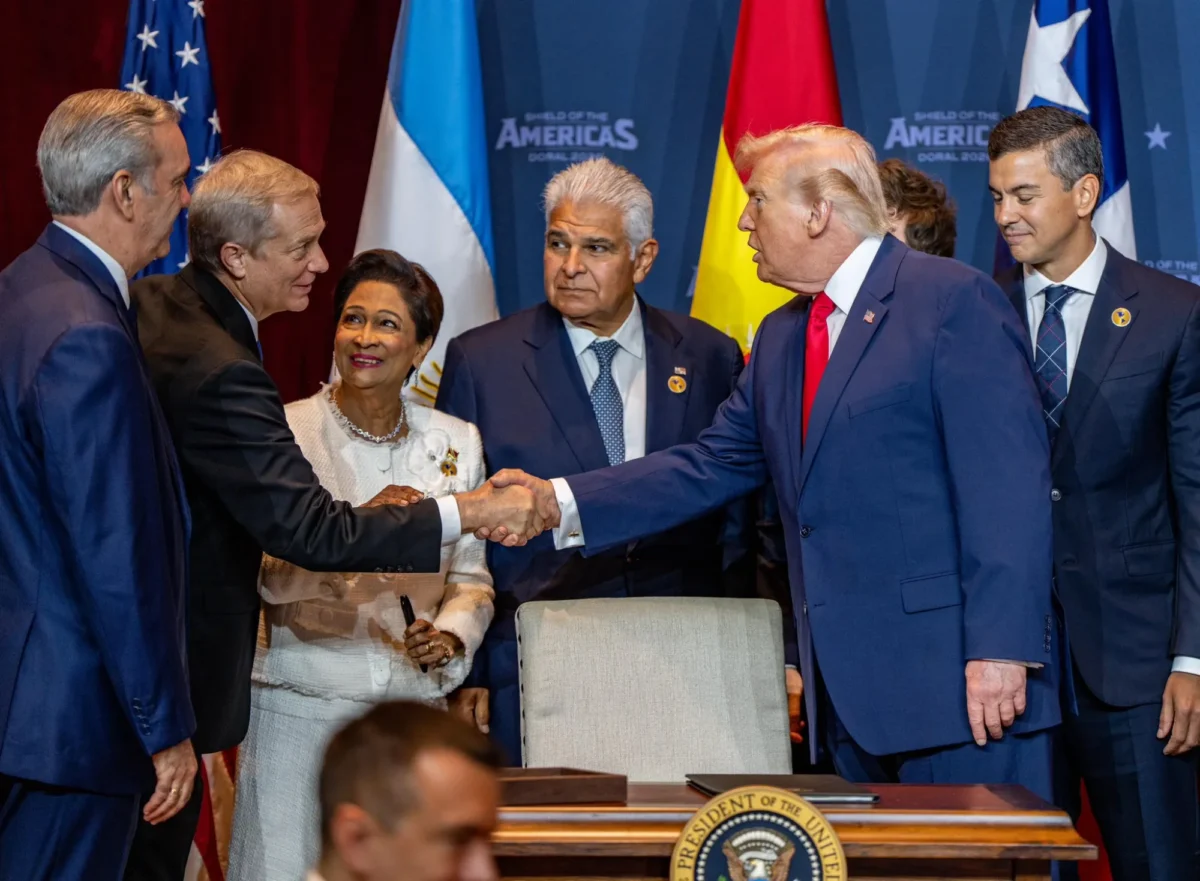
On Saturday, March 7, 2026, President Trump, along with 12 other leaders from the Americas, including the elected President of Chile, signed the agreement known as “Shield of the Americas”, an agreement that President Kast could not sign as he was not in office at that time, unlike the other attendees who were serving presidents.
The meeting, which aimed to establish a joint regional effort led by the United States against transnational organized crime affecting the entire American region, was not attended by important countries such as Peru, Canada, Mexico, Venezuela, Brazil, and Colombia, but countries like Ecuador, Argentina, Bolivia, El Salvador, and others from the Caribbean and Central America did participate.
The meeting was preceded by one held with the same purpose by defense ministers on Wednesday and Thursday of the same week, presided over by Secretary of War Peter Hegseth and the head of SOUTHCOM (U.S. Southern Command), General Donovan, and attended by the designated Minister of National Defense, Fernando Barros Tocornal, along with his designated Deputy Minister of National Defense, Vice Admiral (retired) Rodrigo Álvarez Aguirre.
The previous meeting, primarily attended by defense ministers, recalls the post-Cold War sentiment in Washington that Latin American countries did not need armed forces to face external enemies, but rather state forces, preferably militarized military or police forces, focused on eliminating or mitigating drug-related activities occurring in countries like Mexico and Colombia, where the FARC and other insurgent movements were also active, facilitating the existence of organized crime, which led to the famous “Plan Colombia,” which was in effect for at least 20 years in its most significant aspects.
It should be expected that “Shield of the Americas” will primarily focus on the countries that produce and export drugs destined for the North American market, as everything the United States does in these matters responds to what is important from the perspective of its security and national interest, something indicated in the strategy recently published in November 2025.
This does not mean that the rest of the region does not matter to them, but it is clear that this particular effort will focus on what affects them most directly. We have recent evidence that they are already taking action. They did so in Venezuela by ousting Maduro, in Mexico by supporting the capture of “El Mencho,” in the elimination of drug boats as part of Operation “Southern Lance,” and in joint anti-organized crime operations in Ecuador with Ecuadorian military forces.
Secretary Hegseth has indicated that the priority is what they call Greater North America, which includes the now-called Gulf of the United States, Central America, the Caribbean, and the northern South American countries with coastlines on the Caribbean Sea (Panama, Colombia, Venezuela, and the Guianas). In the rest of the region and as is evident, the priority is to deny China access to and control of critical infrastructure such as ports, airports, roads, submarine cables, data processing, storage, and transmission, strategic mineral resources such as rare minerals, and eventually lithium if deemed necessary.
It is not new that the priorities in the region are defined by the United States. The novelty lies in the fact that their national security strategy prioritizes the Western Hemisphere and particularly the American continent, including for these purposes, Greenland, an island that geographically belongs to the Americas despite being under the control and protection of the Kingdom of Denmark.
The history of relations between the United States of America and the rest of the region is as old as the independent existence of the countries that comprise it. It is said to have begun with the Monroe Doctrine in the first half of the 19th century, but it was not until the end of that century that the United States became aware of its power and influence and began to play a role in a world dominated by Queen Victoria. When this occurred, the Americas became its priority, a priority accelerated by the power that countries like Chile had, something that was not well received in Washington, and is well represented in the so-called Baltimore conflict that occurred at the end of 1891 after the recently concluded civil war.
The United States was unwilling to allow a country like Chile, victorious in the war with Peru and Bolivia, to become a naval power in the Eastern Pacific, nor to maintain significant strength in this part of the world, so it sought to limit Chile’s territorial and economic gains to the Tarapacá region, leaving Tacna with Peru, in what was its first exercise in regulating the balance of power in the South American part of the Americas.
In more recent times, relations with the northern country, always viewed from its perspective and needs, have taken various forms. After an early 20th century marked by assertive actions such as those taken in Nicaragua, the relationship took the form of Pan-Americanism and the Good Neighbor Policy, which sought to mitigate previously generated perceptions, such as securing pro-Allied alignment and access to the mineral and food resources required for the global war effort, which also included North American military presence aimed at safeguarding copper minerals from northern Chile due to their criticality for the military-industrial complex.
After the war, it was time to seek alignment of Latin America with the anti-Soviet bloc during the Cold War, which was manifested in the Inter-American Treaty of Reciprocal Assistance (TIAR) that sought collective action in the event of an external attack, in the Military Aid Pact (PAM) through which ships, aircraft, artillery, and surplus armored material from the war were provided to the countries of the region, something very welcome by the depleted fiscal coffers of the recipients, and a mechanism through which the United States continued to manage the regional balance of power, as it determined what was delivered to whom.
The PAM was in use until at least the 1970s and was the main form of strategic equipment for the Armed Forces of the region. Of course, this came with usage restrictions, such as prohibiting its use against another hemispheric nation, which, in our case, due to the crisis we were experiencing with Argentina, led to purchases in the United Kingdom in the late 1960s to avoid limitations on its destination. The end of the PAM came when military governments became unpopular in Washington, forcing countries like Chile and Argentina to seek assistance and equipment from countries like France and Israel.
The Cuban revolution prompted Americans to seek new ways to align the region. These included the “Alliance for Progress” and the “National Security Doctrine.” The former was supposed to create incentives that made the Western option more attractive, while the latter targeted insurgent and terrorist movements that Fidel Castro and the famous Che Guevara encouraged throughout Latin America.
Obviously, initiatives aimed at eliminating or neutralizing transnational organized crime, such as the one proposed by Shield of the Americas, should be supported. In this sense, it would be interesting to see if SOUTHCOM supports the initiatives that the government of José Antonio Kast will develop alongside Peru, Bolivia, and Argentina in a part of South America that does not necessarily pose risks to the national security of the United States, but is connected upstream.
It is obviously mutually beneficial and entirely logical for the entire region of the Americas, including the countries that did not attend last week’s meetings in Miami, to act collectively against drug trafficking and other forms of organized crime. Given the way this effort is being organized, we should see benefits for all, although more concentrated for those in the Greater North America region.
Those further south must deal with the problem of Chinese strategic investments, but we also know that our support must go beyond that, as we do not want to risk economic sanctions or be prevented from continuing to procure from the North American defense market. The three institutions have a broad matrix of suppliers, but several are located in the United States. We are talking about critical suppliers in terms of ammunition, and in the case of the Chilean Air Force, its main combat material is of North American origin. Sales of military material from that country require approvals from its Department of Defense and Congress, whether under the “Foreign Military Sales (FMS)” program or through direct purchases from manufacturing companies.
The priorities of the United States of America are very clear in matters of national security. Currently, Latin America presents them with three types of problems: drugs, illegal immigration, and strategic investments from China, a country they declare to be their main risk in terms of national security. The relationship with them will be guided by the pursuit of eliminating or mitigating those risks. The rest is just noise, and until that is controlled, that will be the reality under which we will live, but it certainly will not be the last we experience in the more than two-century-long relationship we have with North America, which evolves according to the needs and priorities established in Washington, which is logical given the power differences that exist between the parties, but does not mean that in Chile we should not do the work of defining what our national interest is and how we manage our national security.