COLUMN | Border Shield
This article was translated automatically and may contain differences from the original. For reference, read the original.
- by Richard Kouyoumdjian
- Opinion

The Border Shield will be successful as long as its purpose is clearly understood, it receives the appropriate human, physical, and financial resources, and, above all, it is a well-executed and well-managed initiative.
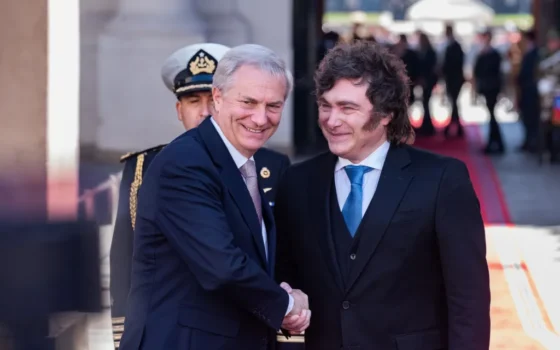
On Monday, March 16, 2026, at the northern border, with the attendance of the President of the Republic, the Ministers of the Interior, Defense, Public Security, Public Works, the commissioner of the Northern Macrozone, Vice Admiral (ret.) Soto, military and regional authorities, the initiative was launched. Border Shield, which can be summarized in a few words as follows:
Exercising control over the borders we share with Peru and Bolivia, but more importantly, asserting sovereignty over our territory.
Border Shield is one of the initiatives developed by the security team of then-candidate José Antonio Kast, an idea that originated from now-senators Vial, Carter, and deputy Bassaletti, aimed at taking control of the borders with Peru and Bolivia to prevent them from being used for smuggling of all kinds of goods, including weapons, drug trafficking, transnational criminal activities, and illegal entry and exit to and from Chile.
For most Chileans, the necessity and rationale for the Border Shield are represented by the massive illegal entry we experienced a few years ago and the little to no control we had over the border, a situation that is clearly better today, but will remain a problem until we can ensure that the border is well controlled along the nearly 1,000 kilometers that separate us from Peru and Bolivia.
Looking back at recent history, it was normal until the late 1990s for the Chilean Army to conduct what is called military border control, a practice that diminished as efforts were made to foster better relations with neighboring countries and implement mutual confidence measures, which included withdrawing armies from the borders, and additionally, proceeding to de-mine or remove anti-personnel and anti-tank mines planted along the borders with Peru, Bolivia, and those in southern Chile, including the Picton, Nueva, and Lenox islands in the Beagle Channel.
During Sebastián Piñera’s second term, the fragility of our northern and northeastern borders had already been detected, leading to the decision for the Armed Forces to support police actions with logistical and technological resources. To this end, decree 265 was signed, which allowed for this support but limited military action. These were times when the left denied the need for military involvement, seeking to limit their actions.
While the initial focus was on controlling border use by transnational criminal organizations, smugglers, and criminals in general, it was the reality of uncontrolled Venezuelan immigration that drew public attention and, consequently, that of politicians, which resulted in the inclusion of borders in the constitutional amendment of critical infrastructure that allows for a more intense use of the Armed Forces than what was considered in decree 265.
Clearly, a more intense use of military forces at the borders, along with a greater state presence, has allowed for better control of what happens at the limits with Peru and Bolivia, including a noticeable decrease in Venezuelan immigration, a decrease that is not solely due to control but also significantly because we are not as attractive a country for immigrants, because things are expected to improve in Venezuela, and also because the new government has sent signals that illegal immigrants are not welcome.
The Kast administration aims to go much further than the initiatives of President Boric’s government, an administration that left things in this area better than it found them, but clearly insufficient for the challenges that lie ahead in public and internal security matters in Chile.
To control the borders, we must not only use physical means such as walls, ditches, or fences, which should be prioritized in their location and quantity to deter illegal transit, but primarily electronic means, digital, AI, satellite, drones, command, control, and monitoring centers, accompanied by police, military, naval, air force personnel, customs officials, SAG, and immigration authorities.
It is not cheap to take control of the borders, and in a scenario of resource constraints, we will have to stop doing something to ensure the necessary physical and human means are available. Otherwise, we are merely discussing superficial measures that seek to fulfill a campaign promise.
Clearly, we want the Army to resume military control of the borders, but we want them in adequate numbers, and also accompanied by police and other state agencies. We want them with the necessary legal authority to detain and imprison those who violate our sovereignty. We want them trained and equipped to operate in the heights and under the climatic complexities of the north. We are talking about a task that is not suitable for conscripts, one that at least requires professional soldiers or non-commissioned officers, of which there are few in the Chilean Army of 2026, and that number may decrease if the 3% adjustment is applied to subtitles 21 and 22 of the Armed Forces.
Border control does not imply the end of free movement, but it does mean the end of those who enter through the back door, without documents, illegally, or with the intent to commit crimes. It implies that illegal entry into Chile must be a crime and not a minor offense, and it implies having the capacity to expel or redirect those who enter without permission or invitation, just as one would in their own home.
Border Shield does not mean isolating northern Chile from its neighboring countries. On the contrary, it seeks good and controlled integration, one that isolates the bad and allows the good. The regions and economies of the north will collapse if we isolate them from southern Peru or the Bolivian highlands. They are very integrated economies and regions, but that does not mean they are free from control and the exercise of Chilean sovereignty.
Border Shield will be successful as long as its purpose is clearly understood, it receives the appropriate human, physical, and financial resources, and, above all, it is a well-executed and well-managed initiative. This is where the role of the commissioner of the Northern Macrozone becomes relevant, the representative and delegate of the President of the Republic whose mission is to transform this from a campaign idea into a reality that provides us with secure and controlled borders, something that must happen and take shape during 2026, regardless of the state of public finances or the shortage of soldiers and police.
Richard Kouyoumdjian