COLUMN | Chile: What Is the Purpose and Function of National Defense?
This article was translated automatically and may contain differences from the original. For reference, read the original.
- by Richard Kouyoumdjian
- Opinion
If we do not understand or agree with the purpose of National Defense and the institutions that comprise it, any discussion regarding budgetary issues or investment in strategic capabilities is a futile discussion that leads nowhere. The fundamental problems of Chile’s defense are not merely a 3% adjustment; they are much deeper. Currently, there is a significant disconnect between what we understand and expect from defense and the institutions that comprise it, the allocated budget, and the investments we make in it.
Let us start with the basics: what is the purpose of National Defense and the Armed Forces? According to Article 101 of the Constitution, they exist for the defense of the homeland and are essential for national security, as also indicated in Article 1 of the respective constitutional organic law.
No one doubts that they are essential for national security, just as the Ministry of Public Security and the police, the Ministry of Foreign Affairs, or the intelligence and counterintelligence services we should have and expect to have in the future are. This also applies to the absence of an organization that manages, coordinates, and leads national security.
It is more complex to define what the defense of the homeland entails, something that I believe the 2020 defense policy, still in effect, defines very well in the section on the principles of Chile’s defense, stating in its Principle No. 1: “It is the duty and will of the State of Chile to protect its population and their fundamental rights, defend its national sovereignty, territorial integrity, political independence, and national interests.”
The second principle of defense is that Chile does not have aggressive purposes against any nation nor territorial claims in the neighboring area; rather, it aspires to achieve harmonious and peaceful development alongside the entire international community. This is referred to as negative political objectives, something we cannot necessarily ensure is the position of our neighbors.
One conclusion from the previous points is that we need capable armed forces to defend the territory, the seas of Chile, including its exclusive economic zone (EEZ), and the air and space.
This raises the questions: defend them from whom? and how do we understand or interpret the national interests that must be protected? In modern times, this includes defense against cyberattacks that could seek to degrade or incapacitate our digital capabilities and critical infrastructure.

Regardless of the good neighborhood reality we currently have, let us be honest: the armed forces exist in our case primarily to defend us from attacks by neighboring countries, attacks that we seek to deter by being well-equipped and trained. The possibility of attacks from superpowers or regional powers is rather low or very low, but not dismissible in a complex global reality. Chile has assets of interest to third parties, such as the Chilean islands located in the Eastern South Pacific, the Strait of Magellan, the Southern Sea, and the Chilean Antarctic territory, which will not protect themselves and deserve our attention. They have geopolitical interest for great powers.
The issue of national interest is more complicated to define because it is usually a matter of opinion. Where I place the national interest depends on whom you ask and what concerns them. If you ask the sailors, they are clearly concerned that 90% of imports and exports circulate by sea, which must be protected. Since it is difficult to do this alone, the value of being able to do it together with others increases, and thus we can contribute naval means to the Panama Canal, the Strait of Malacca, and other places where maritime traffic can be stressed. Naval exercises like Rimpac exist for this purpose, and countries like the United States expect and assume that we will be available to accompany them in this.
Where the limits are placed and what is sought to be protected has a clear impact on the definition of necessary means. It is very different to need oceanic capabilities to operate in Panama or the Strait of Malacca than simply defining that the national interest does not extend beyond the Chilean islands in the Eastern South Pacific or Antarctica. It is different to have a fleet with blue water capabilities than the means necessary to patrol and protect the EEZ or deny access to national waters to foreign naval units, something that can be done with missiles and drones.

Having or not having amphibious projection capabilities or submarine forces capable of positioning themselves in foreign waters and strategically affecting what occurs there are basic definitions that must be considered when analyzing what we need and for what purpose.
The Navy, Air Force, and Army we have can project their capabilities over neighboring countries. Doing so beyond that would involve logistical challenges that can be resolved as long as there are funds to do so. We have the experience of participating in United Nations operations consistently with means from the three institutions in places like Cambodia, East Timor, Iraq, and Haiti.
The military control of borders was discontinued years ago when mutual confidence measures were implemented with neighboring countries, which involved removing military units from those areas, something that was done in parallel with demining that helped make them more exposed. Today, there is a need for the Army to resume that service, only to protect them from criminals or smugglers, something that is not part of its purpose, but rather a task much more akin to what the Argentine National Gendarmerie performs, an institution primarily designed for that purpose. It is different to use the capabilities of the Armed Forces for contingencies, country development activities, and maintenance of extreme areas than to take on new roles that go beyond their main function.
Defining what we need allows us to organize the discussion, determine the necessary means, their operational budgets, staffing, and investments needed to maintain strategic capabilities. What cannot happen is to continue sustaining a model without the necessary resources to operate or what is needed to maintain its effectiveness. We cannot continue year after year allowing degradation without taking action, as if we do, we will soon resemble what the Milei government found in the Argentine Armed Forces after years of Peronist governments. Recovering capabilities takes years; just look at what it is costing them in Argentina.

The current defense policy assumes that we need Armed Forces like those we currently have, but with budgets that allow for their operation, training, and maintenance, and that through the law of financing strategic capabilities, we maintain or renew capacities. It also considers the generation of new capabilities regarding command and control, cybersecurity, and satellite surveillance. If it were updated today, it would likely consider drones and anti-drone technologies, and everything that has been learned in Ukraine and in Middle Eastern conflicts.
If we do not change our definition of defense, the FACH is the one that is best positioned. Its main issue is basically to modernize its fleet of F-16s, something they are already engaged in, bringing it to the best possible standard. These are platforms that have flight hours left and are well supported by the Sentry and aerial refueling aircraft, which will need to be replaced in the future. The Super Tucanos have a lot of useful life left, and the F-5s will not be replaced, but in exchange, we will have a fleet of F-16s with greater capabilities and performance. For the peace of mind of my aviator friends, I do not forget about the helicopters, the rest of the flight material that will need to be replaced, and what they need in terms of air defense capabilities.
The Army, apart from needing a budget to operate, soldiers—many soldiers—for everything it is asked to do at borders and in internal security, and unless there is a change in the Army model, needs better logistics, air defense capabilities, electronic warfare, investment in fire support, and replacement of the Leopard 1 if it is decided to maintain those capabilities in the Southern region.

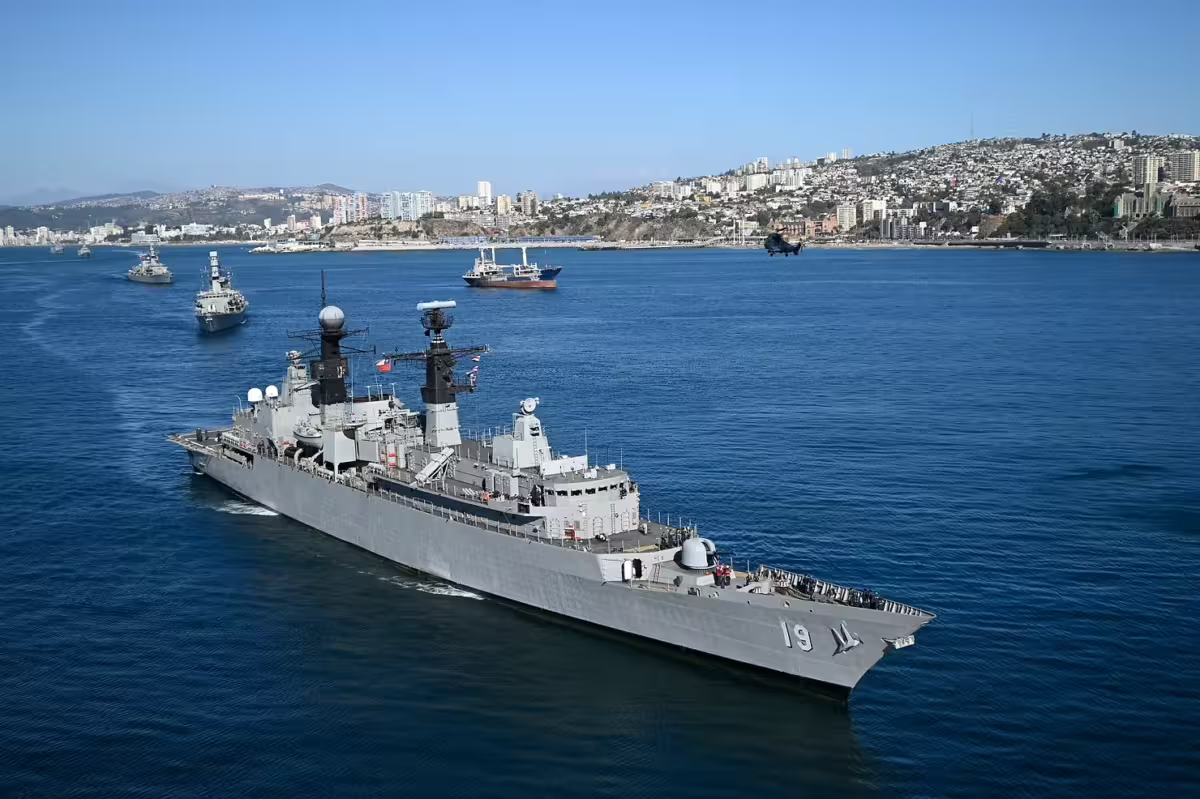
It is estimated that the plans of the Army and the FACH are feasible with the financing generated by the law of financing strategic capabilities, but that is not the case for the Chilean Navy. The Navy is in trouble. The time of having a fleet of 10 ships, missile command units both in the south and north, and a submarine force with 4 units has passed. Today we have a fleet of 8 ships, one of which must be urgently replaced, and the other 7 frigates must be replaced before 2040. The 209 submarines have already been in service for 40 years and must be replaced. The second part of the replacement of logistical units is not financed and authorized. The cost of maintaining naval capabilities if we go for new material is no less than US$ 7 billion, and that does not include maritime, naval aviation, and marine infantry. Clearly, the investment can be made over 20 years, but we are talking about at least US$ 500 million per year, much more than what the current law considers. If second-hand ships in good condition become available, we would gladly take them, but unfortunately, due to the global reality, they are not available.
If we cannot or are not willing to invest in the renewal of naval capabilities at their cost, it is better to change the model, accept that we are not capable of maintaining the successful blue water Navy model we have had for the last 200 years, and opt for armed patrol vessels of the OPV type, accepting that we will not be able to operate beyond the EEZ and that the defense of the seas of Chile will be left in the hands of missiles and drones in a denial of access mode.

What is unacceptable is to continue avoiding making decisions regarding the type of Armed Forces we need and to accept only what we can finance. It would be fantastic to invest in defense what common sense advises, but that would imply having to reduce the size of the State, a decision in which politicians from both the right and left have not proven to be very effective; on the contrary, it increases year by year, but not in National Defense, intelligence, and counterintelligence, key and fundamental aspects of National Security.
In conclusion, the priorities of national defense are not in the fourth star of the JEMCO, or in the need to improve civil-military relations, or in the processes and equipment of the Ministry of Defense, which can certainly be subject to improvements. The priority is to decide the type of Armed Forces we need and to finance them adequately, or to have those we can finance, but if we do so, we must do it well and not half-heartedly. We must take advantage of the economic emergency to finally decide what we will do in defense and be able to answer the question of what the purpose and function of National Defense is.


