The United States Security Strategy in the Americas
This article was translated automatically and may contain differences from the original. For reference, read the original.
Look at the map, and you will understand the reality of North America regarding security. The situation speaks for itself, especially when they are facing an emerging power that threatens and jeopardizes their national security.
Many find it difficult to understand the national security strategy of the United States and, in particular, how the Department of Defense articulates it. This is even more challenging when applying it to the Western Hemisphere and the Americas, where Chileans are located. This sometimes makes it hard for us to comprehend events like the recent meeting of defense ministers in Panama.
The United States essentially thinks like a continental power, seeking to distance itself from its threats or enemies, or to take measures to prevent them from affecting it, such as nuclear ballistic missile defenses that may come from either the Pacific or the Russian plateaus.
The Pacific and Atlantic Oceans separate it from threats to the west and east, respectively, and until recently, the Arctic played a similar role. I say similar because, with the melting ice, the reality has changed, which is why Americans are concerned about taking control of the shipping routes that are opening due to the thaw. Their interest in Greenland is motivated by this.
Before looking further south, it is important to clarify that Mexico and Canada are not threats to them, except regarding the drugs produced in those countries or that transit through them to the U.S. market. Illegal immigration from Mexico is indeed a problem that bothers them. Both countries, being adjacent to the United States, enjoy the implicit protection that proximity provides, allowing them to invest less in defense.
Traditionally further south, that is, south of Mexico or south of Key West, the United States sees three types of problems: 1) A drug supply targeting them, 2) Illegal immigration pressing to reach their lands, and 3) Chinese strategic investments that may jeopardize their physical and digital security, prompting them to deny China a close position from which it could threaten them. This last point is not only specific to the Americas but is something the United States seeks to implement globally, that is, to prevent China from being able to threaten its national security.
The most immediate priority to the south is the issue of drug trafficking destined for the North American market, particularly that which operates in Central America, the Caribbean, and northern South America. The Secretary of Defense speaks of over a million of their citizens dead from drugs, a figure that pressures them to take action. Illegal immigration is more controlled, and the major generator of immigrants, Venezuela, has decreased the flow both north and south since it took control of that country.
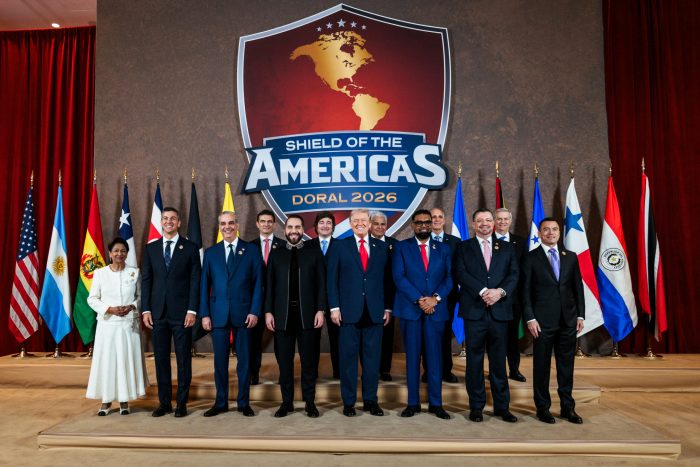
It is under the pressure of drugs that the Shield of the Americas is structured, an initiative that began in Miami at the beginning of the year, organized and led by Southern Command (Southcom), and that will obviously be more focused on what happens in Mexico, Central America, the Caribbean, and northern South America. These are the geographies where the drugs destined for the North American market are produced. These are the geographies where both the United States and, very likely, the affected states will take action. Venezuela is already under control. Colombia and Ecuador are already connected and operating with the United States.
Mexico is also operating in coordination with the United States, but obviously for political reasons, they will not announce it publicly. The operations conducted on Mexican territory confirm the activity that is occurring.
The question for everyone in Chile is what we should do or whether we should assist in anti-narcotics efforts. The answer is that we can help build capacities in countries that lack them, but we help more by effectively tackling organized crime operating in Chile, and in conjunction with Peru, Bolivia, and Argentina, conducting joint efforts in the quadrilateral formed to the south of some and to the north of others. That is, implementing and executing the agreements of May 28, 2026, signed in Santiago.
If the United States succeeds in the areas closest to them, criminal activity further north may seek to move its interests further south, producing in Peru and Bolivia, exiting through Chilean ports, Argentine waterways, and eventually, through the Brazilian Amazon. From the United States, we would only need intelligence support if we were to require it.
In its efforts to improve its security, the United States will seek for us to be autonomous and not have to come to our aid or finance us as in the past, and if they do, it will only be if they see that we are making significant efforts on our own. The issue is not the defense budget; it is that we are autonomous and independent, something they believe does not occur if we remain at our current level of spending and investment.
In summary, look at the map, and you will understand the reality of North America regarding security. The situation speaks for itself, especially when they are facing an emerging power that threatens and jeopardizes their national security. Having the Americas under control is mandatory for them, even better if we understand it as a shared effort.
I recommend watching the video of the Panama meeting or reading the speech by the honorable Pete Hegseth. You will see that “Our common backyard” is not the same as “My backyard,” something that some Chilean authorities failed to grasp or misunderstood.
Participating in the Shield of the Americas is optional, not mandatory. Whether or not it has consequences on tariffs remains to be seen, but I suspect that tariffs run on a separate track. On another note, the defense relationship could not be better. The frigate Cochrane has been operating with them for a good time in the Pacific waters, and the tanker Montt is on its way to work with the U.S. Navy for three months. Similar activities are occurring at the level of the Air Force and the Chilean Army. It is expected that they will support our initiatives to recover strategic capabilities, as they are our main supplier.
RICHARD KOUYOUMDJIAN
Vice President of AthenaLab