Chile versus Argentina
This article was translated automatically and may contain differences from the original. For reference, read the original.

The least important aspect is the potential support or neutrality of the United States of America on the matter or the construction of a naval base in Tierra del Fuego. We know that this opinion may change depending on other factors.
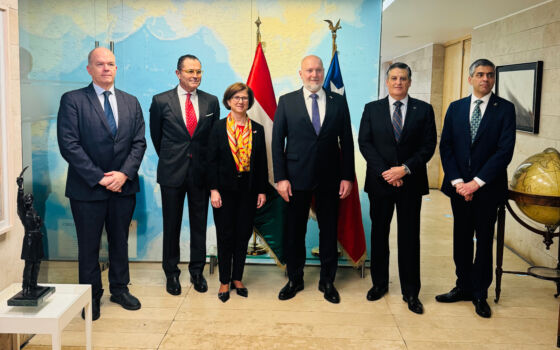
On Thursday, September 3, 2026, a new chapter in Chilean-Argentine relations unfolded. President Milei visited Chile for the Madrid Forum and a meeting with President Kast, resulting in a joint statement and a national broadcast in Argentina presenting the strategy they will follow regarding the Malvinas (Falklands for the British and islanders), South Georgia, and South Sandwich Islands.
What does the analysis of the statement tell us? Essentially, we exchanged access to mineral and gas resources in exchange for support for Argentina’s claim over the aforementioned archipelagos and the surrounding maritime areas, along with our intention not to facilitate or support hydrocarbon and fishing resource exploitation activities in the disputed area.
For some, this can be interpreted as a restriction or potential co-administration of the strait, due to the limitations this could impose on the free passage of vessels through Argentine territorial waters returning to Punta Arenas after supplying Puerto Stanley (Puerto Argentino for Argentina).
Clearly, Chile’s sovereign rights in the Strait of Magellan are mentioned, which may not hold significance beyond the communicational aspect, following the recent controversies generated by General Valverde’s unfortunate remarks in a podcast, a situation that social media exploited to create a pseudo-diplomatic crisis between the two countries, adding to a series of other unfortunate incidents that occurred in 2026 and previous years. In any case, this is a topic that President Kast had already addressed with great clarity in the days prior.
There may be some for whom the inclusion of the mention of Galvarino Apablaza is important or who believe that relations between the two countries are currently favorable in economic and bilateral terms, but this statement and the subsequent national broadcast should be viewed beyond what has already been indicated in previous paragraphs.
First, there were signals coming from Buenos Aires regarding the imminent initiation of extractive activities in the surrounding seas of the archipelagos, which are currently under British control.
For Argentina, this creates a red line that triggers actions on their part in defense of what they consider their national interest. This is why the statement incorporates it, and this is why a national broadcast was made to announce to everyone what they will undertake.
The least important aspect is the potential support or neutrality of the United States of America on the matter or the construction of a naval base in Tierra del Fuego. We know that this opinion may change depending on other factors. Surely, these signals were already known in Santiago, and this complexity was understood to have remained under the radar due to the political focus on the issue of sovereignty over the Strait of Magellan, which has never been in dispute.
Second, the statement says nothing about the pending maritime and land boundary issues we have, both in the Fitzroy mountain sector and regarding the collision of Chilean continental shelves with the extended Argentine one, which arises from their claims over archipelagos in foreign hands, and which, if addressed, should be viewed under the dispute resolution mechanism established by the TPA of 1984.
Third, it is very likely that Argentine actions are guided by the electoral context in which President Milei’s government finds itself, as he has indicated he will seek re-election. Clearly, the reconstruction of the Argentine economy is on the right track, but it has yet to be felt in the pockets of all Chileans, except for those engaged in agriculture and mining.
Fourth, all indications suggest that the statement Argentina sought was overly ambitious, something that the Foreign Ministry team managed to mitigate. Imagine what would have emerged without intervention. We committed efforts, and they sent signals. However, Magellan is awaiting a good explanation.
Richard Kouyoumdjian
Executive Vice President AthenaLab