COLUMN | Chile in the World Headlines: The End of the Exception to the Rule
This article was translated automatically and may contain differences from the original. For reference, read the original.
Diario Financiero, Monday, November 11, 2019
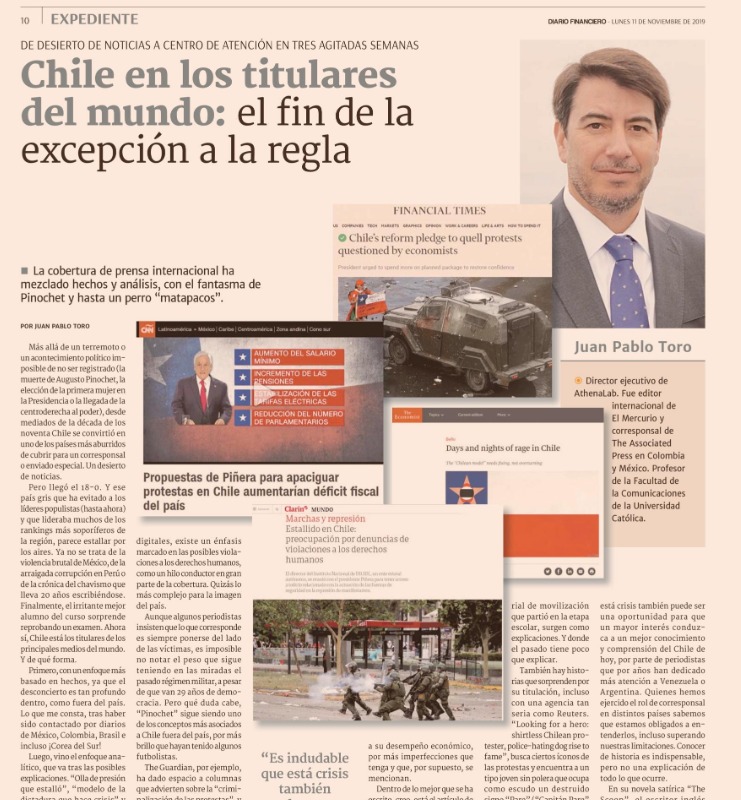
International press coverage has mixed facts and analysis, with the ghost of Pinochet and even a ‘matapacos’ dog.
Beyond an earthquake or a political event that cannot go unrecorded (the death of Augusto Pinochet, the election of the first woman to the presidency, or the rise of the center-right to power), since the mid-1990s, Chile has become one of the most boring countries to cover for a correspondent or special envoy. A desert of news.
But then came 18-0. And that gray country that has so far avoided populist leaders and has led many of the most tedious rankings in the region seems to be bursting at the seams. It is no longer about the brutal violence of Mexico, the entrenched corruption in Peru, or the chronicle of chavismo that has been unfolding for 20 years. Finally, the irritating top student of the class surprises by failing an exam. Now, Chile is in the headlines of the world’s major media. And in a big way.
First, with a more fact-based approach, as the bewilderment is as deep inside the country as it is outside. I know this because I have been contacted by newspapers from Mexico, Colombia, Brazil, and even South Korea!
Then came the analytical approach, which seeks possible explanations. “Pressure cooker that exploded,” “model of the dictatorship in crisis,” and “discontent due to deep inequality” are some of the expressions that have emerged in recent days. Obviously, the focus is on the crack, not on the consistency of the pillars. But these are news stories, not essays.
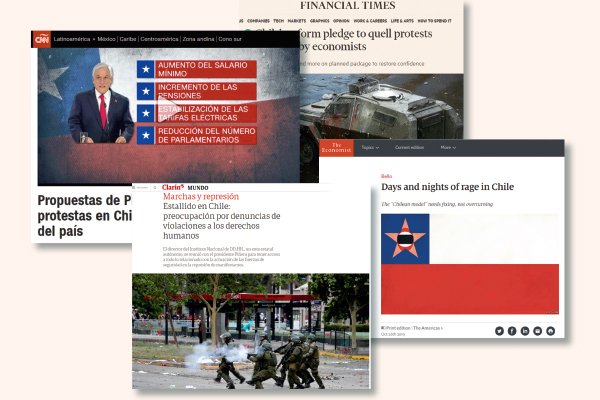
According to private monitoring of international press through digital platforms, there is a marked emphasis on possible human rights violations as a common thread in much of the coverage. Perhaps the most complex aspect for the country’s image.
Although some journalists insist that one should always side with the victims, it is impossible not to notice the weight that the past military regime still holds in perceptions, despite 29 years of democracy. Undoubtedly, “Pinochet” remains one of the most associated concepts with Chile outside the country, no matter how much shine some footballers may have had.
The Guardian, for example, has given space to columns warning about the “criminalization of protests” and the memory of “the old and bad days of Pinochet.” This does not take into account the vast distance between the current context and the past.
In contrast, The Economist, through its Bello column, spoke of a “model that needs fixing, not reversing,” which also shows an understanding of a Chile that has changed significantly due to its economic performance, despite its imperfections, which are, of course, mentioned.
Among the best pieces written, I believe, is the article from The Wall Street Journal titled “In Chile, Peaceful Protests Turn Violent by Night.” Its journalists spoke to those in the midst of protests to understand their reasons. The need for violence as the only way to truly attract attention, the recognition that they do not identify with either the right or the left, or a history of mobilization that began in school, emerge as explanations. And where the past has little to explain.
There are also stories that surprise with their headlines, even from a serious agency like Reuters. “Looking for a hero: shirtless Chilean protester, police-hating dog rise to fame” seeks certain icons of the protests and finds a young man without a shirt using a destroyed “Stop” sign as a shield (“Captain Stop” or “Stop man”) and a dog known as “matapacos” for its hostility towards the police. Heroes?
Probably, some will find the coverage irritating and limited, as it does not account for the country in its proper dimension. But the truth is, there are few journalistic pieces capable of doing so.
That said, it is undeniable that this crisis can also be an opportunity for greater interest to lead to better knowledge and understanding of today’s Chile by journalists who have for years focused more on Venezuela or Argentina. Those of us who have served as correspondents in different countries know that we are obliged to understand them, even surpassing our limitations. Knowing history is essential, but it is not an explanation for everything that happens.
In his satirical novel “The Scoop,” English writer Evelyn Waugh provides a humorous portrayal of those who leave their homes to seek information in the world. And in one of the first lessons of journalism, the endearing William Boot is told the following: “A news story is what interests a guy to whom nothing matters much. And it is only news until he has read it.”