Renewal of the Senior Command of the Armed Forces
This article was translated automatically and may contain differences from the original. For reference, read the original.
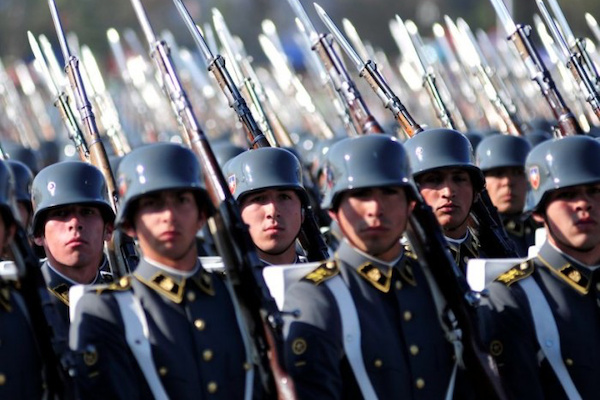
In the current times, we should not be indifferent to who leads our armed institutions or forms the team of the Ministry of Defense. The Armed Forces are, quite simply, the ones who hold the power of arms. Therefore, the selection of the commanders-in-chief, as well as the person serving as the Joint Chief of Staff (JEMCO) and other key positions—such as the heads of Army divisions, naval zones, and air brigades, which are geographically the most critical and strategic—is of utmost importance and should not be taken lightly.
We are about to begin the annual renewal of the senior command of the Armed Forces, a topic that in the past may have only mattered to the institutions, but in the current reality we live in, we should not be indifferent to who wields the power of arms. In Chile, unlike in other countries, this ritual occurs annually, almost always between October and November. In other countries, the renewal takes place alongside political cycles, which we largely curtailed by establishing the immovability of the commanders-in-chief every four years and setting grounded requirements for them to be removed by the President of the Republic before their terms end.
The first issue at hand is the possible change of Vice Admiral Rodrigo Álvarez in the position of Joint Chief of Staff (JEMCO). Admiral Álvarez has been in the Joint Staff for four years, the first two as deputy chief and the following two as the number one. Nothing legally obliges his change, and in fact, the holder of the position is exempt from the maximum years of service requirements and it is not a role with a predetermined time limit, as is the case with institutional heads. His change is rather dictated by historical practice, which recommends common sense regarding the rotation of commands, institutional balances, and the fact that his appointment in 2018 occurred at a time when the Army was removing a large number of generals, leaving few candidates for the position, which led the Government to prefer him.
Subsequently, in 2019, he was caught in the “Social Outburst” in that position, and we would all agree that it was not the right time to change him, even though by that point the Army did have candidates to replace him.
Unlike the private sector, where good leaders are not replaced, Chilean defense institutions renew their senior command for various reasons, the main one being to give “turnover” to the ranks and the maximum years of service established by law. This sometimes forces the removal of good generals and admirals simply because they reach the limit, but as long as that does not change, the rules of the game are set for the exercise we will face in the coming months.
If Admiral Álvarez were not in the JEMCO position, he would already be retired for having completed the 40 years that a general officer can serve. The next question is whether it is advisable to renew him for another term. I am not in a position to evaluate his performance, but not just anyone reaches the level Rodrigo Álvarez has after an excellent professional career in the navy. He certainly has ample merits to continue, but I do not think it is appropriate to leave the Army without someone in that position, which has not happened since late 2013, unless the same approach as in 2018 is taken, that is, promoting the deputy JEMCO, Air Force General Albert Widmer, leaving the number two position for an Army general.
When seeking a candidate for the position in question, the law establishes that it is a position open to all three-star officers, which generates a large number of candidates. However, given that it is a position of high responsibility and that, in my opinion, should clearly be a four-star position like the commanders-in-chief, it is advisable to select an officer who is among the most senior in their respective rank, ideally the number two or, at most, the number three of their institution.
The person who must make the selection is the Minister of Defense himself, a person with extensive political experience but who is not a specialist in defense matters, which is why it is crucial to have good advisors. He inherited two very good undersecretaries from Alberto Espina who know their work well and have extensive experience in the field, along with a solid and experienced cabinet.
The JEMCO is the main advisor to the minister, and that is why his selection should not be delegated to the commanders-in-chief. The only recommendation I make is that if General Widmer is not retained, then it should be a division general from the Army with extensive networks to the other institutions and significant operational experience, as all indications suggest that the guard he will lead will face, in addition to the inherent complexities of the position and a full agenda of issues, health threats such as coronavirus, social unrest that may involve states of emergency, multiple electoral events, and, most importantly, the not insignificant possibility of having to deploy troops in La Araucanía if political solutions are not achieved to calm the passions of those who inhabit that territory and provide definitive solutions that leave everyone at ease.
The second issue is the replacement of Admiral Julio Leiva in the command of the Navy. This should happen in June 2021, and therefore, the pool from which his successor will be drawn is something that will be determined in the formation of the naval high command, which, as I mentioned earlier, should occur around October or November of this year.
The Navy is the only branch with a change in the short term, as Generals Ricardo Martínez and Arturo Merino still have time in their positions, thus time to shape their respective teams.
To conclude, one of the most important actions that can affect the fate and effectiveness of an organization is the appointment of the person who will lead it.
In current times, we should not be indifferent to who leads our armed institutions or forms the team of the Ministry of Defense. The Armed Forces are, quite simply, the ones who hold the power of arms. Therefore, the selection of the commanders-in-chief, as well as the person serving as JEMCO and other key positions—such as the heads of Army divisions, naval zones, and air brigades, which are geographically the most critical and strategic—is of utmost importance and should not be taken lightly.
Richard Kouyoumdjian
Vice President AthenaLab
Source: El Mostrador