Regarding Suez: There is no global trade without maritime security
This article was translated automatically and may contain differences from the original. For reference, read the original.
Diario Financiero, Friday, March 26, 2021
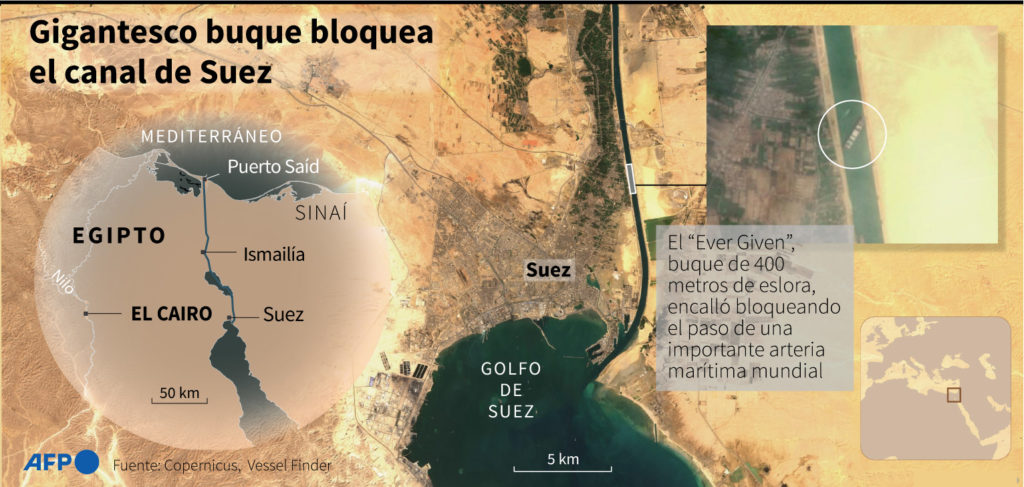
Among the multiple assaults that global trade has faced in recent years, due to protectionist measures and the coronavirus pandemic, it seems there was one more: the blockage of one of the main choke points in maritime export and import transit.
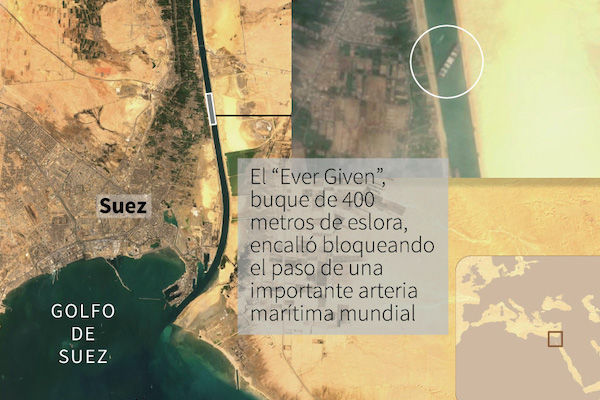
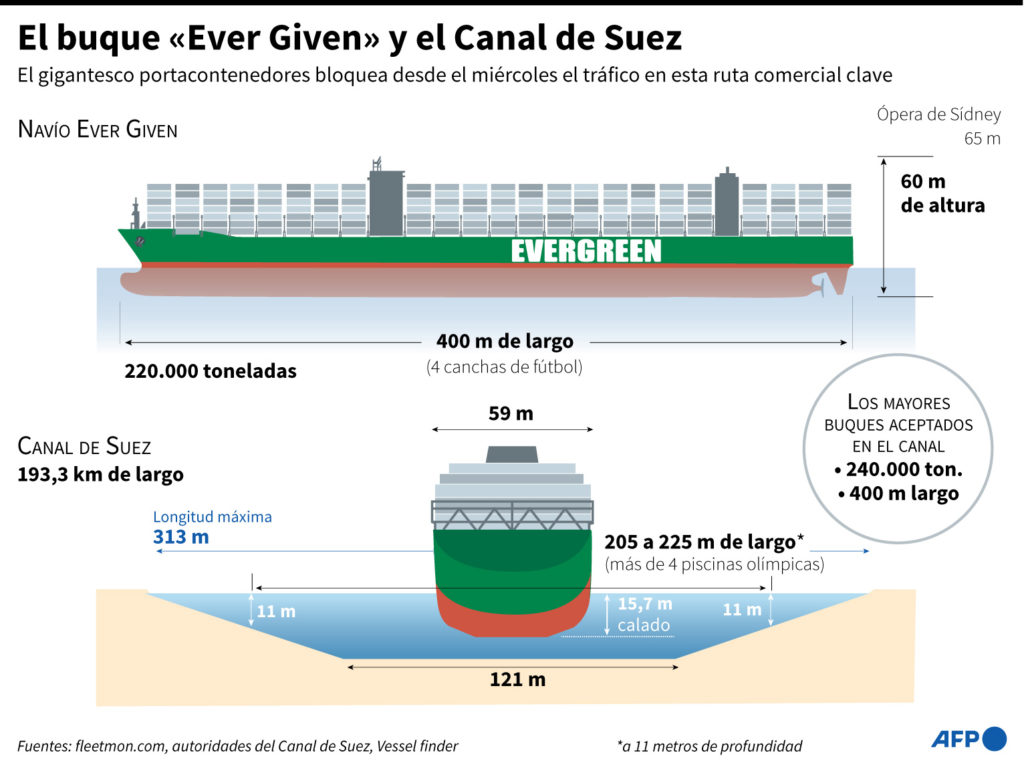
The container ship “Ever Given” (“Always Given” in Spanish) from Evergreen Marine Corp. ran aground this week in the Suez Canal, which connects Europe and Asia, blocking 12% of global trade or the passage of $9.6 billion daily in goods.
While frantic efforts are underway to unblock the route, between 150 and 200 ships are piled up at both ends of the canal. Opened in 1869, this route saves shipping companies a significant amount of time (thus reducing freight costs) by eliminating the need to navigate around Africa via the Cape of Good Hope.
After the initial shock of seeing the gigantic ship across the canal, the accident highlighted at least two key issues: the importance of maritime security for global trade and the significant role of straits and canals.
In a way, what happened reminded us that we cannot take for granted that maritime trade routes will remain open. These routes can be disrupted by many factors, such as poor navigation maneuvers, adverse weather conditions, tsunamis, or actions by malicious actors (pirates, smugglers, terrorists, etc.). Therefore, one of the main tasks of navies is to ensure that routes remain secure in the broadest sense, with physical surveillance, signaling, and remote monitoring on a 24/7 basis. As a result of the grounding of the “Ever Given,” approximately $30 billion in goods are currently held up, which is even impacting the price of oil upward.
Since 95% of Chile’s foreign trade is conducted via maritime routes, the country is very sensitive to disruptions in this area. For example, it is the fourth largest user of the Panama Canal globally and the first in Latin America. Gas from Trinidad and Tobago, which allows us to drive the economy, passes through there, as do fruits and wines destined for the East Coast of the United States and Europe. If something similar were to occur on that route, a much more complex engineering feat than Suez, the impact would be greater.
If Chile also manages to become one of the world’s leading exporters of “green hydrogen,” a large portion of this fuel will be shipped from Magallanes in enormous tankers that will traverse a strait plagued by dangerous winds and currents. Therefore, this route will regain importance, as the value of a strait is related to the volume of trade that flows through it.
For all these reasons, it must be recognized that any investment in maritime security, both by Chilean authorities and the shipping industry, has a return that pays off day by day, hour by hour; whether in the routes we directly control or those that connect our trade with the world. While terrorist groups or rogue regimes may be calculating the real damage they could inflict by sabotaging a ship in a canal or strait, thousands of merchant mariners must have nightmares when looking at images of the “Ever Given,” a marvel of technology that succumbed to the winds of a sandstorm. Nothing is guaranteed in these times.
Juan Pablo Toro
Executive Director AthenaLab