Chile, Ibero-America, and the Crisis in Ukraine
This article was translated automatically and may contain differences from the original. For reference, read the original.
El Líbero, March 3, 2022
For the government that will take office on March 11, the widespread condemnation in our society of the violation of Ukraine’s territorial integrity provides a foundation for dialogue with the future opposition on a matter—human rights—that is understood to be one of the pillars of the Boric administration.
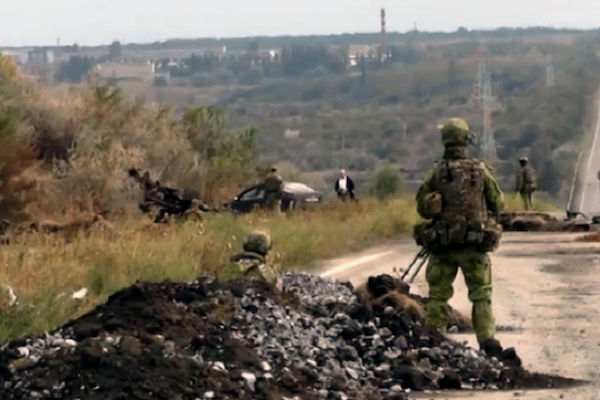
While the worst of the conflict in Ukraine is yet to come, virtually the entire international community has firmly condemned the use of force by Vladimir Putin’s government to compel a neighboring country (and United Nations member) to integrate into its sphere of influence.
The racist and pseudo-cultural argument employed (that Ukrainians are “southwestern Russians”) recalls the Nazi rhetoric that justified the annexation of part of former Czechoslovakia (1938) and the union with Austria (1939). From these “peaceful annexations” emerged the foundations of the Third Reich’s “living space.” As we know, the incorporation of these German-speaking communities into the Nazi empire was the prelude to a global war that not only devastated dozens of countries but also cost millions of human lives. The outcomes of this conflict led to the Cold War, which divided Europe and the world into two antagonistic blocs until 1991.
The massive violation of International Law and the human rights of 40 million Ukrainians is forcing us to witness a form of “banality” that modern society believed had been overcome. Putin’s medieval concept of politics has demonized Western democracy (European Union, United States, United Kingdom, and Canada) to justify his indefinite hold on power. This not only illustrates that the “banality of evil” is an essential part of the psyche of a ruler with psychopathic traits, but also that his imago mundi represents a concrete and grave threat to world peace.
The latest gesture of this psychopathic personality is the interpretation of economic sanctions as equivalent to a threat that justifies putting Russian nuclear forces on alert. Putin has already entered the bunker of his own chancellery in the Kremlin.
In light of all this, the Chilean government has had no choice but to condemn the Russian aggression against Ukraine, which occurred after months of troop and weapon system buildup near the common border; that is, following the repeated use of the threat of force (another international crime).
Gabriel Boric has firmly expressed his condemnation (as have other political leaders, including the president of the Republican Party), indicating that Chile will remain critical of a war through which a member of the United Nations Security Council unilaterally attempts to validate the threat and use of military force as a political tool. “Normalizing” this behavior while remaining neutral would only contribute to politically validating the regular use of force in other circumstances and in other regions of the world.
Through Brazil and Mexico—current representatives of the Latin American and Caribbean Group (GRULAC) in the United Nations Security Council—our region has also condemned the Russian aggression.
In the case of the former, the condemnation comes just weeks after a high-profile visit by Jair Bolsonaro to Moscow. This visit drew criticism from various sectors, as it occurred in a context where everything suggested that the invasion of Ukraine would begin— as it did—after the conclusion of the Winter Olympics in China.
In Mexico’s case, Russia’s veto of a condemning resolution from the Security Council provided López Obrador’s government the opportunity to insist on its argument that the anachronistic veto of the five victorious powers of World War II represents a structural limitation not only for that body but also for international peace and security.
Like the Brazilian government, the Argentine government also had no option but to condemn the invasion of Ukraine. This occurred just days after, like his Brazilian counterpart, Alberto Fernández visited Moscow to invite Putin to transform his country into his “gateway to Latin America.” While this can be understood ideologically as an exercise in equidistance between Washington and Moscow that Peronism has historically attempted to practice, in reality, Fernández’s “offer” was aimed at securing Russian investments, as his country faces severe limitations in accessing international credit. Given the massive Western sanctions against Russian companies, oligarchs, banks, transport, and trade, that goal appears—at least for now—much more than difficult.
The global political landscape has rendered the visits of the presidents of Argentina and Brazil to Moscow completely futile exercises. This is especially true for Bolsonaro’s visit, who, moreover, does not have guaranteed re-election in the upcoming October elections. By then, it is most likely that Western sanctions and the blockade against Russia will remain in place, and the horrors of the war in Ukraine will take their toll.
The totally dissonant note has been struck— as was predictable—by the governments of Cuba, Nicaragua, and Venezuela, all small dictatorships entrenched in power for decades that, like Putin’s regime, have normalized restrictions on individual freedoms. It is not unlikely that, in this context, these countries—victims of their own structural crises—aspire to the easy money from the oligarchs who support the Russian regime. Nicolás Maduro even took the liberty of calling Putin to “congratulate him” on his victory in Ukraine. Outside of these three underdeveloped autocracies, and in addition to Iran (a theocracy) and Belarus (a puppet government), Putin has been left without allies on the planet.
On this point, it suffices to note that, in the Security Council, China and India only abstained, suggesting that while they do not explicitly condemn the invasion of Ukraine, they also do not seem willing to endorse a political aberration that can only be explained by Putin’s personality. It is worth mentioning the essay “Vladimir Putin at the Top of a Collapsing Pyramid of Power” by the Russian intellectual exiled in Germany, Vladimir Sorokin, published this week in various European media. In it, he explains how Putin’s autocracy is merely a continuation of a “medieval” way of doing politics that began in the 16th century with “Ivan the Terrible,” a genocidal psychopath for whom there were no adversaries, only enemies and traitors.
These latter are the categories to which Putin—according to Sorokin, an official “raised on the breast of the KGB”—reduces anyone or any country that does not agree with his objectives. For Putin, as for Machiavelli’s “The Prince,” it is “better to be feared than loved,” for which an appropriate dose of cruelty is always available. The viral reprimand to his head of intelligence services clearly illustrates this aspect of the Russian president’s personality.
For the government that will take office on March 11, the widespread condemnation in our society of the violation of Ukraine’s territorial integrity (and its consequences for millions of its citizens) provides a foundation for dialogue with the future opposition on a matter—human rights—that is understood to be one of the pillars of the Boric administration. From this perspective, the designated chancellor—a specialist in the field—should leverage this foundation to strengthen any action that the next government decides to promote in this area, whether domestically or internationally.
Unexpectedly, a matter in which interpretations divide Chilean political forces offers us the opportunity to— with civic friendship—converge towards consensuses that reflect the sentiments of a public horrified by the severity of a conflict that, all indications suggest, is inaugurating a new stage in world history.
From a very selfish point of view, this may be the only positive consequence of a conflict in which the worst is yet to come.
Jorge Guzmán
Researcher at AthenaLab
Source: El Líbero