Ukraine and German Post-Pacifism
This article was translated automatically and may contain differences from the original. For reference, read the original.
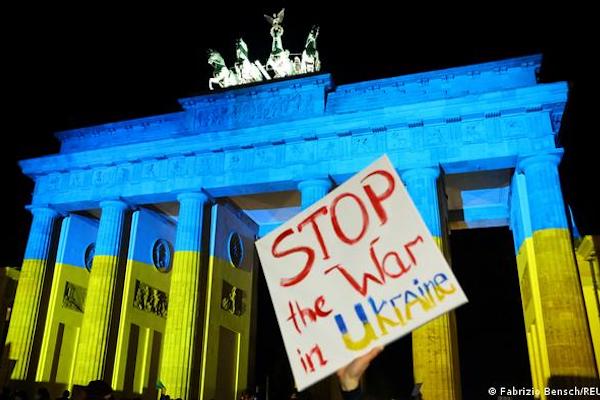
Putin has provided German environmentalism with a tailored reason not only to oppose the Nord Stream II pipeline and dependence on Russian gas (initiated during the socialist government of Gerhard Schröder), but also—against the backdrop of the tragedy in Ukraine—to accelerate the transition to renewable energy.
“February 22 has marked a watershed moment in the history of our continent.” Thus began his speech before the Bundestag (German Parliament) by the Chancellor of Germany, Olaf Scholz, thereby highlighting the significance of the date marking the start of the Russian invasion of Ukraine. Mr. Scholz described this military aggression as a “violation of international law,” “inhumane,” and “unjustifiable.”
Such statements set the “terms of reference” for the announcements regarding foreign policy, international security, and armed forces that followed in the Chancellor’s speech. The most important of these refer to the immediate creation of a fund amounting to an incredible €100 billion to strengthen the defense budget and—starting next year and as a state policy—the confirmation that Germany will finally fulfill a commitment made within NATO in 2006 to allocate 2% of GDP to national and collective defense. To grasp the magnitude of this announcement, it should be noted that in 2021 (a year of crisis), Germany’s GDP stood at €4.55 trillion, and by the end of this year, it is estimated that this figure will reach €5.20 trillion.
Thus, from 2023, the German Ministry of Defense and the armed forces will have an annual budget close to €104 billion to expand contingents and modernize weapon systems to contribute to a new NATO doctrine.
Everything indicates that—from now on—this “defensive alliance” will not be conceived to “contain” but to defeat Russia in a possible European war in the Black Sea and the Baltic Sea, and in the plains of Prussia, Poland, Moldova, Belarus, Ukraine, Romania, Hungary, Bulgaria, and Russia itself.
This will involve the reinforcement of German troops and sophisticated equipment near NATO’s Eastern border, therefore, along the Russian border that runs from the Baltic states to Turkey in a north-south direction. Currently, in these deployments, German forces maintain a comparatively smaller presence than, for example, the United States, the United Kingdom, and even France.
This last circumstance is definitively behind us and is—among many (and “in reaction”)—one of the permanent “collateral effects” of the Russian territorial expansion plan illustrated by the military invasion of Ukraine.
While events demonstrate that the Russian army attempting to advance on Kyiv has adhered to the maxim that “in war, the first thing to fail is the battle plan,” the political confrontation between Putin, Germany, and the rest of Europe has ended up constructing a “new iron curtain.” In the case of the border between Latvia and Russia, this “curtain” places NATO’s weapon systems less than 600 kilometers from Moscow, and in the case of the border with Estonia, less than 130 kilometers from St. Petersburg. German weapon systems will now be at this distance, a situation not seen since 1942. Another of Putin’s “achievements.”
In parallel, explicit Russian threats against Finland and Sweden have contributed to creating a scenario in which Russia’s adversaries now extend across the entire Scandinavian peninsula, including the more than 800 kilometers of border with Finland along the Karelian Peninsula. Individually considered, Finland and Sweden possess economic, military, and technological capabilities far superior to those of Ukraine, and although they are not NATO members, they are part of the European Union. An aggression against either of them would warrant a collective response. In his labyrinth, Putin and his generals should be aware of this “detail.”
However, in context, the threats against Finland and Sweden can be interpreted as “symptoms” of Putin’s “increasing” frustration, who, faced with the progressive international isolation he is undergoing, has ended up “entrenched” in his Kremlin office. Specifically, his threats against the Scandinavian countries have configured a virtual enclosure for the Russian Navy in the Baltic Sea, a maritime region also bordered by Denmark, Norway, and Germany, all NATO members. Another “small detail.”
In the specifically German context, Chancellor Scholz’s decision (social democrat)—reached in consensus with the Green Party and its young Foreign Minister, Annalena Baerbock—has imposed a sort of diplomatic and military “U-turn,” which has abruptly ended the “German pacifist bubble” that for decades allowed bilateral relations to be managed by a “Teflon diplomacy.” As demonstrated by Berlin’s reactions to the wars in Chechnya, the destruction of Grozny, the annexation of Crimea, the Russian bombing of Aleppo, and Putin’s massive support for the genocidal dictatorship of Bashar al-Assad, “German pacifism” contributed to ensuring Moscow a significant capacity for “overdraft” in the realm of humanitarian law and human rights. In the case of the tragedy in Syria (and Iraq), by omission, this “pacifism” contributed to the instrumentalization of the exodus of hundreds of thousands of refugees toward the borders of the European Union, which Russia turned into “another weapon” in its “hybrid war” with Western democracies.
Foreign Minister Baerbock herself has stated that Russia has pushed Germany and Europe into a post-pacifist era. The unprovoked military aggression against Ukraine has made it abundantly clear that the Russian leadership interprets European diplomacy—focused on reconciling positions and interests through trade and economic and political cooperation—as nothing more than a “sign of weakness.” Alternatively, Putin and his allies have characterized Western cooperation through businesses and civil society organizations (focused on civic education) as attempts to “dominate Russia through control of its economy and society.”
In Putin’s and his circle’s perception, three decades of trade (which have enriched him, his family, and his close associates) have served “the West” to “bring Russia to its knees,” to belittle it, and to deny it its status as a great world power. This concept lies at the center of the Russian leader’s frustration regarding Europe and the United States and, by extension, also regarding Ukraine, whose governments he has accused of being “parasites,” “criminals,” “beggars,” “traitors,” and “neo-Nazis” (despite the fact that Volodymyr Zelensky, the Ukrainian president, is Jewish, and his grandparents were killed in Nazi concentration camps).
Germany has inevitably entered a post-pacifist period that, in the immediate sense, has left behind the trauma inherited from the generations born in the 1920s, 1930s, and 1940s, who transmitted to their descendants experiences not only with the destruction of World War II but also the “side effects” of the post-war period, therefore, the destruction of families, the hunger and cold of winter, all “childhood companions” of the grandparents and parents of the current generation of German and European politicians.
If during the first part of the 1990s the destruction caused by the war following the dissolution of former Yugoslavia reminded Europeans that, on the doorstep, serious nationalist extremisms still existed, the invasion of Ukraine from Donbas, Crimea, and Belarus (governed by a puppet regime) makes it evident that peace in Europe is by no means assured.
If in the last Balkan war the horror and crimes against humanity were primarily attributed to Serbia (another “protected” by Russia), despite their enormous gravity and in strictly military terms, those crimes occurred on a “smaller scale,” as it was not a conflict between large armies, but between armed civilians and the remnants of the “national” former Yugoslav army. Given that in Ukraine the aggressors are hundreds of thousands of troops from the Russian army, air force, and navy (all of which possess nuclear capabilities), the threat to peace in Europe is more than obvious. For the new German political class, the ideological significance attributed to this war by Putin renders it—using a phrase from Boris Johnson—a completely “irrational” act. In the German conception of life, irrationality must have no space, and that is what has ultimately compelled Germany—and by extension the rest of Europe—to enter a period of post-pacifism.
From an economic perspective, unwittingly, Putin has invited the massive German industrial sector to engage in what can be simply and directly termed “the German rearmament of the 21st century.” Once again, this is much, much more than a detail.
The billion-euro defense budget indicated will not only enable the growth of the German defense industry (with its multiplier effects on the rest of the economy), but it will also have stimulating effects on the economies of neighboring countries (Poland, Czech Republic, Austria, and Switzerland, primarily), while compelling other NATO countries (France, the United Kingdom, Italy, and Spain) to adopt equivalent measures. By accumulation, Putin will not only have succeeded in “reanimating” NATO, but he will also have ensured that, starting this year, defense investment reaches levels unattainable for the comparatively small Russian economy.
Ultimately, it is curious that this qualitative change occurs, first, as a German response to a “fait accompli” imposed by the Russian government and, subsequently, that it has been driven by the environmentalist left, in no small part composed of the children of the pacifists who in the 1980s—during Ronald Reagan’s administration—massively opposed the deployment of Pershing missiles in Europe.
Putin has provided German environmentalism with a tailored reason not only to oppose the Nord Stream II pipeline and dependence on Russian gas (initiated during the socialist government of Gerhard Schröder), but also—against the backdrop of the tragedy in Ukraine—to accelerate the transition to renewable energy.
In any case, it is ironic that it was this part of the European left that pushed Germany (and the rest of Europe) to leave behind the “70s and 80s pacifism” to transition into a new stage in world history (which all indications suggest will be another period of “armed peace”).
Jorge Guzmán
Associated Researcher, AthenaLab
Source: El Mostrador