The Importance of José Miguel Carrera's Saber for General Iturriaga
This article was translated automatically and may contain differences from the original. For reference, read the original.
El Mostrador, March 9, 2022
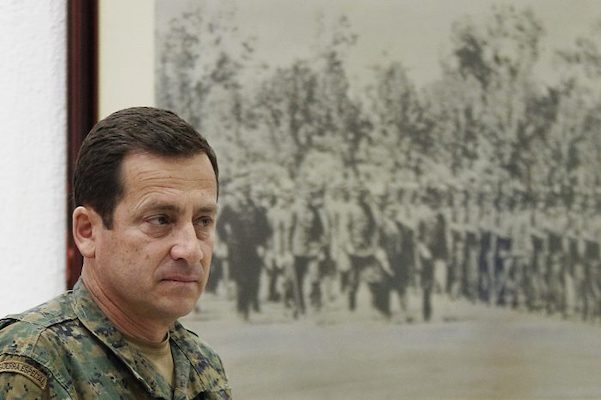
On March 9, Division General Javier Iturriaga Del Campo assumes the Command of the Army of Chile, being promoted that day to the rank of Army General (four stars). Typically, there is a ceremony where he is promoted, his command pennant is raised, and that of his predecessor is lowered, he is presented with the saber of José Miguel Carrera, the first Commander in Chief of our Army, and he proceeds to inform the detachment that he is assuming command.
In the past, there was no elaborate ceremony, as the change of Commander in Chief took place in the office corresponding to the head of the institution. The ceremony we know began with the handover from Pinochet to Izurieta Caffarena and evolved with minor changes until the handover from Oviedo to Martínez, so the ceremony this Thursday should not be very different.
Symbolism in military institutions matters, and perhaps the most important of all is the handover of Carrera’s saber by the President of the Republic to the new institutional chief, symbolizing that the command of the Army granted is the same as that of Carrera and that it is the highest political authority that designates and empowers the command that assumes the direction of the Army of the Chileans, making it clear that this command reports to the executive political authority and does not act independently. In the absence of the President of the Republic, this role is fulfilled by the Minister of Defense, but what is important at the end of the day is that it is a republican ceremony with a clear and profound meaning.
General Iturriaga assumes under challenging circumstances. His predecessor resigned on Wednesday, March 2, due to the possibility of being prosecuted the following day in the travel expenses case, something I am not sure will not affect the new Army chief, as Ricardo Martínez thought the same, and we know how that story ends. Judge Rutherford operates under her logic and not necessarily under the logic of the Army and its internal procedures, regarding which, following the departure of 21 generals in 2018, it was determined that they had not acted irregularly and had complied with the internal procedures in place at the time.
He also has to deal with the issue of having all his predecessors alive, except Martínez, prosecuted for alleged misuse of reserved expenses. I say alleged because I understand that in none of the cases are there rulings, not even at first instance, something that also affects a good part of those prosecuted for travel expenses, despite having been in that condition for more than three years.
The Army has not had recent cases of financial misuse or administrative disorder. Most cases are prior to 2018, the year in which the quality of administrative supervision, controls, and internal auditing improved significantly, either due to the interest of Minister Espina or from the institution itself, which, by the way, implemented the crime prevention model required by Law 20.393 for publicly traded companies, something unprecedented for an Army and rarely seen in the public sector.
Another factor that will not make life easy for General Iturriaga are the ideas circulating in the Constitutional Convention regarding the existence of the Armed Forces or how they should be managed and administered. This will not be easy, as it will be compounded by possible extensions of the States of Exception in the Southern Macrozone and the northern border, something the incoming Government has stated it does not want to do, but which, when holding the guitar, may see differently and feel compelled to act. Lastly, all indications suggest that the budgets for military institutions will be tighter in the coming years due to the interest in increasing spending on social issues. Only Putin’s adventures play in favor of the need for well-trained, equipped, and organized Armed Forces.
General Iturriaga benefits from his training as a commando and paratrooper, and being the son of a well-respected military officer will make his life easier in relation to the Army retirees, who were not very comfortable with General Martínez, especially after the reflections he shared in his last public account.
He has known and lived the Army of Chile since birth, so he will not be easily deceived; he knows what his soldiers and compatriots want, and he has already overcome several complex challenges to reach where he is. I am confident that he will be a good Commander in Chief and a worthy successor to Carrera, knowing how to safeguard the saber used by the first chief of this ever-victorious Army, never defeated.
Richard Kouyoumdjian
Vice President AthenaLab