Misleading signals
This article was translated automatically and may contain differences from the original. For reference, read the original.
El Líbero, March 19, 2022
How far can the political campaign discourse and the solidarity that new leaders once showed with the ‘Mapuche cause’ go? I don’t believe it will go much further.
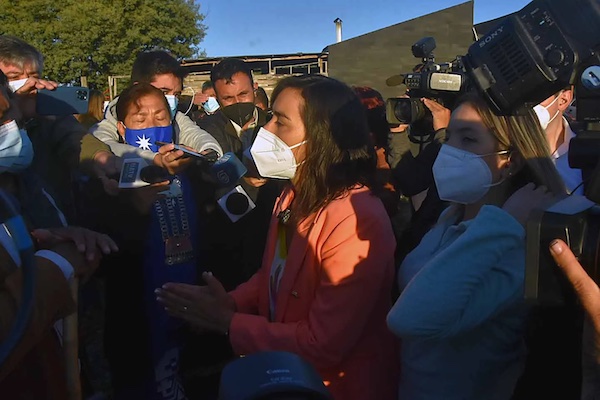
What signals is the Minister of the Interior sending us?! In her first week in office, she traveled to La Araucanía to initiate dialogue with the communities, her delegation moved without uniformed personnel or armored vehicles, and after being attacked and intimidated with gunfire, she decided not to file complaints. It seems, then, that the weak part of the negotiation with radicalized organizations is the government.
One does not negotiate with violent actors. However, reality is not black and white; it is full of nuances. Clearly, one does not negotiate with them, at least as long as they are not willing to abandon violence. After a strategy that combats and weakens them, everyone ends up negotiating. The issue lies in the signals that are sent and how they are interpreted.
She was warned of the risk of entering Temucuicui and chose to go without protection to demonstrate her commitment to peace. But reality is stronger: routes are blocked by barriers set up to intimidate the population, Huentelolén was one of them; there is drug trafficking in the area, with a 53% increase in drug seizures in 2021 compared to 2020; and arms trafficking is real: as of February this year, 129 weapons had been confiscated.
I have no doubt that the minister had good intentions and hoped to mark a change in the approach to the problem. However, when conditions are not right, one must understand the environment, analyze it, comprehend it, and ultimately accept that in a context of insecurity like that in the Southern Macrozone, where the average daily violence ranges from 3 to 5.5 events every 24 hours, the government must use all its legitimate powers to restore the rule of law. Sometimes a change in tone is not enough.
In Colombia, for example, a peace process was developed with the FARC, but only after the state, through the legitimate use of the monopoly on force, had gained a position of advantage over the guerrilla. Of course, Chile is not Colombia, even though it ranks second in Latin America, after that country, as the state with the most terrorist acts.
These data should concern us. Yes, but we must also take action, and at this moment, the leadership lies with the new government. Hence, the signals are so important. It can be understood that filing complaints that do not always yield results may not be an efficient measure, but showing weakness in the face of a group that has profited from violence, threatened communities, and claims to have a problem with the State of Chile is also unacceptable. It seems that the silence from La Moneda points to this last point.
How far can the political campaign discourse and the solidarity that new leaders once showed with the ‘Mapuche cause’ go? I don’t believe it will go much further.
The withdrawal of the State of Emergency without a short, medium, and long-term strategy will only contribute to an increase in violence, whether because radicalized organizations feel empowered or because they seek to test the Executive to see how far they can push. It is time to start sending the right signals to the community and to the violent actors. The state should hold the advantageous position.
Pilar Lizana
Researcher, AthenaLab
Source: El Líbero