Coherence in the Message
This article was translated automatically and may contain differences from the original. For reference, read the original.
El Líbero, May 7, 2022
Conflicting messages only serve to question the true intentions of our leadership.
The government proposed the need for a national agreement and to reduce the firepower of criminals. This is very good; cross-party political will is essential to advance long-term strategies that combat crime and prevent weapons from falling into the wrong hands. However, the most important aspect is coherence in the message. It is incompatible to promote a pardon agreement for those imprisoned during the unrest while repressing Friday demonstrations. Conflicting messages only serve to question the true intentions of our leadership.
In communications, it is very important to understand the recipient of the message, to know who I am addressing in order to achieve the desired impact. It is not the same to speak as president, candidate, congressperson, or student leader. The recipient changes, and the message has nuances. However, the head of state speaks to all Chileans, to those who voted for him and those who did not. Therefore, when a lack of coherence is observed between the before and after, it becomes impossible for those of us who did not vote for him to at least question the true intention behind his words.
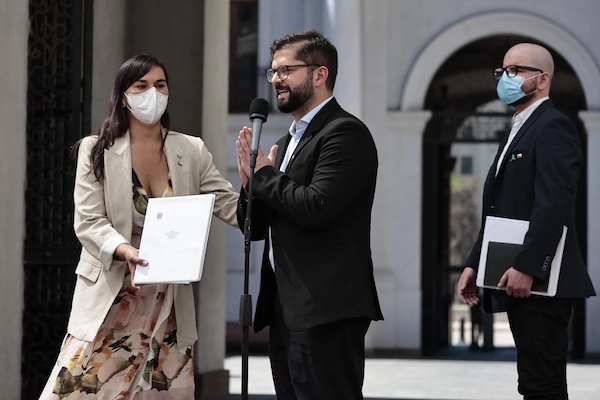
During his tour of Magallanes, President Boric stated that “we cannot continue to allow this violence, we cannot continue to allow this uncontrolled situation with weapons and criminals.” But let us see how this message aligns with actions. The government’s first measure was the withdrawal of 139 lawsuits under the State Security Law applied in the context of the social outbreak that allowed for the detention of individuals for various offenses. In the context of the protests for the Day of the Young Combatant, the Minister of the Interior stated that the government would not tolerate violent attacks and expressed support for Carabineros.
In the Southern Macrozone, this week the creation of intermediate states was proposed for the protection of routes in the country, where the Armed Forces could carry out safeguarding duties. Two years ago, when Gabriel Boric, Giorgio Jackson, and Camila Vallejo were congresspersons, they voted against the Critical Infrastructure project, which specifically aimed at similar objectives.
Last Thursday, the Minister of the Interior stated that “we need to reduce the firepower of criminals.” Two years ago, the same authorities mentioned, in their capacity as congresspersons, voted against the gun control project. Moreover, the current Minister Secretary General of the Presidency acknowledged that he and the President voted against it as a form of protest.
The messages from then do not seem to be coherent with those of today. It is understood that the recipient has changed. But that modification leads to nuances, not fundamental transformations. I cannot endorse violence as a form of manifestation and then repress it for that reason. In a context where words matter, the coherence of their content is the cornerstone that will support the government’s discourse and, most importantly, generate citizens’ credibility in it. Before development, well-being, and security, a coherent narrative must be constructed that understands the weight of words and grants legitimacy to its actions. Otherwise, only questions will arise.
Pilar Lizana
Researcher at Athena Lab
Source: El Líbero