Security in the New Constitution: Do Not Clarify, as It Only Obscures
This article was translated automatically and may contain differences from the original. For reference, read the original.
El Líbero, July 9, 2022
LThe idea of plurinationality and autonomous territories presents a complex scenario for the unity required in the fight against crime.
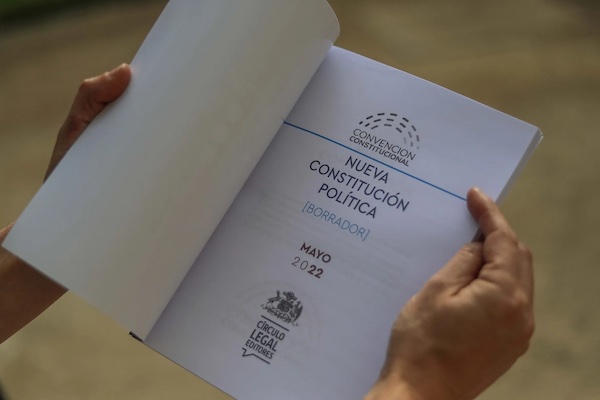
On Monday, July 4, the final text of the new Constitution was delivered to the president. Since that day, an intense debate has developed around the document. The political system, justice, and indigenous peoples have been some of the most discussed aspects. However, little has been heard about whether this proposal provides concrete contributions to address one of the priority issues for Chileans: security. Security. At first glance, it seems to confuse rather than clarify doubts.
As a country, we find ourselves at a critical moment in this regard. Arms trafficking, human trafficking, attacks in the south, an increase in homicides in the north, drug trafficking, and the establishment of operational arms of large international cartels create a scenario where the increase in violent incidents could indicate that Chile is experiencing a power struggle between local and foreign gangs, highlighting the penetration that international crime is having in the country.
The government has made efforts by proposing a State of Emergency in the southern macrozone, legislation to combat organized crime and working groups with local government leaders. However, it seems that all these efforts have little place in the new idea of the country proposed by the Constitutional Convention.
If there is an issue that requires unity, agreement, and willingness to use all available power tools, it is security. Clarity in action is key to success. Without it, crime has opportunities to advance. It is in confusion that crime consolidates its power, especially when institutions are perceived as weak and political power as misaligned. This is precisely what is observed today.
In this sense, the idea of plurinationality and autonomous territories presents a complex scenario for the unity required in the fight against crime. The need to consult indigenous peoples beforehand on administrative measures and legislation that affect them could have a significant impact on the security measures adopted, as national action could be vetoed. For example, what would happen in a State of Emergency like the one we have today? Although unity is mentioned in the text, it does not seem to be so evident, as has already been observed in the public debate generated by the proposal. Clarity is another fundamental aspect. According to the new Constitution, the president is responsible for leading public security
, however, the Public Ministry may issue direct orders to the police. So who leads? Clarity begins to blur, opening spaces that others could exploit.Transversality is also not clear. In matters of state, there can be no ideological biases that hinder development. In this case, they seem to be evident.
Finally, in the 170 pages of the text, security is mentioned only 17 times, and of those, only 8 refer to public or state security. Thus, a text that claims to be the home of all does not give importance to a matter that is indeed a concern for the majority. Pilar Lizana
AthenaLab Researcher
Source:
El Líbero.