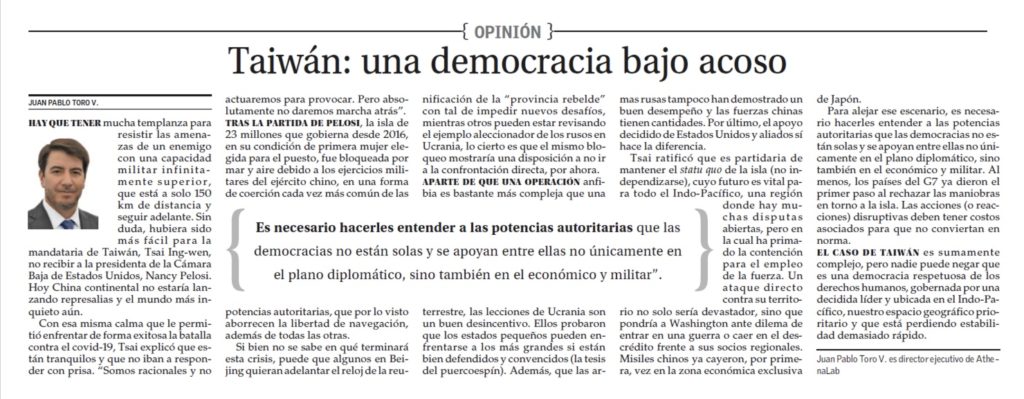
Taiwan: A Democracy Under Siege
This article was translated automatically and may contain differences from the original. For reference, read the original.
El Mercurio, August 6, 2022
It requires great composure to withstand the threats from an enemy with infinitely superior military capabilities, located just 150 km away, and to move forward. Undoubtedly, it would have been easier for Taiwan’s leader, Tsai Ing-wen, not to meet with the Speaker of the U.S. House of Representatives, Nancy Pelosi. Today, mainland China would not be launching reprisals, and the world would be even more unsettled.
With the same calm that allowed her to successfully confront the battle against COVID-19, Tsai explained that they are composed and will not respond hastily. “We are rational and will not act provocatively. But we will absolutely not back down.”
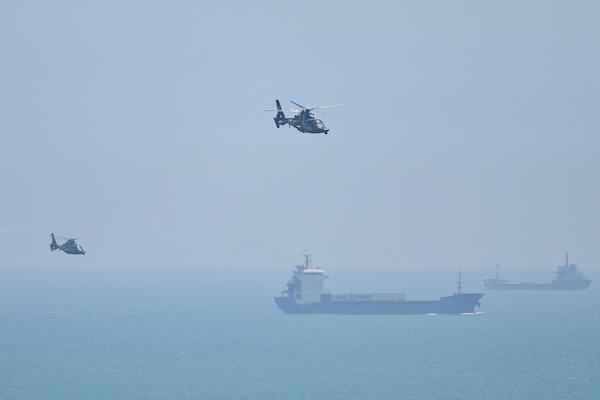
After Pelosi’s departure, the island of 23 million, which Tsai has governed since 2016 as the first woman elected to the position, was blockaded by sea and air due to Chinese military exercises, a form of coercion increasingly common among authoritarian powers that seem to abhor freedom of navigation, among other things.
While it is uncertain how this crisis will end, some in Beijing may wish to hasten the clock on the reunification of the ‘rebel province’ to prevent new challenges, while others may be reviewing the cautionary example of the Russians in Ukraine. The blockade itself would indicate a willingness to avoid direct confrontation, for now.
In addition to the fact that an amphibious operation is significantly more complex than a land operation, the lessons from Ukraine serve as a strong disincentive. They demonstrated that smaller states can confront larger ones if they are well defended and resolute (the hedgehog thesis). Furthermore, Russian weapons have not shown good performance, and Chinese forces have quantities. Finally, the decisive support from the United States and allies does make a difference.
Tsai reaffirmed her support for maintaining the island’s status quo (not pursuing independence), the future of which is vital for the entire Indo-Pacific, a region with many ongoing disputes, but where restraint in the use of force has prevailed. A direct attack on its territory would not only be devastating but would also place Washington in the dilemma of entering a war or losing credibility with its regional partners. Chinese missiles have already fallen, for the first time, in Japan’s exclusive economic zone.
To avert that scenario, it is necessary to make authoritarian powers understand that democracies are not alone and support each other not only diplomatically but also economically and militarily. At the very least, the G7 countries have already taken the first step by rejecting the maneuvers around the island. Disruptive actions (or reactions) must have associated costs to prevent them from becoming the norm.
The case of Taiwan is extremely complex, but no one can deny that it is a democracy that respects human rights, governed by a determined leader, and located in the Indo-Pacific, our priority geographic space that is losing stability too quickly.
Juan Pablo Toro V.
Executive Director of AthenaLab