The Rule of Law, when?
This article was translated automatically and may contain differences from the original. For reference, read the original.
El Líbero, September 17, 2022
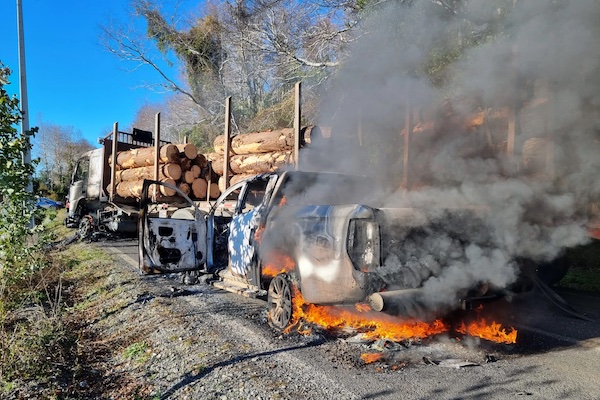
As of September 6, there were 78 attacks against forestry machinery in Biobío, La Araucanía, Los Ríos, and Los Lagos. Between 4,000 and 6,000 trucks circulate each month with stolen wood, and changing the registration numbers on shipping guides is a common practice. So, what are we waiting for to send the right signals? To restore that Rule of Law?
This week, some lawmakers urged the government to enact the law that penalizes wood theft. It has been in Congress for several years, and many have placed their hopes in it. However, laws are of no use if the State does not enforce them. That State, which celebrates a new anniversary this weekend and confirmed its unity after the plebiscite, has a significant debt to those living in the Southern Macrozone and an even greater challenge: to restore the Rule of Law and recover what crime has taken away.
The spokesperson for the Supreme Court stated that the Rule of Law was at stake. Many of us agreed with her. Each advance of crime is a setback for it, and how much it has regressed in the south. Perhaps the hopes of those lawmakers are that with the new law, recovery can begin, but that is not necessarily the case. It will undoubtedly be a great tool; however, it will not have the desired effect if it is not accompanied by something else, the most important factor when it comes to criminality: the political will to combat the problem.
Today, trucks carrying loads that exceed permitted limits circulate freely, logging mafias hire violent groups to clear land and then begin illegal exploitation, attacks on forestry machinery are accompanied by a black market for its parts, insurance is nearly impossible to renew, and the safety of workers is at risk every day. It is an open secret that everyone knows, and little to nothing is done to confront it.
Where is the Rule of Law in the regions of Biobío and La Araucanía? Do we have to wait for more plans and laws to combat the logging mafia?
The former is quite absent, and its presence does not depend on plans or legislation; it simply depends on the will to enforce it. The best proof of that will: the enactment of the wood theft law.
Lawmakers should not have to ask the government to enact it; rather, it should be the government that accelerates its processing to begin utilizing it. As of September 6, there were 78 attacks against forestry machinery in Biobío, La Araucanía, Los Ríos, and Los Lagos. Between 4,000 and 6,000 trucks circulate each month with stolen wood, and changing the registration numbers on shipping guides is a common practice, so what are we waiting for to send the right signals? To restore that Rule of Law?
Words must be accompanied by actions. For now, we only hear words, and this can be very complex for the State. Without actions, criminal groups will understand that there is no real will, which will only increase their perception of power. The government has a great opportunity that, if seized, could change the downward trend in its approval ratings. But to do so, it must combat crime with all available tools, respond with concrete actions, and accept the consequences of a fight that will be met with strong resistance. Organized crime does not improvise; the State cannot afford to do so either.
Pilar Lizana
Researcher, AthenaLab
Source: El Líbero