The Armed Forces and Their Relationship with Politics and Politicians
This article was translated automatically and may contain differences from the original. For reference, read the original.

Having written about this topic many times, I found it appropriate to revisit the relationships between the Armed Forces of Chile and politics and politicians, something that becomes even more significant when the political, economic, and social environment is tumultuous, and the internal security of the State is at risk.
I do this because Chile has a tradition of looking to its armed institutions when things get tough. One only needs to look at the Civil War of 1891, the political instability of the 1920s and 1930s, the intervention of 1973, and many other instances where matters did not escalate further, as well as the fact that they have been used for non-primary purposes in the states of exception that have been in place since the so-called “Social Outburst,” the overcoming of the recent pandemic, and to support the police in securing the northern borders, to the point that public opinion now assumes this deployment as normal, even though it is not normal for them to be used for internal security purposes, as that is a responsibility of the police. Another case is what occurs in the southern macrozone where the Armed Forces are employed in a restricted and limited manner because there is a reluctance to acknowledge that the phenomenon they face is called “armed insurgency,” accompanied by crimes that typically occur in such circumstances, such as drug trafficking and illegal exploitation of natural resources.
The relationship between the military instrument of national power and politics has never been easy, as the former holds the unassailable monopoly on the power of arms and can, if it wishes, seize power, as has happened multiple times throughout human history. The most famous case was Julius Caesar’s crossing of the Rubicon River in 49 B.C., where he disregarded the restriction that prevented Roman legions from crossing that river due to the risk of military intervention in Roman politics. Apparently, that restriction was well thought out, as Caesar’s crossing with his troops marked the end of the Republic, and he was appointed consul and lifetime dictator.
Until recently, it was normal for military power and political power to be integrated, but in the West, over the years, this ceased to be the norm with the establishment of democracy as a form of government and the separation of powers of the State with its political and institutional checks and balances. It is only maintained in some countries where democracy is not well developed, such as China, Russia, Cuba, Venezuela, Myanmar, North Korea, and some Middle Eastern countries, where it is crucial to have effective control of arms to remain in power.
In Chile, we have evolved from the figure of the governor general, who was also the captain general and president of the Royal Audience, to the current situation where the armed institutions are under authority, but not integrated, into the Executive. The president, who must be a civilian, only assumes supreme command of the Armed Forces in times of war. In normal conditions, he appoints and dismisses the commanders in chief and the head of the Joint Chiefs of Staff, approves the annual composition of their high commands, and retains control over administrative acts, including the allocation and control of budgetary resources.
To reach the current situation, we have gone through several events where the Armed Forces became involved in politics, such as, to name a few: the Civil War of 1891, the saber rattling of 1924, the Tacnazo of 1969, the participation of generals and admirals in active service as ministers in the cabinets of Balmaceda or Allende, the military coup of 1973 that led to a military government lasting just over 16 years, and more recently, the “boinazo” of 1993. Considering both historical evidence, whether our own or others’, the reality in non-democratic countries, and assuming we agree that the Armed Forces should not participate in politics, the question is: How do we sustain the reality of non-participatory and non-deliberative Armed Forces beyond legal and constitutional safeguards?
Starting from the premise that they must be effective, efficient, well-managed, and therefore should not be interfered with in their administration, we must respect them for their role in protecting sovereignty and political independence, the existence of democracy as a system of government, economic development, and the well-being of Chileans. This respect should imply fair remuneration, recognition that their pension regime must be different due to their functions, and an understanding that they have the capacity to think and express opinions, which is not the same as deliberating. Above all, we must avoid having them used or captured by interest groups or political parties that wish to nullify them, require them to access or remain in power, or use them for purposes other than their nature. In this sense, it is correct for public opinion to react to the attempts by the Communist Party to reform military education.
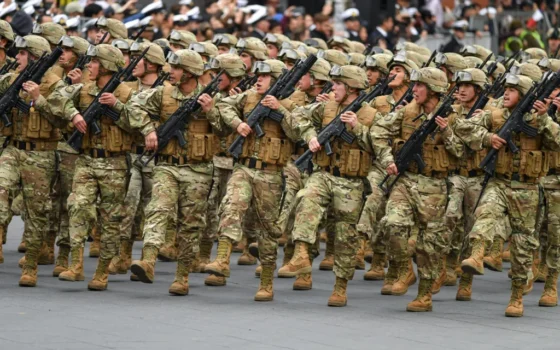
Having said all of the above, it is appropriate to ask whether, under current circumstances, we are pushing the Armed Forces toward situations that may bring them closer to political contingencies. The answer is a clear and resounding yes. The deployment of the Armed Forces for the State of Emergency on October 18, 2019, again for the State of Catastrophe that began in mid-March 2020 and lasted well into 2021, followed by the ongoing States of Emergency in the southern macrozone, and what has been requested of them at the northern border, transforms these institutions into frontline political actors. In states of exception, defense chiefs act by presidential delegation and report to the head of state. They are above the presidential delegates and operate at the political level, commanding the military and police forces assigned to them.
As if that were not enough, politicians are now insisting that they take charge of critical infrastructure, or the creation of a new Constitutional State of Exception called for care and protection. It is like asking a cat to pull chestnuts out of the fire with its paws. It continues to involve them in problems that are political in nature or that have become political problems due to the inaction of politicians.
Not only do current circumstances transform them into political actors, but also the fact that over the years they have been assigned a series of mission areas that go beyond national defense. Having mission areas where versatile capabilities can be utilized is effective and efficient, but it involves engaging them in aspects that are much more political than pure national defense. For example, any of the three institutions—aside from the mission area of defending sovereignty and territorial integrity—has assigned responsibilities in international cooperation and support for foreign policy, national emergency and civil protection, contribution to national development and state action, security, and territorial, maritime, and aerial interests.
The next question is: If they have the capacity and are already deeply involved in what happens in Chile, why do they not seize power and govern themselves? My personal answer is that they have no interest in doing so nor any political vocation in the sense of governing and choosing between leftist or rightist positions. It is not in their DNA. This does not mean they do not think and have their own assessment of what is happening, or that they do not express their opinions through the appropriate channels in a very reserved manner. They know they hold the monopoly on the power of arms, are very clear about the responsibility society has entrusted to them, and understand that their opinions will be heard and taken into account. They care about the well-being of Chile, Chileans, and protecting their homeland, as indicated by the oath to the flag that each of their members takes upon joining the service.
The experience of over 200 years has taught them that being in government is not the role of the Armed Forces and that it is better to act as apolitical, professional, hierarchical, and non-deliberative Armed Forces, focused on Chile and distanced from anything that sounds or smells like partisan politics. They know that those who wish to subvert the institutional order and the rule of law through revolutionary means will seek to have them on their side or at least neutralize them, as no revolution succeeds without the power of arms. They understand that attempts will be made to neutralize them through legal, communicational, or any other means that allow them to advance their plans.
I believe that the institutional framework of the Armed Forces of Chile allows us to have outstanding institutions, rooted in national sentiment and valued by the citizenry. The Armed Forces know they have a significant responsibility because the homeland trusts them. This obliges them to have absolute clarity of purpose and to act in strict adherence to the law and current regulations.
In conclusion, I do not see any possibilities on the horizon for a repetition of 1891 or 1973, despite the fact that some are trying to draw parallels between current situations and past ones. Institutions have deeper memories than individuals, and this is especially true considering that the Army and Navy were born alongside the Republic, and the Air Force is approaching its first century of institutional life.